


Data gaps weaken policy planning
Shaymol Dash, an anthropology student of Dhaka University, wanted to know how many people in his home district, Sunamganj, live with mental or physical impairments. The Bangladesh Bureau of Statistics’ (BBS) Health and Morbidity Status Survey (HMSS) 2025 had that data, but only at the division level.
As the BBS did not have district-level statistics, Sunamganj disappeared into a divisional average.

“Every time I go to the BBS website, I get frustrated,” Shaymol told The Daily Star. Several of the site’s publication pages, he said, are broken. Among them, he said, are the pages hosting multiple volumes of Population Monograph of Bangladesh.
His experience is part of a broader problem in Bangladesh’s official statistics: coverage is limited, service is weak and public access is poor.
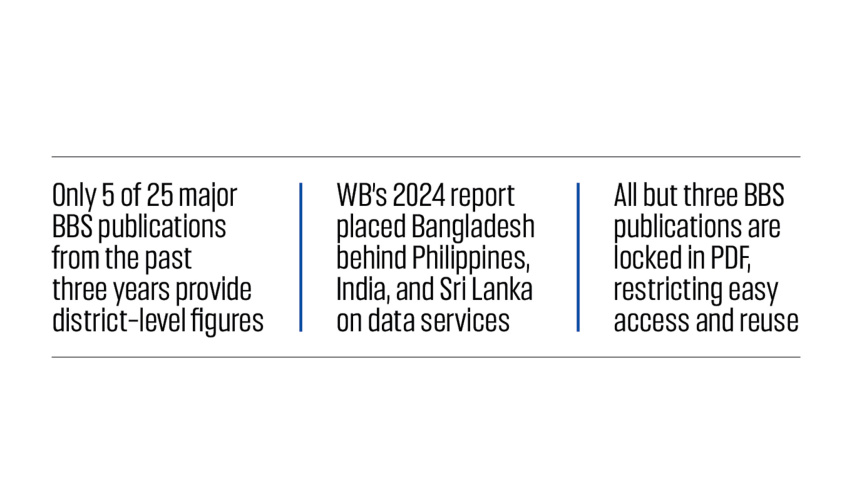
The World Bank’s most recent Statistical Performance Indicators (SPI) in 2024 highlighted these limitations. It placed the country in the middle tier among 186 countries, below several regional neighbours, including the Philippines, India and Sri Lanka.
The WB index has five pillars: data use, data services, data products, data sources and data infrastructure. Bangladesh scored lowest on data services, which measures the quality of data releases, the openness of online access and the availability of data services.
An analysis by The Daily Star found the same weaknesses across various publications by the BBS.
Hasinur Rahaman Khan, professor of statistics and data science at Dhaka University, said Bangladesh’s data crisis stems from the absence of a guiding philosophy that prioritises information.
“I can guarantee that no individual or agency in the country studies what kind of data matters or why,” he said.
LIMITED COVERAGE, POOR ACCESS
In January 2026, BBS published a compendium summarising 25 of its key works from the past three years: two censuses and 23 surveys.
The Daily Star reviewed all 25 publications. Nineteen of them do not break data down below the divisional level. They include the Health and Morbidity Status Survey (2025), the Food Security Situation and Coping Mechanism in Bangladesh Survey (2025), the Violence Against Women (VAW) Survey (2025) and the Socio-Economic and Demographic Survey (2024).
Only five include district-level figures. They are the Population and Housing Census 2022, the Economic Census 2024, the Bangladesh Sample Vital Statistics 2022, the ICT Access and Use by Households and Individuals Survey 2024-25, and the Citizen Perception Survey 2025.
“The larger and more macro‑level the data, the better we can read the situation. And with a clear reading, policy planning can be done effectively,” said Prof Hasinur.
He noted, however, that such comprehensive data often remains out of reach in practice due to funding constraints.
Emdadul Haque, director of the Demography and Health Wing at BBS, identified budget constraints as the primary barrier to generating district-level data.
“To provide district-level figures, you would need a much bigger sample, almost 64 times the current size,” he explained. “A bigger sample means a bigger budget.”
Stronger demand from policymakers and planners, he added, could push BBS towards making that change.
BBS publications are also hard to use even where detailed data exists. Apart from the Population and Housing Census, the Economic Census, and the Labour Force Survey, which provided data in Excel, every other work in the compendium is available solely as PDFs.
Award-winning data journalist and Netra News executive editor Nazmul Ahasan said publishing data in PDF format poses a major obstacle to data processing.
 For all latest news, follow The Daily Star's Google News channel.
 “Government officials sometimes argue that data could be altered if it were not published in PDF format, but this justification is absurd,” he said.
Some of the BBS publications also remain inaccessible entirely. Five BBS web addresses containing publications were non-functional at the time of this review.
Nazmul Ahasan pointed to the lack of historical data repositories in the country. “In many cases, once a project ends, the website created under that project or the data collected through it is no longer available,” he said.
Speaking to The Daily Star, Saeeda Begum, senior programmer at BBS, acknowledged that their servers sometimes went offline. When informed that several sections of the website had been inaccessible for at least a year, she said, “We will be looking into the issue.”
ETHNICITY DATA GAP
BBS also rarely publishes ethnicity-disaggregated data across major indicators, such as literacy, poverty, health or labour-force participation. For example, the most recent such breakdown on literacy that The Daily Star could find came from the Education Household Survey 2014.
Only three of BBS’s 25 key publications discussed above provide data broken down by ethnicity: Population and Housing Census 2022; MICS 2025; and Socioeconomic and Demographic Survey 2022.
Even the publications with ethnicity data are not without issues. MICS 2025, for instance, did not provide data on individual ethnic groups such as Chakma, Marma or Garo. Instead, it grouped respondents into only two categories: “Bengali” and “Other”.
Indigenous groups had previously disputed the official count of the 2022 census, arguing that it undercounted their population.
This gap in ethnicity data is at odds with Bangladesh’s commitment under SDG target 17.18, which calls for timely, reliable data disaggregated by characteristics, including ethnicity.
Sanjeeb Drong, general secretary of Bangladesh Indigenous People’s Forum, called this gap both troubling and regrettable.
“It is deeply disappointing that over 50 years after independence, Bangladesh still lacks comprehensive, disaggregated data on indigenous communities, which is a direct breach of the SDG commitment,” said Drong.
Without such data, the specific vulnerabilities of marginal communities like the Khasia, Manipuri, and Santal remain invisible to policymakers, and talk of development rings hollow, he added.
Contacted, Zakir Hossain, deputy director general of BBS, said they recently launched a new nationwide project to specifically survey Bangladesh’s indigenous communities.
NO DATA AT ALL
The Daily Star identified 10 nationally important public-interest statistics that the government agencies either do not publish or publish only in fragmented form.
For example, the country lacks comprehensive suicide statistics that would allow officials and researchers to follow trends, understand causes or analyse risk by age, sex, location and socioeconomic background.
This is despite a January 2026 report, which cited Police Headquarters data showing 13,491 suicides in Bangladesh between January and November 2025. On average, that is 41 people dying by suicides every day.
Pritom Kumar Das, a researcher and counsellor at icddr’b, said Bangladesh needs a national suicide death registry to understand the true scale of the problem.
A similar gap exists with non-communicable diseases (NCDs), which cause more than 70 percent of deaths in Bangladesh. The government tracks NCD patients through NCD corners at Upazila government hospitals, but the system captures only those who seek treatment there, leaving out many others who do not use those services.
The government also withholds data on the socio-demographic characteristics of armed forces and civil service members, making it impossible to assess how representative these institutions are of the population.
Other statistics that this newspaper found wanting are representation of women in important decision-making sectors; police use of force; Bangladeshi students going abroad; parliamentary activity statistics and comprehensive national crime statistics.
In the absence of such data, journalists, researchers and the public rely on proxy statistics, compiled and published by NGOs and research or advocacy organisations. Organisations such as Ain o Salish Kendra, for instance, compile data on rape cases based on reports published in newspapers.
Comments