


‘GDP alone cannot measure progress’
The capability approach had broadened development thinking beyond income poverty to health, education and wider wellbeing, but did not offer a structural solution to inequality.
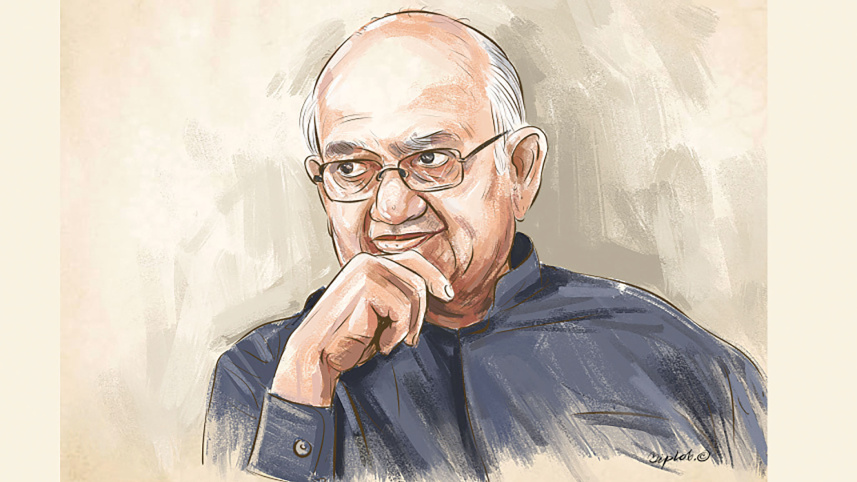
Professor Rehman Sobhan yesterday said the world would remain “unequal and unjust” unless structural flaws in the prevailing development models were addressed.

“We are going to go on living in an unequal world, in an unjust world, in which power, not just economic but political, is concentrated in the hands of a few people,” he said.
Prof Rehman, chairman of the Centre for Policy Dialogue, made the remarks at the Syed Humayun Kabir Memorial Research Symposium 2026 in the capital.
The daylong event was organised by Banglar Pathshala Foundation and Sajida Foundation under the theme “Justice, Capabilities and Wellbeing: Rethinking Human Development for a More Just Bangladesh”.
He said the capability approach had broadened development thinking beyond income poverty to health, education and wider wellbeing, but did not offer a structural solution to inequality.
“If you are looking at the structural issues, then you have to look at the nature of the state, the nature of the economy,” he said.
Prof Rehman also criticised the dominance of GDP as a measure of economic performance, saying economic performance should also be judged by healthcare, education, nutrition, inequality and distribution of ownership. He called for democratising ownership, stressing greater ownership by workers.
He described the Renata-Sajida model developed by Syed Humayun Kabir as an “enlightened form of corporate capitalism”, in which profits from a competitive enterprise could support social purposes. Such models, however, could not by themselves address structural inequality, he said.
Delivering the keynote, Cornell University Professor Kaushik Basu said rapid technological change was adding to economic trouble, political polarisation and conflict.
Artificial intelligence was reducing demand for some conventional labour, while the share of GDP going to profits and intellectual property was rising and the labour share was declining, he said.
Highlighting the dangers of inequality, Basu said the super-rich could use their wealth to acquire newspapers, TV stations and social media platforms.
Such concentration of influence was damaging democracy, he cautioned.
Referring to his work on the UN’s Beyond GDP initiative, Basu said economic progress should give greater attention to equity, sustainability and wellbeing.
At a governance session, senior Supreme Court lawyer Dr Kamal Hossain recalled helping draft the agreement after Pfizer decided to exit Bangladesh, paving the way for Renata. He noted that social responsibility was built into the business framework rather than treated as charity.
Sajida Foundation Chairperson Farooq Sobhan said Bangladesh was still “grappling with creating a coherent system of governance”.
He called for a “whole-of-government” and “whole-of-society” approach, stressing coordination within government and interaction with society. Corporate governance still had a long way to go, he said, adding that functioning boards and independent directors were crucial to accountability.
Transparency International Bangladesh Executive Director Iftekharuzzaman said strong institutions could survive beyond their founders when built on clear vision, governance systems, embedded values and ethical leadership.
“Great institutions outlast their founders,” he said, adding that institutions seeking transparency and accountability from others must practise those principles themselves.
Drawing on TIB’s experience, he recalled early governance problems, including staff unrest, frozen donor funding and withdrawal of Transparency International accreditation. TIB later spent about a year rebuilding its governance system.
 For all latest news, follow The Daily Star's Google News channel.
 M Syeduzzaman, a CPD trustee and former finance minister, called for raising the tax-to-GDP ratio to fund health and education, greater reliance on direct taxation, and more priority for education and research.
At a session on institutions, innovation and quality, PKSF Managing Director Md Fazlul Kader said PKSF was fundamentally an institution-building organisation.
“Finance cannot create magic,” he said, arguing that finance had to be combined with institutional development. Public-sector institutions, he added, were too procedure-driven rather than result-oriented.
Syed S Kaiser Kabir, managing director and CEO of Renata PLC, said the company spent years training a young research team to build R&D capabilities, and argued that Bangladesh must similarly build capacities and move towards higher-value technology and products.
Human rights activist Hameeda Hossain said institutions must learn from what is not working and adapt to current realities.
Using Ain o Salish Kendra as an example, she noted how its work expanded from legal aid to rights awareness, field work, paralegal support and counselling.
Dr Firdausi Qadri, emeritus scientist at icddr,b and founding chairman of ideSHi, believes that fruits of scientific research must reach the public.
Drawing on her work, she stressed generating evidence, using existing public-health systems and building young teams capable of carrying institutions forward.
Abdul Muyeed Chowdhury, a member of BRAC University’s Board of Trustees, hailed PKSF as a “home-grown institution”. He also recalled his work with BRAC and Sajida Foundation and praised Syed Humayun Kabir’s patience in hearing people out.
Among others, Ahmed Javed Chowdhury, founder of Banglar Pathshala Foundation, Dr Sajeda Amin, senior research adviser at Sajida Foundation, Shamira Mumtaz, Dr Mohammad Helal Uddin and Sajjad Sharif also spoke. Barrister Rashna Imam and journalist Farabi Hafiz moderated separate sessions.
Comments