


Health budget success hinges on execution
Despite receiving the highest-ever budgetary allocation in the country’s history, the health sector’s success will ultimately depend on how effectively the funds are utilised, health experts and economists said yesterday.

Given the health ministry’s poor record in implementing development budgets, they called for a clear roadmap to ensure the ambitious allocation translates into tangible improvements in healthcare services.
MA Muhit, state minister for health, also acknowledged that budget implementation remains a major challenge. He said the government would work to strengthen implementation so that people can benefit from the additional allocation in the next fiscal year.
The remarks came at a discussion titled “FY 2026-27 Post-Budget Civil Society Reflection on the Health Budget” held at the CIRDAP auditorium in the capital. The programme was jointly organised by Bangladesh Health Watch and ARK Foundation.
In the proposed national budget for FY2026-27, the government allocated Tk 69,409 crore to the health sector, equivalent to 1.01 percent of GDP, marking the first time the allocation has crossed the one-percent threshold.
Of the total allocation, the health ministry received Tk 62,852 crore, up 50 percent from the outgoing fiscal year’s original budget and 124 percent from the revised budget.
Of this amount, Tk 35,026 crore has been earmarked for development expenditure and Tk 27,826 crore for operating expenditure.
Of the development allocation, Tk 23,522 crore has been kept as a block allocation, indicating that the government may undertake new projects to fulfil its election pledges.
In her presentation, Prof Rumana Haque, executive director of ARK Foundation, said the proposed health budget has nearly doubled, fulfilling a long-standing demand of health experts.
“However, the increased allocation alone will not automatically benefit people. Effective utilisation of the funds must be ensured through stronger institutional capacity, improved workforce skills, and greater transparency in spending,” said Rumana, a professor of economics at Dhaka University.
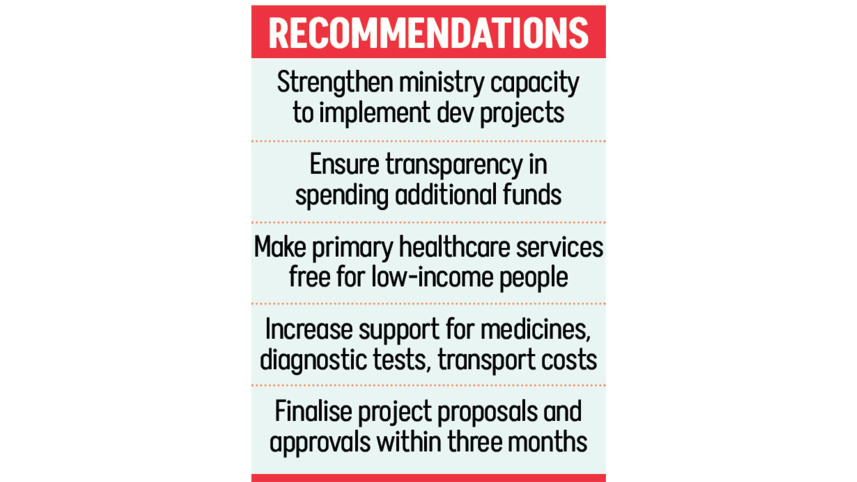
She stressed the need for a clear government roadmap, particularly for the large block allocation, to ensure proper utilisation of the funds.
Public health expert Mushtuq Husain said the government should use the additional allocation to make primary healthcare services free, which would significantly benefit low-income people.
Prof Mohammad Zakir Hossain, a member of the Health Sector Reform Commission, said healthcare seekers spend a large portion of their out-of-pocket expenses on medicines, diagnostic tests, and transportation.
He said greater budgetary allocations are needed in these areas to reduce the financial burden on patients and their families.
Prof Syed Abdul Hamid of the Institute of Health Economics at Dhaka University said the government needs to quickly identify priority projects, prepare project proposals and secure necessary approvals within the next three months to ensure proper use of the allocated funds.
Fazle Huda Babul, lawmaker from Naogaon-3, among others, also spoke at the programme, which was moderated by Faruque Ahmed, a member of Bangladesh Health Watch.
 For all latest news, follow The Daily Star's Google News channel.
Comments