


Measles resurges in August

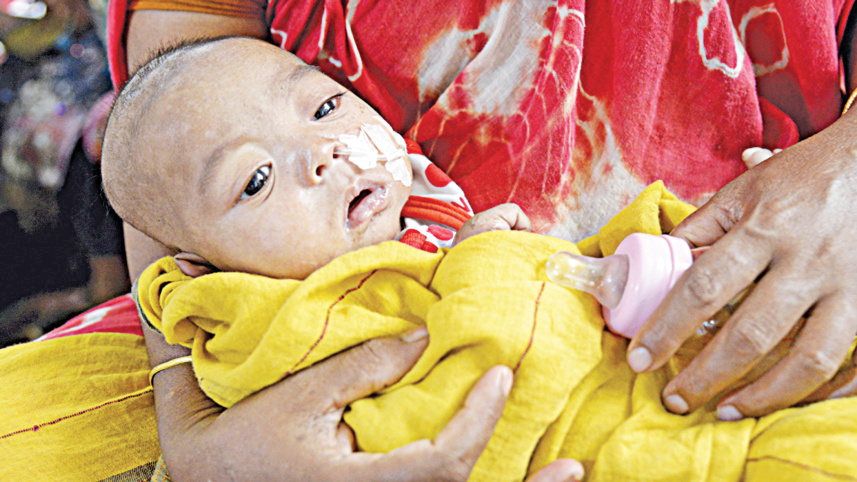
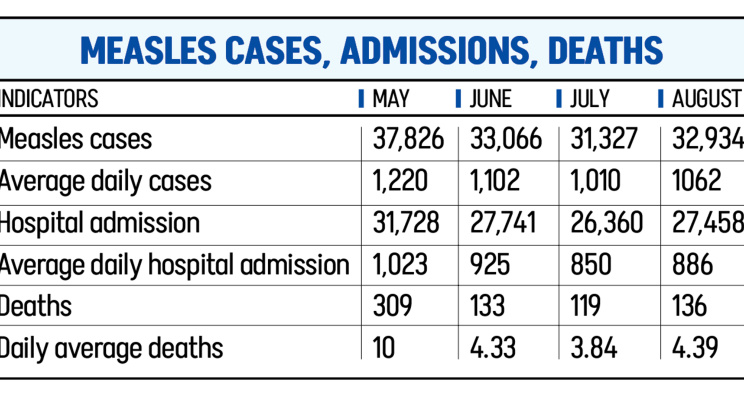
After declining for two consecutive months, Bangladesh’s measles situation took a worrying turn in August, with cases, hospitalisations, and deaths all rising.
The number of cases increased last month after reaching its lowest level in July following nationwide vaccination campaigns. Hospital admissions also rose and deaths climbed from the previous month.

The daily averages for all three indicators showed the same upward trend.
The measles situation worsened at a time when the country is recording a growing number of dengue cases, putting additional pressure on the already strained healthcare facilities.
A total of 7,724 patients, 2,663 with dengue and 5,061 with measles, were undergoing treatment in hospitals yesterday, according to the Directorate General of Health Services (DGHS).
Public health experts blamed gaps in vaccination coverage and the absence of adequate public health measures, particularly to prevent the spread of measles among children under six months, for the situation.
The health authorities acknowledged the problem, saying that they are procuring more vaccines and are likely to launch a short, intensive programme to cover the remaining children.
Meanwhile, six more died of measles-like symptoms in the last 24 hours ending at 8:00am yesterday, taking the death toll in measles and measles-like symptoms to 979, according to the DGHS.
A total of 1,231 cases were recorded during the period, while 1,074 patients were hospitalised with measles-related symptoms.
For the third consecutive day, the country logged over 1,200 measles and suspected cases and over 1,000 hospitalisations.
Amid an unprecedented outbreak of the disease in recent memory, the government launched an emergency measles-rubella vaccination campaign on April 5.
By May 20, the campaign’s initial deadline, 1.84 crore children aged six to 59 months had been vaccinated, exceeding the target of 1.8 crore.
Following the campaign, measles cases, hospitalisations, and deaths gradually went down in June and July, according to DGHS data.
However, health experts said the decline was not as significant as expected and pointed to a gap in vaccination coverage, which became evident after the nationwide Vitamin A Plus campaign on June 28.
A total of 2.23 crore children in the same age group received Vitamin A capsules, revealing a gap of 38.83 lakh between Vitamin A capsule and measles vaccination coverage.
The government later admitted that its target for the measles campaign had been underestimated and conducted a mop-up campaign in late July to identify and vaccinate children who had been missed. By yesterday, around 1.97 crore children had been jabbed under the campaign.
However, the effort proved inadequate, as all three indicators, measles cases, hospitalisations, and deaths, rose in August compared with the previous month.
The country registered 32,934 cases in August, up from 31,327 in July. The daily average also increased to 1,062 from 1,010.
A total of 27,458 patients were admitted in August, which was 26,360 the previous month, while the daily average rose from 850 to 886.
Deaths, too, went up. Measles claimed 136 lives in August, up from 119 in July, with the daily average shooting up from 3.84 to 4.39.
 For all latest news, follow The Daily Star's Google News channel.
 WHAT EXPERTS SAY
Epidemiologist Prof Mahmudur Rahman, also chair of the National Verification Committee for Measles and Rubella Elimination, said the government should first form an expert group to analyse surveillance and vaccination data to identify gaps in coverage.
The gaps could be geographical, age-related or socioeconomic, depending on what the data show, he said, adding that targeted interventions should then be taken in areas with low vaccination coverage.
“If necessary, sub-immunisation activities (SIAs) should be conducted in those areas. Even if it is not possible to cover everywhere, focusing on areas with major gaps could produce results.”
He also called for stronger public health measures to contain transmission, noting that a significant number of children under six months, who are ineligible for vaccination, are being infected.
“From the beginning of the outbreak, we have not adequately implemented public health measures. Now we have to do it because the number of cases continues to rise.”
These steps should include isolating children with fever, wearing masks, practising handwashing and ensuring that caregivers accompanying patients in hospitals wear masks, he said.
Regarding vaccination of older children, Prof Mahmudur said authorities should consider extending vaccination beyond five years to stop transmission.
Prof Pravath Chandra Biswas, director general of DGHS, said they were working to bring the remaining children under inoculation coverage as quickly as possible.
“We are noticing that children who have not received the vaccine are becoming infected. We will quickly bring them under vaccination coverage,” he told The Daily Star yesterday.
He said they already placed an order for another 4 million doses, in addition to the 1.5-1.6 million doses currently in stock.
The authorities have yet to finalise a separate vaccination programme but might launch a short, intensive programme to rapidly cover the remaining children, Prof Pravath said.
The ongoing door-to-door search for unvaccinated children would also be strengthened, he said, adding that they would start the additional programme once they had a clearer timeline for receiving the new shots.
Comments