


Rain, labour shortage deepen woes of Jhenaidah paddy farmers

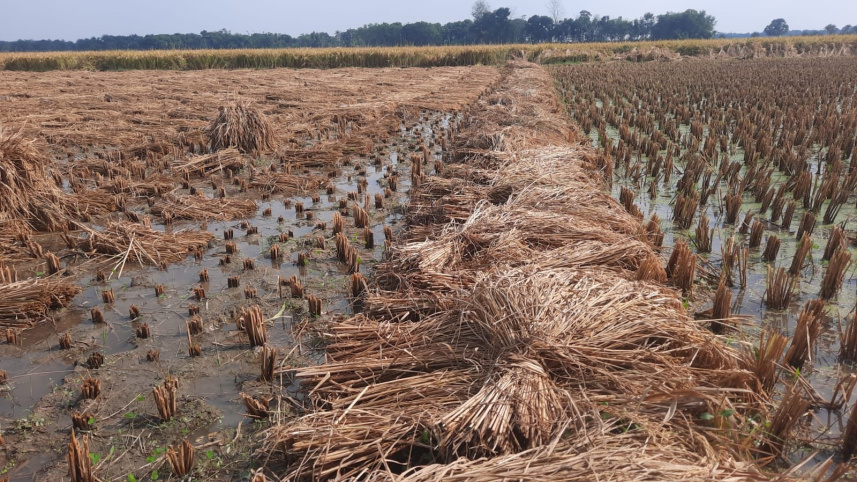
Two consecutive days of rain and an acute labour shortage have left many paddy farmers in Jhenaidah facing rising harvesting costs and uncertainty over returns during the ongoing Boro season.
Farmers said labour demand has surged as paddy ripened across large areas at the same time, pushing wages sharply higher.

At the same time, waterlogged fields are preventing harvested paddy and straw from drying and being properly processed, increasing losses.
According to the Department of Agricultural Extension, around 7 millimetres of rainfall was recorded between the afternoon and evening on May 6, followed by several more hours of rain on the night of May 7.
Farmers in Jhenaidah Sadar, Kotchandpur, Maheshpur, Harinakundu and Kaliganj upazilas began harvesting paddy two weeks ago.
Normally, after cutting the crop, farmers leave harvested paddy in the field before threshing, while straw remains spread in the field for drying in the sun to be used as cattle feed, sold in markets or used in betel leaf cultivation.
This year, however, many paddy fields became submerged before harvesting. In several areas, farmers said labourers collected only the upper grain-bearing portions of the plants, leaving submerged straw in waterlogged fields.
Rubel Musalli, a farmer from Betai Mathpara village in Jhenaidah Sadar upazila, who cultivated paddy on 10 bighas of land, said, “After cutting, the harvested paddy was left in the field before threshing, but rain submerged everything.”
He said labourers usually charge Tk 500 a day, but are now charging Tk 1,200 along with three meals a day.
Titon Mia, a farmer from Bhadalidanga village, said straw previously helped offset production costs.
“Straw worth around Tk 7,000 per bigha is used to cover much of the threshing expenses. It is valuable as cattle feed and for sale in the market. But this year, many farmers may lose that income,” he said.
According to the district DAE office, farmers cultivated Boro on 90,291 hectares against the target of 90,280 hectares.
Jhenaidah Sadar Upazila Agriculture Officer Nur-e Nabi said around 35 percent of paddy in the upazila had been harvested as of May 7.
“Paddy on large areas ripened almost simultaneously this season, creating unusually high demand for labourers,” he said.
Deputy Director of the district DAE Md Kamruzzaman said farmers were being advised to complete field operations quickly to reduce losses.
“We are advising farmers to bring harvested paddy home as quickly as possible to minimise damage,” he said.
 For all latest news, follow The Daily Star's Google News channel.
Comments