


Slum dwellers bleed in the clutches of utility syndicates

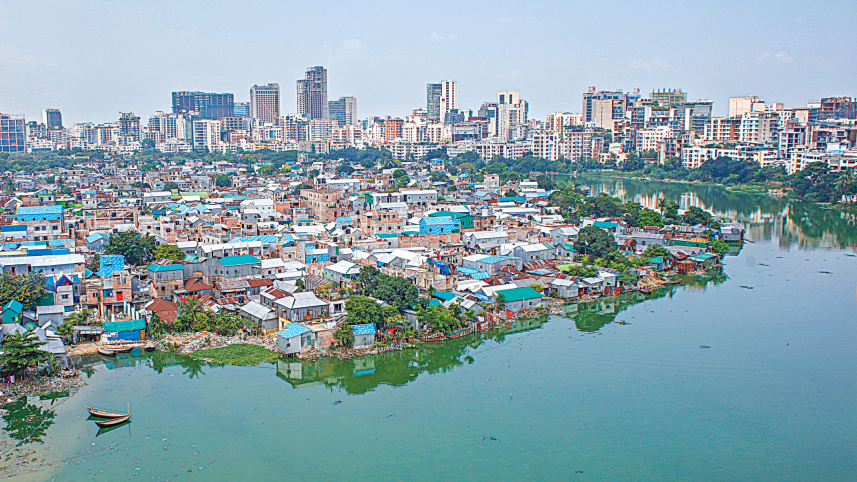
Jannat Begum, a domestic worker living in Dhaka’s Korail slum, pays Tk 600 a month to use a light and a fan in her single-room home. But according to government electricity tariffs, her estimated usage should cost less than Tk 450.
Hers is not an isolated case. In the absence of direct connections, thousands of low-income families in Dhaka’s slums depend on unauthorised utility service providers who charge far more than the official rates for electricity, gas and water.

Slum residents allege that syndicates comprising local actors and politically influential people run these systems.
“Governments come and go, but our suffering never ends,” Md Johny, a resident of Kalyanpur Pora Basti, told this correspondent.
Architect and urban planner Salma A Shafi said the government lacks a long-term plan for these settlements of low-income people whose numbers are growing.
“As the slum population increases, residents are forced to seek informal means to meet their basic needs at additional costs. Over time, these illegal arrangements become the norm, as there is little oversight by the authorities.”
According to city corporation officials, Korail, the country’s largest slum, has around 17,000 households. Bhashantek slum has about 5,000 households, while Kalyanpur Pora Basti is home to more than 3,000. Each household has five members on average. All three slums are in areas under Dhaka North City Corporation (DNCC).
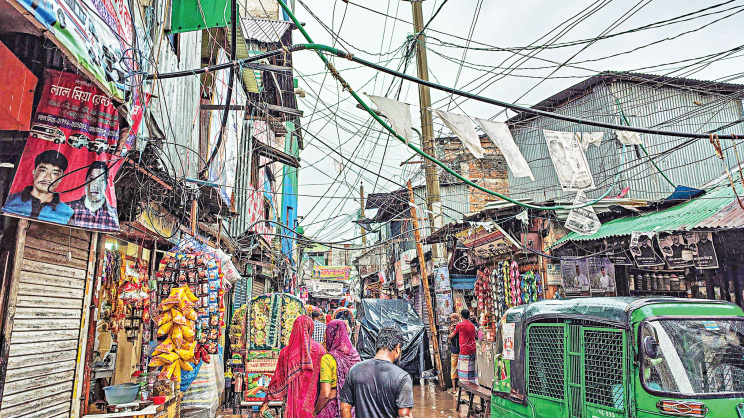
Between May and July, this correspondent interviewed more than 50 residents of the three slums, people involved in unauthorised utility networks and officials from relevant agencies.
Seeking anonymity, a senior DESCO official said a single main electricity meter in a slum can serve up to 20 households, with power billed at residential tariff rates. Dhaka Electric Supply Company (DESCO) distributes power in the northern parts of Dhaka and Tongi town.
The existing rules, however, do not specify the process through which electricity connections should be provided to households or makeshift structures in slums. As many slum residents lack the documents required for individual connections, electricity is sometimes supplied through shared-meter arrangements involving NGOs or other authorised intermediaries, said the official.
But in many cases, syndicates gain control of these meters through which they illegally supply electricity to slum households, added the official.
Mizanur Rahman, a former member of Bangladesh Energy Regulatory Commission (BERC), said, “So-called ruling-party members make these arrangements in slums for commercial gain, while many residents depend on them because they provide an easier way to obtain electricity in the absence of legal individual connections.”
AHM Shafiquzzaman, president of Consumers Association of Bangladesh (CAB), said, “Though the government has changed, the system continues to run as before. Slum dwellers use electricity, water and gas from government supply lines but have to pay these syndicates to get these services.”
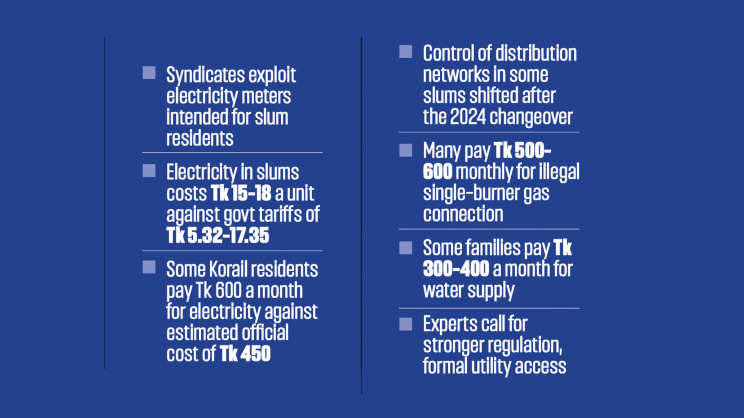
SYNDICATES’ CONTROL ON KORAIL
According to DESCO’s latest tariffs effective from June, residential electricity tariffs range from Tk 5.32 to Tk 17.35 per unit depending on consumption.
Mizanur estimated that a household using a 65-watt fan for 22 hours and a 40-watt light for eight hours a day consumes about 52.5 units of electricity per month.
Based on this calculation, Jannat’s estimated monthly bill would be below Tk 450.
“My room’s rent is Tk 5,000. I pay Tk 300-400 a month for water and Tk 500 for a gas connection to a single-burner stove,” said Jannat, who received utility connections from a man named Md Jamal Badsha.
Several other slum residents showed this correspondent four main electricity meters and said one of those was registered in the name of Jamal who provides electricity to 179 households.
They further said that Jamal, who had close ties with local Awami League leaders in the past, continues to run his illegal utility business by making arrangements with a group of BNP loyalists.
 For all latest news, follow The Daily Star's Google News channel.
 When contacted, Jamal said 139 of his customers have sub-meters, while 40 are provided electricity through direct lines. He charges sub-meter users Tk 13 per unit and others Tk 250 per electrical device.
This correspondent obtained a copy of Jamal’s electricity meter bill for June 2026, which shows he paid DESCO Tk 7.47 per unit.
According to residents, people linked to the AL controlled utility distribution in parts of Korail before the AL government’s ouster on August 5, 2024. Following the political changeover, control shifted to individuals associated with the BNP.
They said Asma Begum, joint convener of BNP’s Banani Thana Mahila Dal, oversees electricity distribution to around 200 families through bills issued in the name of her son, Md Qayyum Sarkar.
When contacted, Asma said DESCO had previously provided one meter for several families. Later, a main meter was obtained in her husband’s name to provide sub-meters to beneficiary families.
“We cannot always get assistance from DESCO staff when needed… We have employed a few workers who fix problems and work throughout the month. There is a service charge for this. That’s why customers are charged an additional amount,” she said.
Residents of Kalyanpur Pora Basti said they used to get electricity supply through two main meters during the AL government’s tenure. The number of meters rose to eight after the July uprising.
They said the syndicates that control the meters charge them between Tk 15 and Tk 18 per unit.
“Following the uprising, the charge dropped to Tk 12 per unit. But it rose again,” said 30-year-old Johny, who grew up in the slum.
Md Jewel Hossain Billal, who collects bills for one of the syndicates, said the increase resulted from higher government tariffs.
“We charge Tk 17 per unit. DESCO charges us Tk 9.75 excluding taxes. The rate went up after the new tariffs took effect in June,” he said.
ILLEGAL GAS CONNECTIONS
Residents of Korail slum alleged that a group led by Jamal provides illegal gas connections, with the help of Md Shahabuddin, who claimed to be a BNP member from Ward 19 under Banani thana.
They pay Tk 500 to Tk 600 monthly for a single burner and Tk 1,000 to Tk 1,200 for a double burner.
When asked, Jamal said, “I give Shahabuddin all the money collected from gas bills. He controls the lines. He comes every month to collect the money.”
He further said he provided gas connections to around 50 families in the slum.
Shahabuddin, however, denied controlling the gas lines.
“I’m merely a worker… I don’t run this business,” he said.
ILLEGAL WATER PIPELINES
According to Dhaka WASA, Korail slum has around 1,500 metered water connections set up with assistance from BRAC, Dushtha Shasthya Kendra (DSK) and other NGOs.
Residents said several local groups illegally tapped into authorised water connections, extended pipelines to households and charged them for the service.
Jamal said he supplied water to 40 families at Korail for Tk 300-400 each per month.
Kanchana Begum, a garment worker, said, “No matter how little water we use, we have to pay Tk 300 for our family of three.”
WHAT OFFICIALS, EXPERTS SAY
Rashedur Rahman, managing director for operations at DESCO, said, “We are working to install meters in all households as per government instructions. The process will take time, but implementation has started.”
Titas Gas Manager Shah Newaz Chowdhury said local syndicates repeatedly reconnect lines after Titas personnel remove the illegal connections.
He also acknowledged that some Titas officials may be involved in the illegal business and said the problem could not be solved by Titas alone.
Nayan Sarkar, Dhaka WASA field officer for Korail, acknowledged that some connection holders illegally distribute water in the slum, turning it into a profitable business.
“There should be no additional charges for taking water from a metered line,” he said.
When contacted, Mohammad Mamun Ul Hasan, chief of Social and Slum Development at DNCC, said the city corporation currently has no plan to provide new utility connections to slum households.
He further said DNCC would follow any policy or legal framework if introduced by the government in this regard.
Experts, however, suggested bringing slums under a formal system and adopting a comprehensive policy for their management.
“Such steps will not only help increase government revenue but also ensure that slum residents receive safe and affordable services,” said Salma.
This would benefit both residents and the state, she added.
Comments