


Fears mount for civilians
♦ UN chief warns of 'humanitarian catastrophe'
♦ UN Syria envoy says at least '10,000' terrorists in Idlib
♦ Tensions heat up among powers over looming assault
The United Nations called on Russia, Iran and Turkey yesterday to forestall a battle in Syria's Idlib province which would affect millions of civilians and could see both militants and the government potentially using chlorine as a chemical weapon.

UN Syria envoy Staffan de Mistura said there was a high concentration of foreign fighters in Idlib, including an estimated 10,000 fighters designated by the UN as terrorists, who he said belonged to the al-Nusra Front and al-Qaeda.
There could be no justification to use heavy weapons against them in densely populated areas, he said. Miscalculations could lead to unintended consequences, including the possible use of chemical weapons.
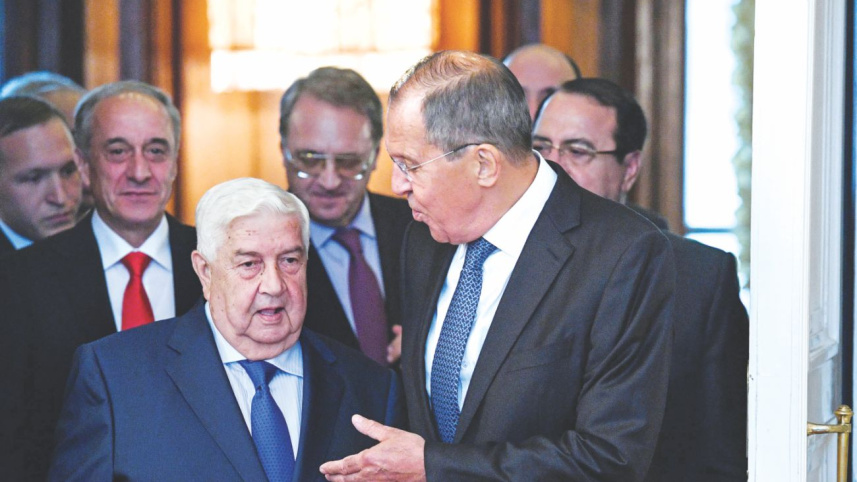
Syrian Foreign Minister Walid al-Moualem, speaking during a meeting with his Russian counterpart Sergei Lavrov in Moscow yesterday, said: "We are at the final stage of solving the crisis in Syria and liberating our whole territory from terrorism."
"I assure you that we do not have chemical weapons and are not able to use them," he added, according to Syrian state news agency SANA.
Idlib province is the last major rebel-held area in Syria, serving as what the UN has called a "dumping ground" for fighters and civilians evacuated from other battles after surrender deals with regime.
But fighters who reject similar surrender deals for Idlib will have nowhere to go, heightening the chances of even deadlier battles if an all-out offensive is launched.
But a source said on Wednesday that Russia's ally, Syrian President Bashar al-Assad, was preparing a phased offensive there.
Russian Foreign Minister Sergei Lavrov said on Wednesday that militants in Idlib had to be liquidated, describing them as "a festering abscess".
Key brokers held last-ditch talks yesterday on the fate of Syria's only remaining rebel-held province, hoping to stave off a government offensive the UN has warned could spark catastrophe.
The province's most powerful armed faction is the Hayat Tahrir al-Sham (HTS) jihadist group and neighbouring Turkey is trying to use its influence to avert a major offensive against it.
"The negotiations between Turkey and HTS are still under way," said the head of the Britain-based Syria Observatory for Human Rights, Rami Abdel Rahman.
Russia, whose 2015 military intervention in support of Assad helped the government reclaim much of the ground it lost in the early days of the seven-year conflict, wants the jihadist outfit to disband, he said.
"This is the condition set by Moscow to avert a broad offensive... Its launch hinges on the failure or success of these talks with HTS," Rahman said.
While Turkey actively sponsors rebel forces in Idlib, its influence over the former Al-Qaeda affiliate is less clear and Abdel Rahman warned the chances of success were slim.
Iran's Foreign Minister Mohammad Javad Zarif also held previously unannounced talks with Turkish President Recep Tayyip Erdogan on Wednesday. The outcome of the talks is not known.
Russian media reported this week that Moscow has been reinforcing its military set-up in the region and currently has 10 warships and two submarines in Syrian waters.
The prospect of a massive Russian-backed offensive in a province that is home to some three million people -- half of them already displaced from other parts of Syria -- has raised fears of a new humanitarian tragedy.
UN chief Antonio Guterres said on Wednesday he was "deeply concerned about the growing risks of a humanitarian catastrophe in the event of a full-scale military operation in Idlib."
 For all latest news, follow The Daily Star's Google News channel.
Comments