


Research funding under UGC sparks strong opposition at DU Senate
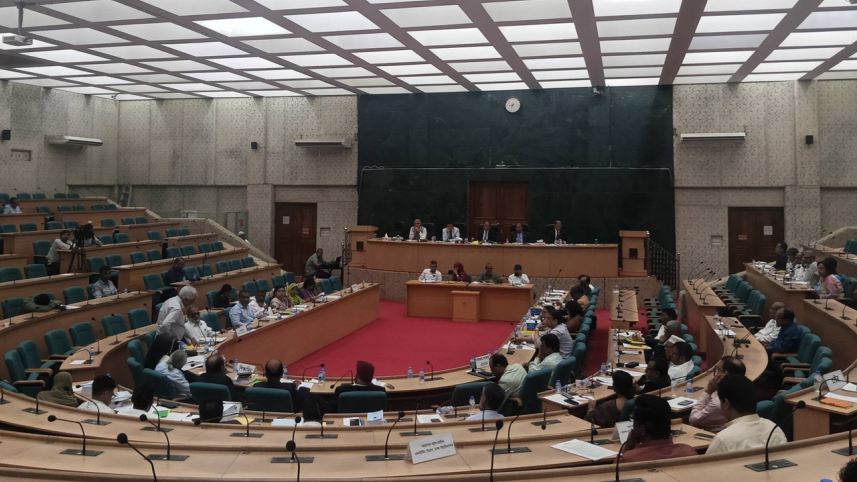
Dhaka University (DU) senate members, including the university’s treasurer, have strongly denounced the government’s recent decision to centralise research funds under the University Grants Commission (UGC), a move that has left the institution with a “zero” research allocation in its proposed budget.
During DU’s annual senate session, held today after a two-year hiatus, academics cautioned that routing research funds through the UGC undermines the university’s autonomy and poses a direct threat to academic freedom.

The concern stems from a government directive ending the direct disbursement of research funds to universities. Instead, the funds will be channelled through the UGC, which will distribute them based on demand and designated categories.
Sharmina Nasrin, joint secretary at the Ministry of Education and a senate member, defended the government’s stance, saying, “This year, in the tripartite meeting among the finance ministry, education ministry, and university representatives, it was decided that the research allocation for all universities will be curtailed and given to the UGC.”
Nasrin further requested a correction to the budget text, adding, "I request you to correct this part to state that it is a government decision. The research allocation will be implemented through the UGC this time, not through the university."
DU Treasurer Prof M Jahangir Alam, who questioned the legitimacy of the policy shift, said, “Dhaka University is the number one institution in this country; the nation’s expectations from it are immensely high. How could this nation expect this university to be a research university with a zero research budget?” The decision was taken without consultation, he added.
Prof Samina Luthfa of DU's Department of Sociology also opposed the move, mentioning that shifting financial control to the UGC would be catastrophic for independent scholarship. “If the University Grants Commission holds our research fund, it means we are being heavily influenced, and we will have to work under government influence. What kind of research we can do, and what we cannot do -- this is completely against our academic freedom,” she said.
Prof Mohammad Siddiqur Rahman Khan, vice-chancellor of Bangladesh Open University, said there appeared to be some misunderstanding over research funding. “Research funding is available, but the way it has been allocated is, in my view, unacceptable if the aim is to make universities more research-oriented,” he said.
“Placing all research funds for public universities under the University Grants Commission in a single central pool is unprecedented in Bangladesh. I do not believe this approach will yield positive results,” he added.
Urging the government to reconsider the decision, he said the existing system of allocating research funds directly to individual universities should be retained. “If greater accountability is required, appropriate mechanisms can be introduced to ensure it,” he said.
 For all latest news, follow The Daily Star's Google News channel.
Comments