


We need a long-term dengue control plan
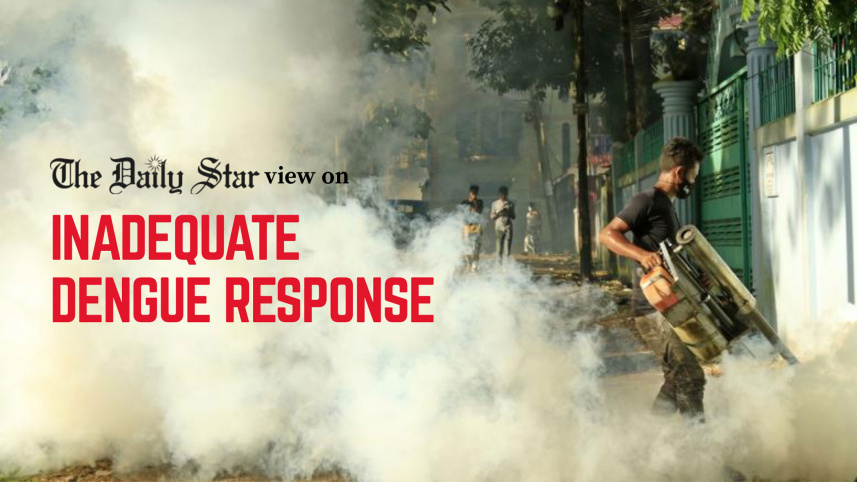
We fail to comprehend how, despite over a decade of dedicated spending on mosquito control, government agencies’ response to the yearly dengue outbreak can still be so threadbare. According to DGHS data, at least 143 dengue patients have died—over 40 in September alone—while 50,276 were hospitalised this year as of Saturday. But the figures could be higher, as the current DGHS data only covers 139 hospitals, out of around 20,000 health facilities registered across the country. Despite this situation and the capital’s two city corporations proposing a combined mosquito control budget of Tk 200 crore this year, immense gaps remain in the government’s strategy to control the spread of dengue.
At this point, there can be no excuse for such lacklustre dengue preparedness. Alarmingly, due to the past interim government’s cancellation of the proposed fifth Health, Population and Nutrition Sector Programme (HPNSP) and the resultant funding gap, the DGHS could not conduct its three entomological surveys last year. Meanwhile, no survey has yet been conducted this year, save for a small-scale pre-monsoon one by the DSCC. And although we have researchers and entomologists equipped with the knowledge needed to prevent dengue outbreaks, only one out of 12 city corporations has an entomologist to help authorities control mosquito-borne diseases. Meanwhile, civil surgeon offices in only 24 out of 64 districts have approved posts for entomologists. Of the 24 districts with approved posts, in at least six, the post has remained vacant for years. Is it any surprise then that dengue has spread to all 64 districts?

The government’s three-month dengue prevention campaign is surely a timely intervention. It promotes cleanliness at the individual level, encouraging citizens, including students, scouts, cleaning workers, and young people, to keep their respective surroundings free of trash and stagnant water. This collective action can go a long way to prevent Aedes mosquito breeding grounds from persisting. But, more crucially, the government must adopt a science-based approach to countering dengue. And as a first step, the near-absence of entomologists in relevant public agencies and departments must be rectified.
It is reassuring that the government has directed civil surgeons to step up hospital preparedness and public awareness efforts, as the peak of the dengue outbreak could occur over the next one month. However, it is equally important to resume the DGHS’ annual surveys. Besides, experts’ input must be welcomed and implemented properly. Dengue has unfortunately become a year-long danger now. The situation must be reversed so that by next year the dengue situation can be much better managed.
 For all latest news, follow The Daily Star's Google News channel.
Comments