


Amid rising debt pressures, a case for sukuk to ease the burden

The government’s proposed Tk 9.38 lakh crore budget for FY2026-27 is the largest in Bangladesh’s history. The budget frames economic democratisation, deregulation, and the empowerment of the people as priorities on Bangladesh’s path to becoming a trillion-dollar economy. Funding it, however, will rely heavily on debt. To this end, the government plans to borrow Tk 2.43 lakh crore during the fiscal year, of which Tk 1.16 lakh crore will be from foreign sources. The remainder will be raised domestically, with Tk 1.12 lakh crore from the banking system and Tk 15,000 crore from national savings certificates. Economists warn that heavy reliance on domestic borrowing could crowd out private sector credit. Interest payments alone will reach Tk 1.05 lakh crore on domestic loans and Tk 22,500 crore on foreign loans.
The Asian Development Bank (ADB) and the IMF-World Bank debt sustainability assessment both classify Bangladesh as being at moderate risk of external and overall debt distress. Both warn that rising domestic debt-servicing costs are already eroding fiscal space, and that any major shock (climatic, geopolitical, or otherwise) could turn a still-manageable debt burden into an unmanageable one.

The months-long closure of the Strait of Hormuz is the latest example of this warning. Still, such shocks do not change what the state owes its lenders; its debt-servicing obligations remain the same. Risk-free fixed payments are precisely what make sovereign debt cheaper, but they also place the entire burden of adjustment on the state. When a shock erodes the economy’s capacity to pay while its obligations hold firm, the fiscal cushion thins and the government loses room to manoeuvre. The present is a good time for Bangladesh to rethink how it borrows.
One option would be to tie the government’s payment obligations to its capacity to meet them. This is the idea behind state-contingent debt instruments (SCDIs): securities whose repayments adjust in line with a measurable indicator of the state’s ability to pay. Encouragingly, Bangladesh has already laid the groundwork for such instruments.
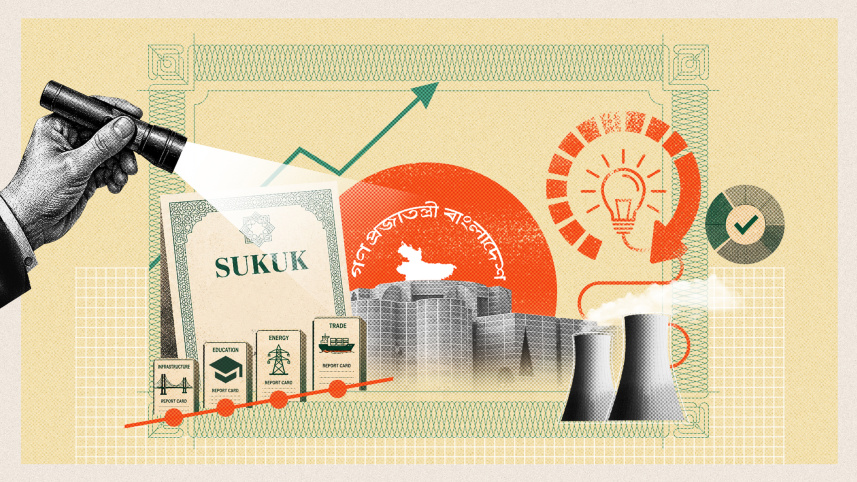
Since 2020, the government has been issuing investment sukuk, all of which have been oversubscribed, the most recent by 12.30 times, despite offering lower returns than comparable conventional treasury instruments. This indicates that a sizeable Shariah-sensitive investor base already exists in the market. With Shariah-compliant options still scarce, depositors unsettled by uncertainty in parts of the Islamic banking sector, and Islamic pension schemes under development at the National Pension Authority likely to require such options once launched, demand for sovereign sukuk is set to deepen in the coming years.
The investment sukuk issued has so far financed clearly identified socioeconomic projects—such as safe water supply, schools, rural roads, and bridges—rather than merely covering general budget gaps. Each issuance carries its own prospectus, setting out the purpose of issuance, the use of proceeds, and the expected impact of the underlying projects. In some cases, the economic internal rate of return (EIRR) of those projects is assessed to confirm that their economic benefits exceed their funding costs.
Yet, for all their merits, these remain fixed-rate structures that closely track comparable conventional treasury bonds. Neither is the actual performance of the underlying projects measured, nor do payments to investors vary with it. The government’s obligation stays the same regardless of how the projects actually perform. For investors, this means a safe investment. But from a debt-management perspective, they are no more than conventional debt, offering no relief from the rigidity of debt servicing.
This is where an alternative sukuk design becomes an opportunity. Short-term, trade-based sukuk, for instance, could finance recurring commodity purchases by the government and its agencies, tying issuances to the genuine trading activities of the state. Long-term, performance-linked sukuk could fund profitable state enterprises or their viable segments, with returns tagged to actual performance. Sukuk could likewise be issued against revenue-generating public assets such as tolled bridges, power plants, ports, and transport networks. Impact-linked sukuk could support public welfare projects that generate no revenue, with payments tied to verified outcomes such as improvements in air quality, traffic, education, healthcare, and employment generation. Waqf resources could complement this welfare financing, while zakat funds could support eligible beneficiaries in the social sector. Together, these structures would bind government spending more closely to performance-oriented economic activity.
If a growing share of government financing were channelled through sukuk whose payouts track the actual performance of the underlying assets, or clearly defined indicators of the state’s capacity to pay, the government’s debt-servicing burden would adjust accordingly. If scaled sufficiently, this could provide greater fiscal flexibility at the sovereign level. These structures would also be more than financing tools and, done properly, they would serve as accountability mechanisms. Since payouts would depend on performance, investors can gain a direct stake in how each project is run and would press for fuller disclosure—a form of scrutiny rarely associated with conventional debt. Done well, sukuk could quietly strengthen the country’s broader governance.
Of course, such structures would not be easy to introduce. Given limited trust in the performance of government agencies, investors may initially demand a government guarantee or a premium for bearing performance risk, while the agencies themselves may resist stronger monitoring and disclosure. Because of the performance link, every element of the structure would need careful design. The supporting infrastructure would also be essential: tax neutrality, streamlined issuance, strong oversight, an active trustee, Shariah-compliant segregation of income, honest and verifiable impact reporting, and effective coordination among the central bank, the finance ministry, and project-implementing agencies.
Issuances could begin with structures closest to the familiar fixed-rate profile while still carrying a performance-linked element, then move towards fuller performance-based forms as investors grow comfortable. To build confidence early on, a government guarantee may be offered—but not in a blanket form that severs the link between performance and payout. Instead, it should be transitional, paired with full disclosure, and withdrawn as the market matures. Over time, this approach could diversify the government’s financing mix, reduce its reliance on entirely fixed obligations, and embed stronger accountability in public projects.
Conventional borrowing, or a plain debt-based sukuk, is easy to issue. But it also locks in the rigidity already burdening debt management. Genuinely performance-linked sukuk may be harder to launch, but that difficulty is the price of fiscal flexibility and gives everyone involved a built-in reason to care about how an underlying project (or the economy itself) performs.
The shift need not be abrupt. We could begin with small-scale projects and early-stage structures that stay close to today’s fixed-rate profile, while carrying some performance-accountability elements, and then scale up and shift towards fuller performance linkage as the market matures. Debt management reimagined in this way has the potential to become not merely a means of covering the deficit but also a lever for a stronger, more transparent economy.
Mezbah Uddin Ahmed is research fellow at ISRA Institute of INCEIF University in Malaysia. He can be reached at mezbah.u.ahmed@gmail.com.
Views expressed in this article are the author's own.
Follow The Daily Star Opinion on Facebook for the latest opinions, commentaries, and analyses by experts and professionals. To contribute your article or letter to The Daily Star Opinion, see our guidelines for submission.
 For all latest news, follow The Daily Star's Google News channel.
Comments