


Can the climate budget be just if resilience is ‘subsidised’ by women’s unpaid care work?

The allocation for climate action in the proposed budget for FY2026-27 deserves recognition. At a time when climate impacts are intensifying, Bangladesh has continued to institutionalise climate-responsive budgeting across ministries and expand allocations for adaptation. The proposed climate budget of around Tk 51,746 crore, more than 25 percent up from that in the outgoing fiscal year, signals sustained political commitment to climate action.
Bangladesh is among the world’s most climate-vulnerable countries, despite contributing less than one percent of global greenhouse gas emissions. The emphasis on adaptation is both necessary and justified. Nearly 75 percent of the allocation is directed towards adaptation measures, including flood control, embankments, climate-resilient agriculture, water management, and social protection. In this sense, the proposed allocation is clearly climate-sensitive.

However, the central question is whether it is climate-just. To answer this, we must move beyond how much is being spent and ask: who benefits from climate investments, who bears the costs of adaptation, and whose labour makes resilience possible?
The first concern is adequacy. Climate change is estimated to cost the country around $3 billion annually, equivalent to roughly one to two percent of GDP, yet climate-related public expenditure has remained below one percent of GDP in recent years, including in the proposed budget. The gap becomes starker when viewed against long-term needs.
The National Adaptation Plan (2023-2050) estimates that Bangladesh will require around $230 billion for adaptation by 2050, or approximately $8.5 billion annually. Current climate finance flows, however, remain around $2-3 billion per year. Despite increases in allocations, a significant structural financing gap persists.
But adequacy is only part of the story. A more fundamental issue lies in how climate resilience is actually produced. Public discussions tend to focus on embankments, infrastructure, disaster systems, and renewable energy. These investments are essential, but they capture only a portion of what makes adaptation possible in practice.
A feminist analysis reveals a critical yet often invisible dimension: Bangladesh’s climate resilience is not sustained solely by public spending or international climate finance. It is also sustained by the unpaid and under-recognised labour of women and girls.
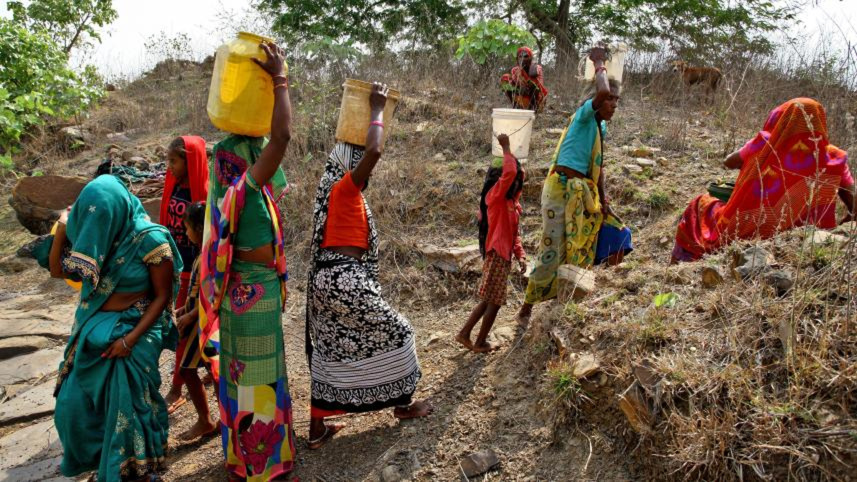
When floods contaminate drinking water sources, it is women who walk further distances to collect water. When cyclones destroy homes and livelihoods, and rising temperatures lead to health hazards, women take on the burden of caring for children, older family members and the sick, while simultaneously managing household recovery. When climate shocks threaten food security, women absorb the impact through longer working hours, reduced rest, and reduced personal consumption. But this rarely appears in climate budgets, adaptation plans, or economic indicators.
In effect, the country’s climate resilience is subsidised by the unpaid care work of women and girls. It is a form of invisible subsidy that enables households and communities to withstand repeated climate shocks, but because it is not measured, it is not recognised in policy design. This has serious policy implications.
Recognising care work is not simply a gender concern but a core adaptation issue. Proper investments in safe water systems, healthcare, childcare services, social protection, and climate-resilient public services can directly reduce unpaid care burdens while strengthening our adaptive capacity. These are not peripheral welfare interventions; they are central climate strategies.
Climate impacts also deepen existing gender inequalities. Displacement caused by floods, cyclones and river erosion increases women’s exposure to violence, exploitation, school dropout, and early marriage. Salinity intrusion and damaged sanitation systems create additional reproductive and menstrual health risks in many vulnerable regions.
These realities underscore the need to align climate budgeting more closely with Bangladesh’s own Climate Change Gender Action Plan (CCGAP) 2023, which calls for women’s leadership in climate governance, improved access to resources and technology, and stronger integration of gender equality across climate action.
There are three priorities here. First, strengthen gender-responsive climate budget tracking to assess not only how much is spent, but who benefits from climate expenditure. Second, scale up locally led adaptation and ensure dedicated support for women-led organisations working in climate-affected communities. And third, invest explicitly in reducing unpaid care burdens through improved access to water, healthcare, childcare and social protection in climate-affected areas.
Bangladesh has made important progress in climate budgeting. The next challenge is to ensure that climate finance not only builds embankments and infrastructure but also addresses the inequalities that determine who is most exposed to climate risk and who carries the greatest burden of adaptation. If climate justice requires recognising who suffers most from climate change, it must also require recognising who performs most of the work of adaptation. Until the contribution of millions of women and girls is recognised, measured, and reflected in climate policy and budgeting, the country’s climate resilience will continue to depend on an invisible subsidy.
Farah Kabir is country director at ActionAid Bangladesh.
Views expressed in this article are the author's own.
Follow The Daily Star Opinion on Facebook for the latest opinions, commentaries, and analyses by experts and professionals. To contribute your article or letter to The Daily Star Opinion, see our guidelines for submission.
 For all latest news, follow The Daily Star's Google News channel.
Comments