


A congestion charge alone will not untangle Dhaka’s traffic

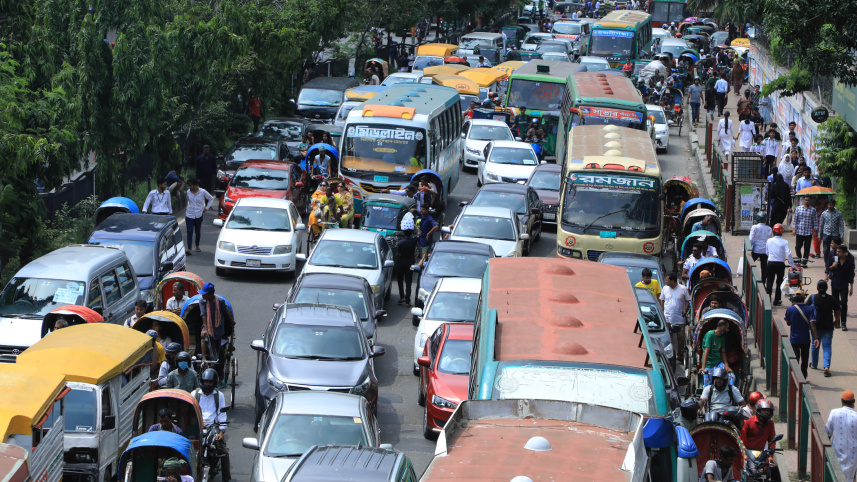
Over the years, Dhaka has gained notoriety for the severe gridlock affecting the lives of commuters. According to a 2018 Buet study, the city suffers an annual loss of Tk 20,000 crore to Tk 55,000 crore due to congestion, with vehicular speeds falling below 8 km/h. Another study by the World Bank and the Accident Research Institute (ARI) shows an estimated 16 km/h drop in traffic speed from 2007 to 2022. In a bold bid to regain control of the Dhaka streets, the government is considering a massive $64 billion multimodal investment over the next two decades based on Updating the Revised Strategic Transport Plan for Dhaka. Prioritising the reduction of vehicular congestion, the government, with a simple yet transformative goal, is planning to implement a congestion charge of Tk 6.27 per km on motorcycles, private cars, and trucks entering and exiting areas with high traffic density during rush hours. However, the need for arranging alternative public transport is also taken into consideration before implementing this system.
Congestion charge is a unique concept implemented by major cities in developed countries, including Singapore, England, Sweden, Italy, and recently, the United States. Despite having similar goals, the fee systems adopted around the world are distinctively different.

Singapore is credited with being the pioneer in introducing the congestion fee back in 1975 as the Area Licensing Scheme (ALS), charging vehicles a flat rate for entering central locations. This brought a dramatic reduction in traffic congestion of approximately 45 percent. The system was upgraded to the fully automatic Electronic Road Pricing (ERP) programme in 1998. Utilising overhead gantries, the tolls are charged and adjusted based on time, location, vehicle type, and traffic rush. From 2027, the country aims to implement ERP 2.0, a satellite-based congestion fee mechanism to eliminate the cost and limitations of the gantry-based system.
In London, England, the congestion charge introduced in 2003 applies a standard rate within a set time frame for vehicles using the designated zones. Congestion charging zones are under strict camera surveillance, recording number plates for monitoring the payment of fees. Failure to pay within the set time results in a financial penalty. The revenue generated from this system is utilised in maintaining the public transport system of the city.
In Sweden’s Stockholm and Gothenburg, the system was introduced in 2006 and 2013, respectively. The congestion tax applies to vehicles entering and exiting the cities during weekdays, and the fee varies based on time and location. Vehicle number plates are registered, and tax is applied through unmanned electronic control points.
Compared to other countries, implementing this model in Bangladesh, especially in Dhaka, will undoubtedly be a monumental task. With the use of public transport sharply declining in Dhaka, the number of cars and motorcycles has dramatically increased over the past decade. Between 2010 and 2025, the number of passenger vehicles skyrocketed by more than 300 percent from 4,62,785 to 19,21,387, with motorcycles alone making up 1,291,245 of the total in 2025 (more than a 500 percent increase). The number of buses, on the other hand, has seen a slower rise of about 133 percent—a total of 54,375 in 2025. To reverse this trend, Dhaka’s transport network must be expanded with modernised buses and other modes of public transportation before the congestion toll is operational, so that the charge is not seen as a punitive penalty on the middle class.
The complex nature of Dhaka’s traffic ecosystem, consisting of private cars, buses, motorcycles, CNG auto-rickshaws, and battery-powered rickshaws, could make it difficult for the automated system to accurately identify and charge the intended vehicles, even with AI-powered traffic cameras, and proposed Radio Frequency Identification (RFID) technology. Also, vehicles that do not want to be charged under this system have to be restricted from accessing these zones. Another key consideration to be taken into account is that middle-income families relying on ride-sharing for safety and speed may be disproportionately affected, while well-off vehicle owners might simply pay the fees instead of using public transport.
Disincentivising single-occupancy private vehicle trips through a congestion charge aims to encourage travellers to use public transport. This will not only lessen traffic gridlock but also play a major role in improving the air quality of the area. On the other hand, revenue from the tolls collected can be reinvested into upgrading Dhaka’s public transport system.
The success of the congestion charge will largely depend on public acceptance of the system, based on visible results. In Stockholm, people opposed the congestion tax system before its launch, but when it proved to be successful in resolving the gridlock issue, the same people voted to make the system permanent. Dhaka’s technological and structural limitations may pose challenges at the initial stage, but if the solutions are well thought-out, the obstacles can be overcome. Awareness campaigns to highlight the positive outcomes of the initiative at an early stage will further help bring about the behavioural shift among the masses to use public transport.
Mohammad Inzamul Haque is a development practitioner, researcher and analyst.
Views expressed in this article are the author's own.
Follow The Daily Star Opinion on Facebook for the latest opinions, commentaries, and analyses by experts and professionals. To contribute your article or letter to The Daily Star Opinion, see our guidelines for submission.
 For all latest news, follow The Daily Star's Google News channel.
Comments