


How the FY2026-27 budget repeats the habits of the past
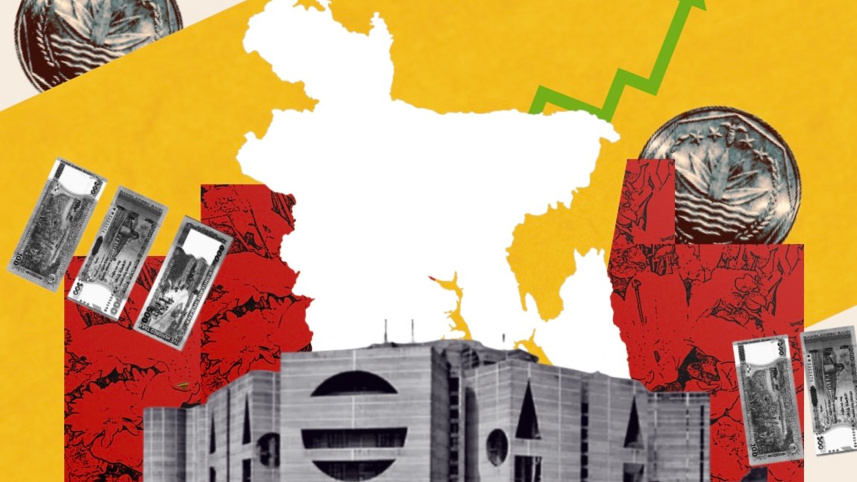
Four habits appear to have been defining budget-making in Bangladesh for decades, regardless of who headed the finance ministry. The first is a near-automatic inflation of the budget’s size every year, with little concern for affordability. The second is an ambitious projection of revenue—mainly tax revenue—needed to finance that ever-larger budget. The third is tinkering at the margins: shuffling allocations across more or less the same expenditure heads while leaving the underlying structure and priorities largely untouched, with one distinct aberration after the one-sided 2014 election, when Sheikh Hasina’s government poured money into highly visible infrastructure that, evidence now suggests, served as much as a vehicle for plunder as for development. The fourth is an instinct to placate everyone, especially organised vested-interest groups such as the beneficiaries of energy sector subsidies, rather than make the hard choices that reform requires.
The proposed Tk 9.38 lakh crore budget for FY2026-27, the first since the BNP’s landslide win in February and Tarique Rahman’s installation as prime minister, offers a useful test of whether these habits persist.

Let’s start with the size. The budget has grown almost every single year this past decade: from roughly Tk 5.23 lakh crore in FY2019-20 to Tk 5.68 lakh crore, Tk 6.04 lakh crore, Tk 6.78 lakh crore, Tk 7.62 lakh crore, and Tk 7.97 lakh crore by FY2024-25, before settling at Tk 7.88 lakh crore after revision this outgoing year. The proposed budget leaps to Tk 9.38 lakh crore—a nearly 19 percent jump over the outgoing budget, easily the largest single-year increase in recent memory—despite serious concerns about the revenue source.
This ambitious increase rests, as always, on the second habit: revenue projections divorced from the National Board of Revenue’s (NBR’s) actual record. The NBR has missed its annual collection target for roughly a decade, and in the outgoing year, too, it expects to fall Tk 88,000 crore short of the revised target. The tax-GDP ratio has fallen to about 6.8 percent, among the lowest in the world. Against this backdrop, the government has set an NBR target of roughly Tk 6.04 lakh crore for FY2026-27, a jump of nearly 20 percent over the revised FY2025-26 target, which can at best be termed elusive because it assumes collection growth approaching 40 percent in a single year—a figure with no logical basis. We have seen this game before: set an unreachable target, watch it fall short, plug the gap with borrowing or printing money, and repeat the following year.
The third habit—keeping the structure intact while occasionally redirecting money towards “visible” infrastructure that enriches only insiders—is harder to undo because the liabilities were locked in years ago. The Rooppur Nuclear Power Plant (RNPP), built at a cost of roughly Tk 1.13 lakh crore, is now the subject of a probe into an alleged $5 billion embezzlement scheme. The Padma Rail Link, built at a cost of about Tk 39,246 crore and now 95 percent complete, runs only 10 trains a day against a planned 48 and seems to be a white elephant. These are not isolated lapses but illustrations of how “development” became, in the post-2010 period, a euphemism for procurement designed more to be looted than to serve public interests. A budget that does not reckon with this legacy—through radical efforts to stop such corruption and waste—is choosing continuity over reform.
The fourth habit, pleasing entities with vested interests, shows up most starkly in the energy sector. Total subsidies are nominally being trimmed in the proposed budget to about Tk 89,538 crore from an actual Tk 1,08,673 crore in FY2024-25. But power and energy subsidies alone still exceed Tk 40,000 crore, and the core problem—capacity payments to private plants for electricity they don’t generate—remains essentially untouched. Bangladesh has paid more than $9 billion in such capacity charges since 2009; in FY2023-24 alone, the figure reached roughly Tk 38,000 crore, accounting for the bulk of all power sector subsidies. These are guaranteed, largely non-competitive payments to a politically connected set of private power producers. The government needed to think outside the box and restructure or renegotiate these contracts. Instead, the old arrangement survives, untouched, inside a brand new budget.
All of these landed at a moment when expectations were genuinely high. The July 2024 uprising demanded deep reform: an end to democratic deficits and governance failure, a serious assault on corruption and bank looting, job creation that finally captures the country’s demographic dividend, a reversal of widening disparity in opportunity, and the repair of broken constitutional and statutory institutions. The much discussed “plan” of Tarique Rahman carried the implicit promise that the budget-making process would be rethought, not merely repeated. His government’s own stated vision—a $1 trillion democratic human welfare state by 2034—requires exactly the kind of structural departure that the proposed budget conspicuously avoids. Freezing the tax structure for five years “for policy continuity,” while pinning an ambitious target to a largely underperforming NBR, appears to be a deliberate avoidance of reform.
None of this is to claim malice on the part of the present government. Bureaucratic inertia, fiscal-year deadlines, and the sheer difficulty of overhauling tax administration or unwinding power-purchase contracts within months of taking office are real constraints. But the uprising did not ask for a budget that is merely larger and somewhat reordered. It asked for a different road. Going back to the drawing board would have meant matching revenue targets to NBR’s demonstrated capacity, opening the RNPP and other megaproject files to genuine scrutiny, renegotiating the capacity payment regime that bleeds the exchequer for power nobody uses, and tying new spending visibly to job creation and reduced disparity rather than headline size. Travelling the same old path, however briskly, will not take the country to the new destination its people demanded in 2024.
Dr Badiul Alam Majumdar is secretary at SHUJAN: Citizens for Good Governance.
Views expressed in this article are the author's own.
Follow The Daily Star Opinion on Facebook for the latest opinions, commentaries, and analyses by experts and professionals. To contribute your article or letter to The Daily Star Opinion, see our guidelines for submission.
 For all latest news, follow The Daily Star's Google News channel.
Comments