


Rule cannot survive on fear alone: Foucault, Althusser, and our mob culture

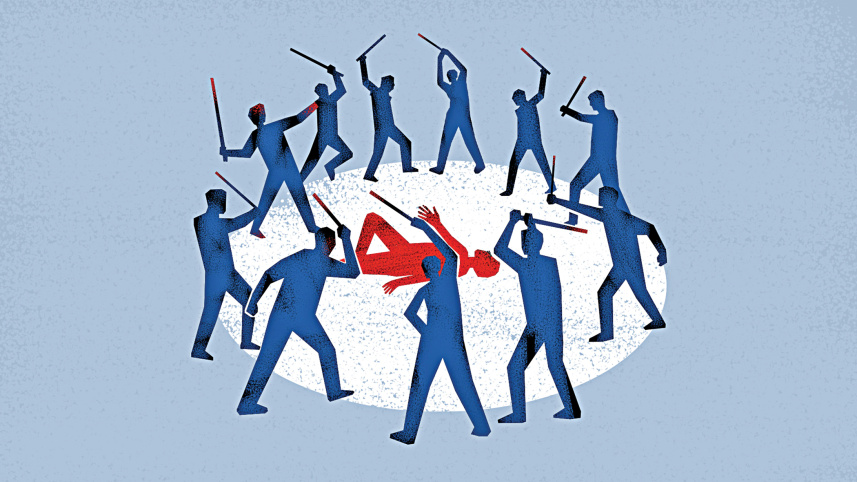
The work of French philosophers Michel Foucault and Louis Althusser remains useful to understand how the modern state governs. Their methods differ, but for a society like ours, where state power, citizen behaviour, and mob culture intersect, it is worth reading the two together. Foucault’s idea of governmentality shows that the state does not govern only through the police, courts, prisons, or coercion. Modern rule also shapes how people think, behave, regulate themselves, and imagine their duties as citizens. Power operates through education, health, statistics, security, development, and civic responsibility. The state does not merely control people from outside, but it creates conditions in which people begin to see themselves as “good citizens” and “productive individuals.” Governance is therefore not only the fear of punishment. It is also the production of normality.
But how do modern states produce these conditions? Althusser talks about the types of apparatuses that help states create this condition of governmentality, divided into repressive state apparatuses (RSA) and ideological state apparatuses (ISA). RSAs include the police, military, courts, and prisons which operate through direct force. ISAs include family, schools, religious institutions, media, universities, culture, literature, art, and intellectual spaces. The latter do not repress directly. They instead shape citizens’ beliefs, values, morality, and common sense. Together, RSAs and ISAs exemplify how the state governs both through force and the production of governable subjects.

Here, I should clarify my own position. I do not see the state as inherently evil. The state can repress and destroy citizens’ rights, but it can also be a vehicle for public welfare. Health, education, security, rights, justice, and civic dignity are difficult to protect without institutions. Without institutions, what remains is individual will, party power, and public anger. None of these can sustain or stabilise a society.
Recently, while taking an Uber ride in Dhaka, I had a conversation with the driver. He told me that nothing would improve in the country unless people were caught on the streets and punished. “If rickshaw pullers, motorcyclists, or CNG-run autorickshaw drivers were publicly punished in 50 places across Dhaka,” he argued, “everyone would fall into line.”
I was disturbed not simply because he spoke in anger, but because this line of thought has become common. For him, the solution to traffic disorder was not law, management, training, urban planning, fines, trial, or institutional reform. The solution was immediate public punishment.
Another example shows the same problem more sharply. When the recent rape and murder of a child was being discussed, someone told me that rape incidents could be stopped only if the accused were punished publicly as soon as an allegation was made. In the same conversation, he added that if girls moved around “recklessly,” they too should be punished publicly.
The deeper issue is that the meaning of justice itself is also changing. Courts, investigation, evidence, rights, and due process are being pushed aside, while people take refuge in fantasies of instant punishment.
Some may say that people speak this way out of anger. That is partly true. But these words, unfortunately, do not stay confined to remaining words. Whenever an allegation emerges, groups of people seize someone, punish them, record videos, circulate those videos, and defend the punishment online. This is not merely a law-and-order problem. It is a sign of the breakdown of governmentality.
To understand this breakdown, we must consider the toxicity that has shaped Bangladesh’s political environment since 2014. The violence of 2013-2014, the Shahbagh-Shapla Chattar divide, the crisis of the electoral system, repression of opposition politics, partisan state institutions, pressure on the media, and the political use of courts and police gradually pushed society into rigid binaries. Conflicts existed before, but from this period onward the divisions became more hardened and uncompromising.
As the electoral system weakened, the need for a genuine public mandate also declined. In its place came the effective use of RSAs. Police, courts, cases, prisons, and administration became tools for securing power. At the same time, ISAs such as the media, universities, culture, religious institutions, and educational institutions were used to create legitimacy. People were told that repression was security, control was stability, and silence was responsibility.
But when power uses institutions in this way, the opposition naturally begins to attack them. It delegitimises the repressive apparatus by pointing to police abuse, judicial bias, and the political use of prisons. Much of that criticism was necessary. But opposition politics also began to question ideological apparatuses. Media, universities, culture, intellectuals, and civil society all came under suspicion. Those in power used institutions to serve their own interests; the opposition began viewing those same institutions with complete distrust.
The result was a collapse of governmentality. Trust in the state declined. Trust in law declined. Trust in courts, media, police, and the educated professional class declined. People began to believe that justice could not be done by institutions. Therefore, justice had to be delivered by the people themselves. Punishment would not come from the court, but from the crowd. Rules would not be made by the state, but by the mob.
After August 5, 2024, the symbolic structures of power collapsed. People came out onto the streets. Buildings were occupied. Police stations were attacked. This was not merely the fall of a government, but also a collapse of governmentality.
The question is, where was the effort afterwards to rebuild civic trust, restore police and courts, make the media credible again, and renew a sense of civic morality? Unfortunately, this task did receive enough emphasis. And the reality remains that a country of nearly 18 crore people cannot be governed only by police, administrators, and bureaucrats. A state survives when people believe, at least minimally, that obeying the law is worthwhile, going to court is necessary, informing the police is useful, trusting procedure matters, and that even protest should follow a rules-based path.
What we are seeing now is not the problem of any one party. For a while, we may infer that this or the other political party is at fault. But these are surface-level explanations. The deeper reality is that the power conflict of the last decade and more has destroyed governmentality from the inside out. The average citizen no longer imagines themselves simply as a citizen, but as judge, police, punisher, and avenger.
The breakdown of governmentality is especially visible on social media platforms. Judges, teachers, journalists, political activists, bankers, and other professionals often cross the bounds of professional ethics and participate in mob behaviour. Mistakes, political opinions, and controversial actions deserve criticism. But criticism and mob action are not the same. Our society is rapidly losing cognisance of that distinction.
If governmentality is not restored, mob culture will not lose power. Police action, legal cases, and political speeches cannot solve this. The government has to begin working with citizens again. Police must become protectors, courts must be faster and more credible, the media less partisan, and schools, universities, religious institutions, and cultural spaces must rebuild a language of citizenship, tolerance, due process, rights, and responsibility. The rule of law must be seen in action. The role of the state is not only to catch criminals but also to create a society where people can feel anger, protest, and ask questions without handing the duty of delivering justice over to a mob.
The politics of the last decade has damaged our society from within. The naked misuse of power and blatant expressions of anger against power have produced a language of violence. What we need now is politics that restores institutions and rebuilds civic trust.
Asif Bin Ali is a geopolitical analyst and doctoral fellow at Georgia State University in the US. He can be reached at abinali2@gsu.edu.
Views expressed in this article are the author's own.
 For all latest news, follow The Daily Star's Google News channel.
 Follow The Daily Star Opinion on Facebook for the latest opinions, commentaries, and analyses by experts and professionals. To contribute your article or letter to The Daily Star Opinion, see our guidelines for submission.
Comments