


As the budget nears, a word of caution on money printing

Money-printing, or monetary expansion, is often described in a way that makes it sound as if the government runs a printing press. In practice, most modern money is created electronically: the central bank credits government accounts, buys government securities, or injects liquidity into banks so that they can lend more to the state. The process may look technical, but its consequences are very real for ordinary citizens.
Bangladesh is now facing an uncomfortable mix of high inflation, still-low reserves, rising interest payments, weak revenue collection, and pressure in the banking sector. Between July 2025 and March 2026, the government borrowed Tk 1,26,102 crore from the banking system, exceeding the full-year FY2026 target of Tk 1,04,000 crore by more than Tk 22,000 crore. Revenue collection fell short, net foreign financing declined sharply, and private sector credit growth remained weak, reaching a record low of 4.72 percent in March—a sign that heavy public borrowing is crowding out productive private borrowers.

In such a situation, the temptation to rely on the central bank becomes strong. The usual sequence is straightforward: the government runs a deficit and issues treasury bills or bonds; banks or investors buy them; then the central bank directly or indirectly supports the market by purchasing that debt or providing liquidity to banks. The government gets cash to spend, and the money supply expands.
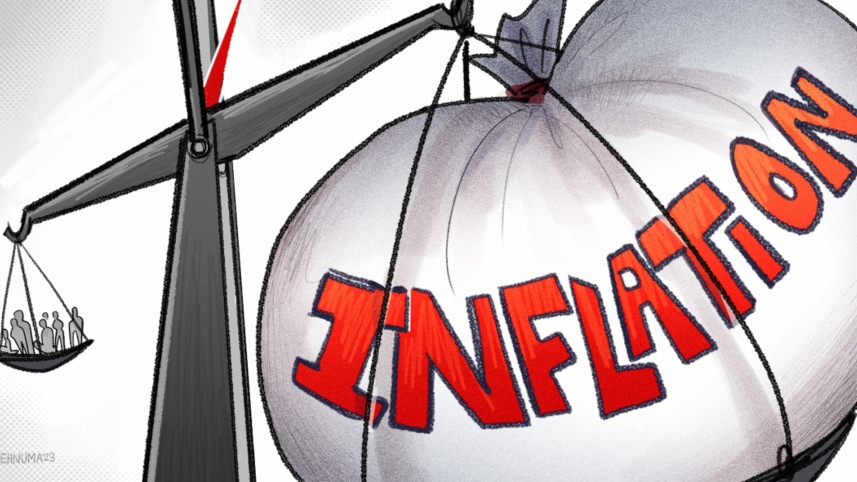
At first glance, this appears to be an easy solution. Public salaries can be paid, projects can continue, and banks can hold government securities that look safe. But creating money does not create additional rice, fuel, electricity, medicine, housing, or jobs. If the supply of goods and services does not increase along with the new purchasing power, prices rise. This is why central bank financing of government deficits is often called an inflation tax. The government avoids visible taxation, but citizens pay through the reduced purchasing power of their money.
Nominal wages may rise, but real incomes fall when food, rent, transport, and utility costs rise faster. Pensioners and people with fixed incomes are hit especially hard. Low-income families, whose savings are often held in cash or small deposits, lose purchasing power quickly and have few ways to protect themselves.
Bangladesh already has an inflationary environment. Food, housing, and transport-related costs allowed inflation to leap from 8.71 percent in March 2026 to 9.04 percent in April 2026. Bangladesh Bank has kept the policy rate at 10 percent for the second half of FY26, describing its stance as contractionary and aimed at anchoring inflation expectations. But if fiscal policy keeps injecting liquidity while monetary policy tries to restrain it, the two arms of macroeconomic management will only work against each other.
This tension has become more visible after Bangladesh Bank’s announcement of a Tk 60,000 crore stimulus package for job creation in closed industries. Of this, Tk 41,000 crore is expected to come through refinancing facilities at banks with excess liquidity, while Tk 19,000 crore will come directly from Bangladesh Bank’s own resources under a government guarantee. The objective—reviving output and employment—is rational. But in a supply-constrained economy, easier credit can expand nominal spending faster than real production. The result may be more inflation, and not enough new output. The central bank-financed portion is particularly sensitive because it expands high-powered money at a time when inflation is already elevated.
There is also a serious exchange rate risk. Bangladesh depends heavily on imports of fuel, industrial inputs, and consumer goods. When new money raises demand for imports, it also raises demand for foreign exchange. If export earnings, remittances, and reserves cannot meet that demand, the taka comes under pressure. A weaker taka, in turn, makes imports more expensive, feeding yet another round of inflation.
This risk is not theoretical. Bangladesh’s net international reserves stood at about $30.45 billion (gross reserve $35.11 billion) at the end of April 2026, far below the $48.1 billion level reached in August 2021. In early May, credit rating agency Fitch also revised Bangladesh’s outlook to negative, citing macroeconomic vulnerability, possible future funding needs, and regional risks that could raise energy prices or affect remittance flows.
For these reasons, Bangladesh has little room for expansive monetary financing. If deficit monetisation weakens the taka or fuels inflation, a self-reinforcing cycle can begin: higher prices lead to higher spending needs, larger deficits require more borrowing, and more borrowing fuels further inflation. Once expectations become unanchored, firms raise prices in advance, importers hoard dollars, and households shift savings into gold, land, or foreign currency. Restoring confidence then becomes much harder.
This does not mean every central bank liquidity operation is reckless. Modern economies need central banks to provide liquidity, especially during crises such as pandemics, wars, banking panics, or sudden financial stress. Temporary support may be justified when inflation is low, idle capacity is high, and the intervention is clearly limited. The danger begins when emergency financing becomes a permanent substitute for tax reform, disciplined spending, honest debt management, and effective banking supervision.
The policy lesson for Bangladesh is clear. The government should not treat Bangladesh Bank as a routine source of budget financing. Deficits must be addressed mainly with stronger revenue collection, review of exemptions and wasteful subsidies, better prioritisation of development spending, and credible control of recurrent expenditures. The banking sector must also be protected so that public borrowing does not squeeze productive private investment.
Bangladesh Bank’s credibility is equally important. A central bank cannot control inflation if it is repeatedly required to monetise fiscal obligations. People must be able to trust that the central bank will defend the taka’s value and that fiscal authorities will support, rather than undermine, monetary discipline.
Public debate should also be precise. Not every increase in money supply is reckless printing, and not every bond issue signals instability. But when deficits are financed by central bank-created liquidity in an economy already facing inflation, reserve pressure, and external shocks, the risks are substantial.
Money creation can help a government pay its bills today. But it cannot replace real production, responsible revenue generation, prudent spending, or institutional credibility. Bangladesh’s challenge is not simply how to finance deficits, but how to do so without imposing an inflation tax on low-income families or further weakening the taka. Printing money may delay accountability, but only reform will deliver sustainable growth.
Dr M Kabir Hassan is professor of finance and economics at the University of New Orleans in the US and recipient of the 2016 IsDB Prize in Islamic banking and finance.
Views expressed in this article are the author's own.
Follow The Daily Star Opinion on Facebook for the latest opinions, commentaries, and analyses by experts and professionals. To contribute your article or letter to The Daily Star Opinion, see our guidelines for submission.
 For all latest news, follow The Daily Star's Google News channel.
Comments