


The UPL incident shows how to ban a book without banning it

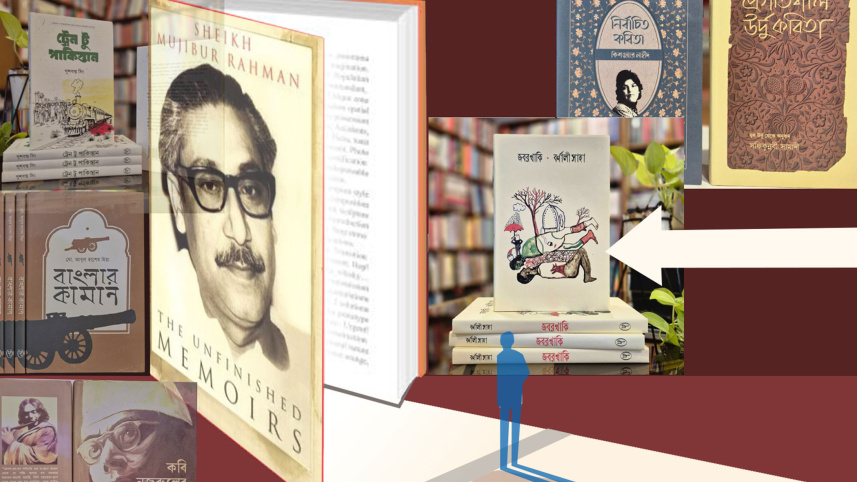
On Monday afternoon, two men posing as customers walked into the Banglabazar outlet of the University Press Limited (UPL) and asked for Sheikh Mujibur Rahman’s “Oshomapto Attojiboni”, also published in English as “The Unfinished Memoirs”. When the book was produced, however, they started to harass the salespeople, objecting to its sale and claiming it to be banned. More people gathered. The shop was locked, and two UPL employees were taken to the Faridabad outpost under Sutrapur Police Station. The officer-in-charge of the station later told Prothom Alo that the employees were released on the condition that they would not sell the book anymore. A senior DMP official told The Daily Star that the book was not banned, there was no restriction on its sale, and that such a condition, if imposed, would be “inappropriate.”
Although reportedly the book has not been reprinted since 2024, there is no question about who was right and who was at fault in this instance. It showed what happens when those without any legal authority to restrict a book nevertheless feel emboldened to prevent its sale or circulation, thereby producing the practical effects of censorship. Imagine the sequence: a book remains legal, yet its sale is prevented. A publisher has committed no offence, yet its employees end up at a police outpost. Individuals orchestrating the forcible closure of a bookshop face no immediate consequences, while the latter is asked not to sell the book again. That is where the problem begins.

Censorship is usually imagined as something formal. A government bans a book or some other publication, confiscates copies, blocks publication, or prosecutes a writer. There is a documented history of such bans in Bangladesh. Among notable examples are several books by Taslima Nasrin, including “Lajja” (1993), as well as Humayun Azad’s “Nari” (1992). Alongside formal bans, we have also often seen informal pressures or restrictions. So, “censorship” does not always arrive from the top in the form of an executive order. Powerful non-state actors can also begin policing ideas when they believe the surrounding political environment will tolerate such actions.
The UPL incident was a continuation of that trend.“The Unfinished Memoirs” was not banned. Two citizens had every right to dislike the book. They could criticise it. They could even write against Sheikh Mujib, publish another book, organise a discussion, or encourage people not to buy it. They had all these options at their disposal, but what they did not have was the authority to impose a ban of their own.
This distinction between formal censorship and informal coercion is important. Formal censorship at least announces itself. There is an identifiable authority behind the decision to restrict or ban a book and, in principle, a legal process that can be challenged. Informal censorship is harder to see because nobody necessarily says, “This book is prohibited.” Instead, the cost of keeping it available becomes high enough that people begin making safer choices. This is where fear enters the picture. I do not mean fear simply as a private emotional reaction. Sociologically, fear changes behaviour. People observe what happens to others and adjust their behaviour before the same thing can happen to them.
Imagine being a publisher in such an environment. A politically sensitive manuscript reaches your desk. You believe it can legally be published. But you also know that a group may arrive at your office, create a confrontation, and leave you dealing with the police. Do you still publish it? Perhaps you do. Perhaps you decide the manuscript is not worth the trouble.
That second decision is what we might call anticipatory compliance. Nobody has formally prohibited the book. Nobody has ordered you not to publish it. You simply adjust your behaviour because you can anticipate the possible cost. This is why the number of formally banned books does not tell us the full extent of censorship or self-censorship. Once writers, publishers, and booksellers begin calculating which subjects are safe, control starts operating before any official intervention becomes necessary.
Bangladesh has seen a similar logic in debates around laws regulating expression. The Digital Security Act (DSA) was not a law governing book publication, but the criticism surrounding it repeatedly centred on self-censorship caused by fears over its broad provisions. The connection to UPL here is not legal—it is social. When the possible cost of expression becomes unpredictable, people start moving away from the boundary themselves. This is why freedom of publication cannot be defined simply as the absence of a government ban.
Publishing is a chain. A writer must be able to write. A publisher must be able to decide to publish. A distributor must be able to circulate the book. A bookseller must be able to keep it on the shelf. And a reader must be able to choose whether to buy it. If pressure or intimidation from political or religious actors breaks one of those links, saying that a book—or the ground for publishing one—remains legal does not address the problem.
UPL’s own response is important here. The publisher said it had faced pressure under different governments over different books and had tried not to allow such pressure to determine its publishing decisions. It referred, among other examples, to controversies involving books by Moudud Ahmed and Professor Asif Nazrul. UPL’s stated position was that banning a book requires a specific process, and that it would not withdraw a published book simply because outside groups demanded it.
That is exactly the position all serious publishing institutions should take. Not because every book deserves respect. Some books are bad. Some are dishonest. Some arguments deserve to be dismantled line by line. But there is a basic difference between criticism and censorship. Criticism says: I think this book is wrong, and I will tell you why. Censorship says: you should not be allowed to encounter this book and make that judgment yourself. That brings us to a part of intellectual freedom that often receives less attention: the autonomy of the reader.
When somebody removes a lawful book from circulation, the restriction does not fall only on the writer or publisher. It also affects everyone who might have chosen to read it. Someone else has made the decision for them. That is a form of intellectual paternalism. As a reader, I do not want a political or government authority deciding which books I am capable of reading. I do not want a religious group making that decision. I do not want a police officer making it. Nor do I want a group of private citizens acquiring that power simply because they can create enough disruption. Give me the book. Let me decide whether it is history, propaganda, scholarship, political mythology, or nonsense.
That is why standing with UPL does not require agreement with a particular account of Bangladesh’s history. Today, it is “The Unfinished Memoirs”. Tomorrow, the dispute may concern a book about Ziaur Rahman, Mawdudi, Taslima Nasreen, an Islamist writer, a feminist writer, an atheist writer, or a historian. If our commitment to publication disappears when the writer or subject changes, then we are not defending intellectual freedom. We are defending our preferred politics.
The state also has a responsibility in this relationship. It does not need to approve of a book or endorse its arguments. But when the book is lawful, the state must protect the lawful activity of publishing, selling, and buying it against coercive interference of any form. Otherwise, people who have no authority to censor begin acquiring the practical power to do so. A democratic public sphere does not require us to like the same books; it requires enough freedom for us to disagree about them. The answer to a book or poem or concept we dislike should be another argument—not an empty shelf.
Asif Bin Ali is a doctoral fellow at Georgia State University in the US. He can be reached at abinali2@gsu.edu.
Views expressed in this article are the author's own.
Follow The Daily Star Opinion on Facebook for the latest opinions, commentaries, and analyses by experts and professionals. To contribute your article or letter to The Daily Star Opinion, see our guidelines for submission.
 For all latest news, follow The Daily Star's Google News channel.
Comments