


When love meets a political fault line


Love, as innocent as one can imagine, folds into new political contestation in the ongoing divisive politics dominating Bangladesh-India relations. The recent case of a Bangladeshi woman in Gujarat, who reportedly faces deportation despite having lived in India for years after marrying an Indian citizen, illustrates how marriage itself has become entangled in questions of national security and citizenship.
Thanks to globalisation, the grammar of making friends, falling in love, and starting families has transformed in recent years. Social media, international education, and digital connectivity have made cross-cultural marriages increasingly common. Couples featuring a Bangladeshi citizen with a foreign spouse have amassed large online followings, where the everyday life of the “bideshi bou” is celebrated, scrutinised, and consumed as entertainment. In neighbouring India, marriages involving foreign partners are often portrayed as symbols of cosmopolitanism and global openness, while interfaith marriage comes under increasing scrutiny in the guise of preventing what the current BJP government frames as “love jihad.”


This celebration of international romance also reveals a striking contradiction: not all cross-border relationships are valued equally. While a Western spouse is often welcomed as a marker of prestige, relationships built across the Bangladesh-India border—between two societies bound by geography, language, history, and shared cultural traditions—are increasingly viewed through the lens of suspicion. But such marriages have long been part of everyday life. Families divided by partition, migration, and shifting borders have maintained kinship ties for generations. What was once considered a natural extension of shared social worlds is now increasingly subjected to bureaucratic and political scrutiny.
This shift reflects a broader transformation. Around the world, states have become more involved in regulating intimate relationships through immigration laws, visa regimes, and citizenship policies. During the Covid pandemic, this hierarchy became particularly visible. Several European countries introduced exemptions allowing unmarried partners to reunite despite travel restrictions. Yet, many from the Global South who were part of legal marriages with someone in the Global North continued to face prolonged separation because visas remained suspended or inaccessible. Even marriage itself did not guarantee mobility. Love, it turned out, was filtered through race, passports, nationality, and geopolitical privilege.
Journalist Anna Lekas Miller captures this painful reality in her memoir Love Across Borders, recounting her struggle to build a life with her Syrian husband while navigating travel bans for Muslims, asylum procedures, and unequal passport rules. Her story demonstrates that borders not only regulate migration, but also determine which relationships are recognised, whose families are protected, and whose love is treated as legitimate.
South Asia offers perhaps an even starker illustration. Here, cross-border and interfaith marriages are frequently politicised by imposing narratives of “infiltration,” demographic anxiety, or conspiracy on them. Rather than being understood as expressions of personal choice, intimate relationships are recast as matters of national security. The expectation often extends beyond marriage itself: acceptance frequently depends on one partner eventually surrendering or subsuming their original national identity.
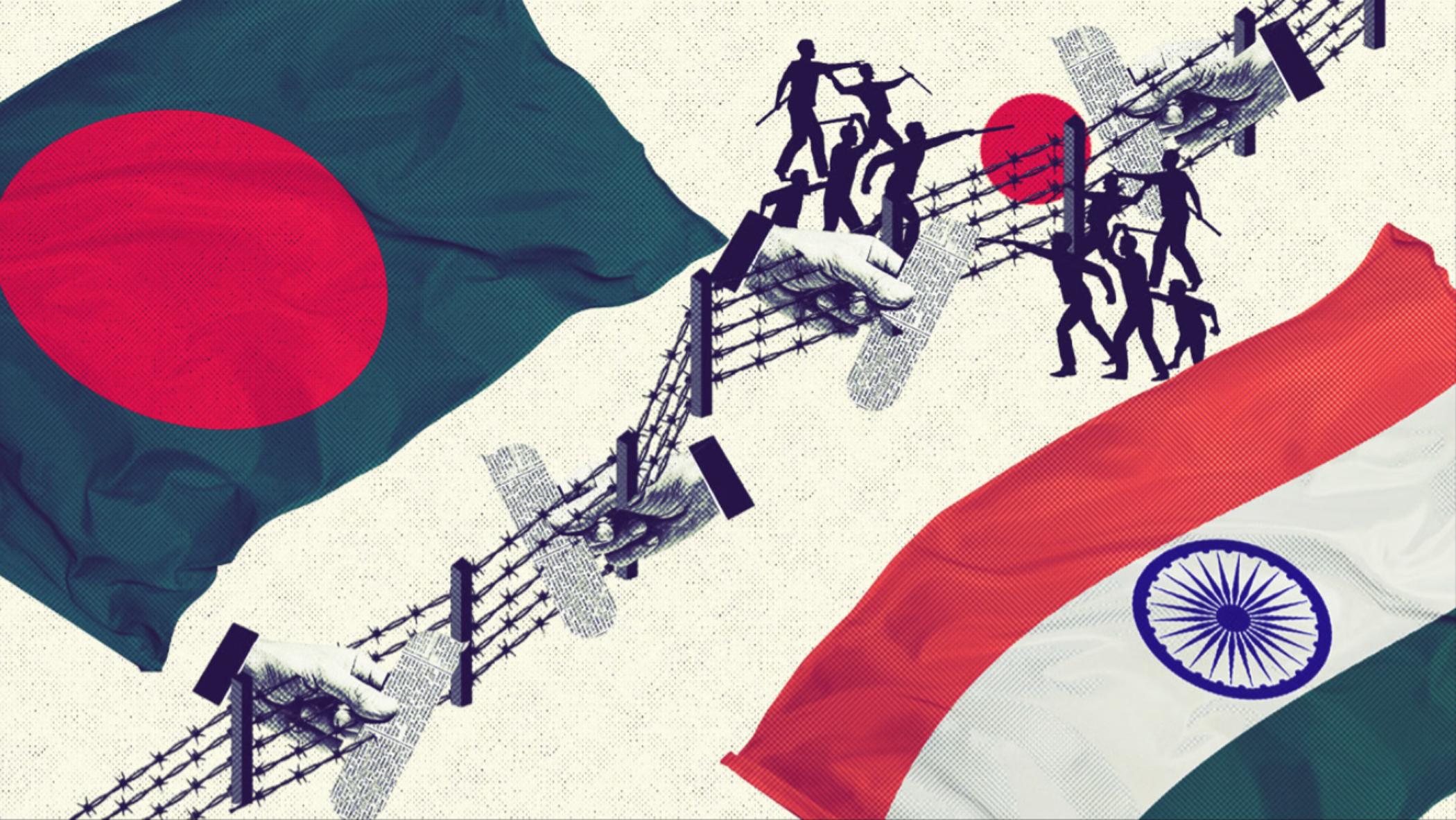
The irony is difficult to ignore. Bollywood has long produced celebrated stories of love overcoming borders—from Veer-Zaara (2004) to the recent blockbuster Main Vaapas Aaunga (2026) invoking nostalgia across divided communities between India and Pakistan. However, the everyday realities of families living across the Bangladesh-India border rarely receive the same empathetic treatment. Meanwhile, technology continues to make these relationships more likely. Friendship, romance, and marriage no longer follow the limits of geography. The question is whether governments can, or should, attempt to police these human connections.
Diplomatic tensions inevitably affect ordinary people whose lives transcend national boundaries. Cross-border families become vulnerable to changing political winds, with residency, mobility, and even marital legitimacy increasingly dependent on fluctuating bilateral relations rather than enduring human bonds.
Love has never existed entirely outside politics. But when governments increasingly determine who one may marry, where couples may live, and whether families may remain together, intimate life becomes another arena of state power. The issue is no longer simply immigration policy; it is the expanding reach of nationalism into a most personal space. Furthermore, the tragedy lies in the hierarchy that states quietly construct. Some foreign brides and grooms are celebrated as symbols of global modernity, while others are viewed as potential infiltrators simply because they come from the “wrong” side of the border. Nationality, identity, and passports have become measures not only of mobility but also of the legitimacy of love itself.
Dr Anas Ansar is assistant professor in the Department of Political Science and Sociology at North South University and senior researcher at Arnold Bergstraesser Institute, University of Freiburg, Germany.
Views expressed in this article are the author's own.
Follow The Daily Star Opinion on Facebook for the latest opinions, commentaries, and analyses by experts and professionals. To contribute your article or letter to The Daily Star Opinion, see our guidelines for submission.
 For all latest news, follow The Daily Star's Google News channel.
Comments