


Why is the drive for arsenic-safe drinking water losing momentum?


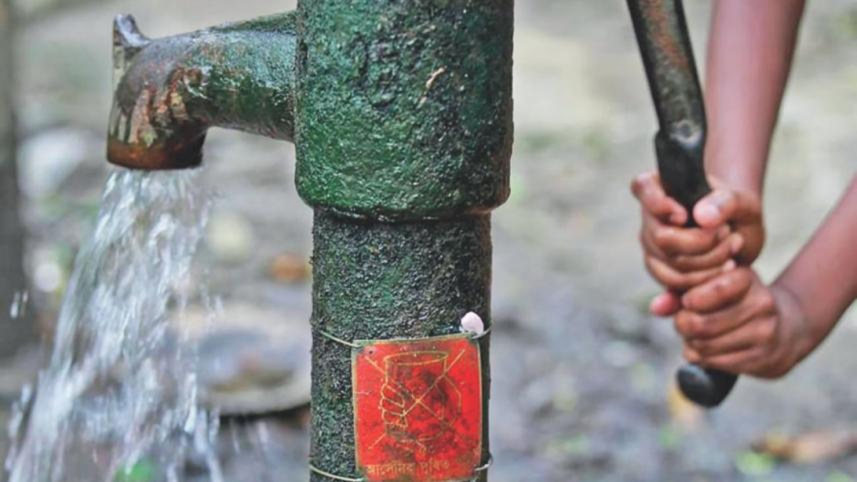
Over three decades since arsenic in groundwater was identified as a national danger, millions of people are still drinking unsafe water. Despite some success in reducing arsenic exposure and accumulated experience, Bangladesh has yet to build a permanent system that can ensure people have access to safe drinking water year after year.
The broad national picture is already well known. Early nationwide surveys estimated that around 5.7 crore people were drinking water contaminated above the World Health Organization guideline of 10 micrograms per litre, while about 3.5 crore were exposed to levels above Bangladesh’s standard of 50 micrograms per litre. By 2009, those figures had fallen to roughly 5.2 crore and 2.2 crore, respectively. That was genuine progress, driven by major efforts in testing, public awareness, and mitigation. But since then, progress appears to have slowed. Recent national comparisons suggest that around three crore people are still exposed to arsenic levels above 10 micrograms per litre, and about two crore above 50 micrograms per litre. In June 2024, the then-LGRD minister revealed in parliament that 11 percent of the population remained at risk of arsenic contamination.

In simple terms, we strived to reduce exposure but then allowed the pace to slacken. Since arsenic came to national attention in the 1990s, successive governments supported major screening campaigns, policy development, and mitigation efforts. These helped bring exposure down, but the work was never turned into a permanent national system, and that is why millions remain at risk today.
Arsenic exposure has been linked to cancers, cardiovascular disease, and skin lesions. It can also reduce crop yield in some settings and move into the food chain through irrigation. There is growing concern about links with antimicrobial resistance and child development, or lack thereof, including effects on learning and cognition. When we talk about arsenic, we are not only talking about tube wells; we are talking about health, food, education, and the future capacity of the country.
A 2025 study published in JAMA states that arsenic in drinking water may account for around five percent of adult deaths in Bangladesh, mainly through long-term diseases such as cardiovascular illness and cancer. The same study has also shown that when arsenic exposure falls, the risk of death falls markedly. This is why arsenic mitigation should not be treated as an optional environmental programme. It is a life-saving public health intervention.
So why has this progress not continued? Arsenic, unlike a flood or a cyclone, is easy to ignore. It does not arrive or leave dramatically. Its damage spreads across years. That is why we need to respond to it with the same seriousness as it applies to other long-term national risks.
Bangladesh’s natural groundwater environment is a geological reality. But that does not mean accepting unsafe drinking water. The country has learned to live with floods through systems, forecasting, infrastructure, local action, and public awareness. Arsenic needs the same kind of layered management. Groundwater can be used in many ways, but drinking water must come from safe sources.
There is also institutional failure. Bangladesh still does not have an independent water regulatory body. People pay for water, yet there is often no independent authority to hold providers accountable when water is unsafe, services fail, or complaints go nowhere. A service provider should not also be its own regulator. Rural services under the Department of Public Health Engineering (DPHE) and urban systems under WASA and related bodies need independent oversight, common standards, transparent monitoring, and real public accountability.
Then there is the value-for-money question. Large-scale screening is essential to determine the scale of the crisis. But repeated blanket campaigns are costly, and screening alone cannot keep people safe over the long term. The next phase, therefore, must be smarter and stronger.
And in this, digital support can help. A platform built around tools such as iArsenic could connect households, local volunteers, government agencies, and policymakers. Households could assess the risk of their own well. Volunteers could report when village wells are damaged, become non-functional, or are no longer used. DPHE and other agencies could then see, in near real time, where people may be returning to unsafe sources and where confirmatory testing, repairs, or safe replacement wells are most urgently needed. Technology here is not a substitute for infrastructure. It is a way to make the whole system more connected and responsive.
What Bangladesh needs now is a permanent safe water system. That means regular testing, clearly designated safe drinking wells, open but protected data, school and community awareness, regular follow-up by health and local government workers, safe well sharing where possible, and necessary infrastructure in the highest-risk areas. When awareness, monitoring, institutions, technology, and infrastructure work together, safe behaviour becomes easier to sustain. Of course, arsenic will not disappear, but continued mass exposure is not inevitable. It depends on our policy choices, and better choices are possible.
Mo Hoque is senior lecturer in hydrogeology and environmental geoscience at the University of Portsmouth, UK. He can be reached at mo.hoque@port.ac.uk
Ashraf Dewan is director of research at the School of Earth and Planetary Sciences, Curtin University, Australia. He can be reached at a.dewan@curtin.edu.au.
Views expressed in this article are the author's own.
Follow The Daily Star Opinion on Facebook for the latest opinions, commentaries, and analyses by experts and professionals. To contribute your article or letter to The Daily Star Opinion, see our guidelines for submission.
 For all latest news, follow The Daily Star's Google News channel.
Comments