


July charter implementation: Growing distance between BNP and the opposition is worrisome

After our Liberation War, we started off with the parliamentary system of government. Then Bangabandhu himself betrayed that vision and that of multiparty democracy by instituting BAKSAL, a one-party system, and introducing the presidential model of government.
After General Ziaur Rahman took over, he, thankfully, dismantled every aspect of the BAKSAL structure except the presidential system. The parliamentary system was restored during Khaleda Zia’s first tenure as prime minister. This particular episode can be termed the most illustrious example of cooperation between the ruling and opposition parties in parliament, as the demand for restoring the parliamentary system came from the then-opposition Awami League.

Both Bangabandhu, the unquestioned leader of our Liberation War, and General Ziaur Rahman, who declared independence on March 26, 1971, on behalf of Bangabandhu, inspiring Bangalees to join the war, were later assassinated by certain sections of the armed forces. Ironically, the commanders of both these groups had participated in the war of independence. Besides, the same group that killed Bangabandhu also killed the four national leaders who had led our government-in-exile—Acting President Syed Nazrul Islam, Prime Minister Tajuddin Ahmad, and senior ministers M Mansur Ali and AHM Qumruzzaman. Even Maj Gen Khaled Mosharraf, Maj Gen Abdul Manzur, Col Abu Taher, and many others who had played decisive roles during our Liberation War also met a brutal end.
Yet, we learnt nothing from these tragic and self-destructive experiences and kept on fighting each other. We seemed to be oblivious to the fact that with each such assassination, the sacred narrative of our Liberation War and the supreme sacrifices made by millions of ordinary citizens, especially the rural youth, were being belittled. This also gave a handle to those who did not believe in our Liberation War to distort the most glorious chapter of our history.
Then, in 1991, after a prolonged mass agitation, President Ershad’s autocratic government was toppled, and democracy, the parliamentary system, and elected governments were all restored. (Coincidentally, it was also when The Daily Star was born, on January 14, 1991.) We all thought then that, finally, we came back to the fundamental goal of our Liberation War: democracy. Since then, we have had regular elections in 1991, 1996, 2001, and 2008. The subsequent elections in 2014, 2018, and 2024 were doctored, eventually resulting in the ouster of Sheikh Hasina’s regime.
Bangladesh’s democratic experience from 1991 to 2008 produced several enduring strengths. Though we failed to properly institutionalise parliamentary democracy, people’s faith remained in that system. During this period, our economy moved forward, the private sector expanded, and press freedom began to see a ray of bright future. The most satisfying experience was that the transfers of power during this period were mostly peaceful. During this era of democracy, Bangladesh was able to prove that it was capable of sustained economic growth, despite failing to strengthen democracy.
Following the 2024 mass uprising and the February 12 election in 2026, we are again back on track with an elected government, elected parliament, an active opposition, the emergence of many political parties, and noticeable improvements in freedom of speech and of the media. However, it is political stability that we need most. Our economic development, foreign investment, and good governance all depend on it.
Against this backdrop, Jamaat-e-Islami chief Dr Shafiqur Rahman recently said that his party would resort to street agitation to bring the government down if the July National Charter is not implemented. We find such threats worrisome. Such rhetoric is deeply harmful to the future of democracy and, more importantly, to the future of the country.
While we criticise Jamaat for its bellicose tone, we also need to examine what BNP is doing in terms of implementing the July National Charter, which cannot, and must not, be ignored as it is the product of “public will”. During the long process of deliberation overseen by the National Consensus Commission, co-chaired by Ali Riaz of the interim government, about 30 political parties participated. Many of them were not widely known. But still, it was a positive process that brought most parties, with the notable exceptions of Awami League and Jatiya Party, to dialogue.
After months of discussion, the July charter was formulated and 26 parties signed it. On November 13, 2025, President Shahabuddin issued a July National Charter (Constitutional Reform) Implementation Order. This provided the legal framework to implement the charter and to hold a referendum on reform proposals that require constitutional changes. When the work of the consensus commission was completed, it delivered a document with 84 proposals, of which 48 needed constitutional changes. The rest could be put into effect by executive orders and amending laws. Of the 48 items that require changes to the Constitution of Bangladesh, BNP expressed its dissent on only nine.
So, the process can, by and large, be considered quite successful, as never before have we seen such convergence of views among so many political parties, marking a major achievement in a political culture where divisiveness has been a running thread.
To bring about constitutional changes, a referendum was held on the same day as the general elections on February 12. However, it also meant imposing an instrument on voters whose knowledge about the issues in question was superficial. Usually, referendums are held on specific, simple, and easily understandable topics that a voter can accept or reject. But this one had four separate questions that touched on all 48 constitution-related issues. Clustering so many constitutional amendments into one “yes or no” vote and not adequately educating the voters about their meaning and implications was a wrong move. Most voters did not know the full extent of what they were voting on.
The referendum also proposed that the elected parliament act not only as a legislature but also as a “Constitution Reform Commission” for a specific period. This was where the unity broke. BNP never accepted this formula and suggested that the relevant reforms could all be accommodated through a process of adopting amendments. This is a more formal and widely practised method, not only here but also globally.
But as of now, BNP’s handling of the July National Charter and the process of its implementation has started to raise some serious questions. BNP’s explanation for dragging its feet on issues that have been agreed upon by consensus is causing some concern. They claim that these issues need to be studied more thoroughly before amending the constitution. While this argument has some merit, the way the whole reform process, proposed by the July Charter, is being handled is perhaps not the best way to move forward.
Our constitution envisioned a system of checks and balances by distributing power among the executive, judiciary, and legislative branches. The idea was to prevent the concentration of all power in the hands of the executive branch, especially that of the prime minister. But over the years, the system of checks and balances was ignored and, in its place, came what some political scientists called an “elected dictatorship.” This, unfortunately, is what we experienced for a long time.
We need to ask why our parliamentary system did not succeed as it did in many other countries. The answer lies in the fact that our politics has always been leader-centric. Our governance process has always experienced the highest concentration of power in the hands of the prime minister. With the total lack of inner-party democracy, a central leader’s role has always been beyond scrutiny and accountability, and when such a party wins an electoral majority, all the power already concentrated in one individual gets combined with the executive power of the government when that leader becomes prime minister.
This then leads to the politicisation of many state institutions that often become extensions of the ruling party. Take, for example, the police. They were always used to suppress the opposition. The same is true for the bureaucracy, whose political loyalty, rather than efficiency and integrity, was mostly considered the main criterion for promotions and benefits. Turning these two vital institutions into extensions of the ruling party of the day did more harm to the country than many other factors put together.
Another important reason that often crippled our parliament over the decades is the highly confrontational relationship between the opposition and the ruling party. From 1991 to the present, we have never allowed the opposition to play its due role within parliament. Contrarily, the opposition also always thinks that it is its sacred duty to oppose the ruling party even when its policies are beneficial to the country.
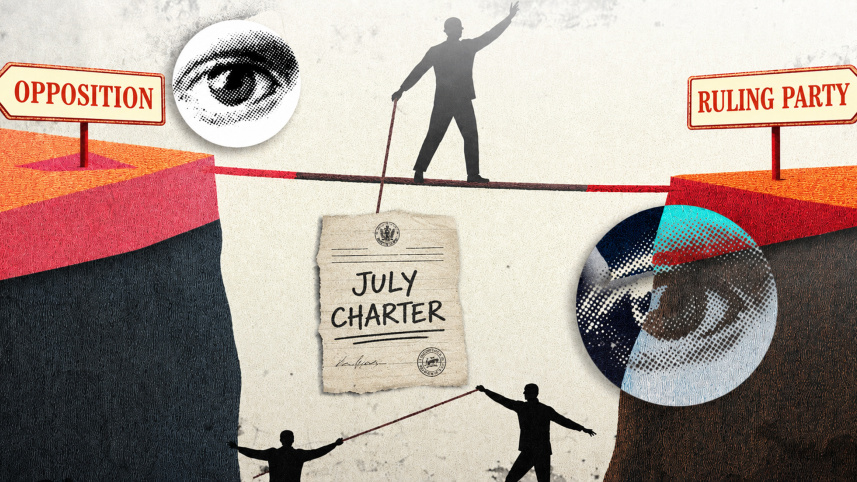
At present, the future of constitutional changes seems to be stuck between two words: “amendment” or “reform.” BNP is offering dialogue on “amending” the constitution, whereas the opposition led by Jamaat is asking for “reforms” of the constitution. The real reason behind Jamaat’s intransigence is that it wants to rewrite the Constitution, which will most likely throw us into a chaotic and insoluble crisis. But doesn’t amending the constitution also amount to reforming it?
On April 29, BNP proposed the formation of a special parliamentary committee to amend the constitution. The proposed committee was to consist of 17 members, seven from BNP, five from other parties, and the remaining five seats were offered to the opposition, which Jamaat sought time to decide. On June 16, Jamaat chief declared in a press conference that they would not join. On July 13, the ruling party passed a resolution forming the special committee to amend the constitution in line with the July National Charter.
 For all latest news, follow The Daily Star's Google News channel.
 We think Jamaat should reconsider its stance and join the process of amending the constitution. Its presence will give it a chance to play a more effective role than being outside it. If the working of the special parliamentary committee for amending the constitution does not live up to Jamaat’s expectations, then it can always oppose and withdraw and then present its reasons for withdrawal to the citizens. The opposition’s decision not to join the committee, without even observing how it works, seems to be an attempt to impose Jamaat’s own will over that of others.
The time has come for a new collaborative approach between the ruling party and the opposition. Otherwise, the crisis may again lead to uncertainty and instability, which would negatively impact our country’s growth and prosperity.
Mahfuz Anam is editor and publisher of The Daily Star.
Views expressed in this article are the author's own.
Follow The Daily Star Opinion on Facebook for the latest opinions, commentaries, and analyses by experts and professionals. To contribute your article or letter to The Daily Star Opinion, see our guidelines for submission.
Comments