Can Dhaka’s Pink Bus break a four-decade pattern?

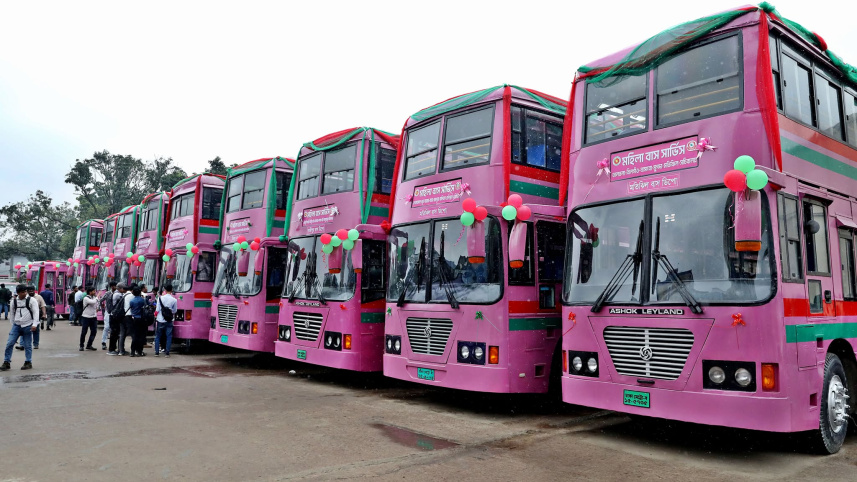
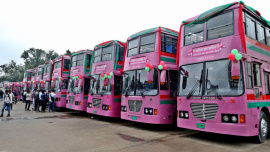
On 18 August 2026, the Bangladesh Road Transport Corporation (BRTC) rolled out 14 women-only “Pink Buses” from its Tejgaon depot. Ten will run in and around Dhaka, two on the Dhaka–Bogura route, and two between Dhaka and Chattogram. The buses are painted pink, driven and conducted by women in pink uniforms, and were launched as proof that the government keeps its promises to women. On the first day, one of them was hit by a Balaka bus in city traffic.
The intention behind the service is hard to argue with. Women in Dhaka face real danger and real indignity on public transport, and a bus where they are not crowded, groped or stared at is a genuinely appealing idea. The trouble is that Dhaka has had this idea before and has watched it fail more than once. The women-only bus is not new here. It is one of the most repeated experiments in the city’s transport history. Before the eighth version is celebrated, it is worth asking honestly why the earlier ones did not last and whether anything about this attempt is different.
A familiar experiment
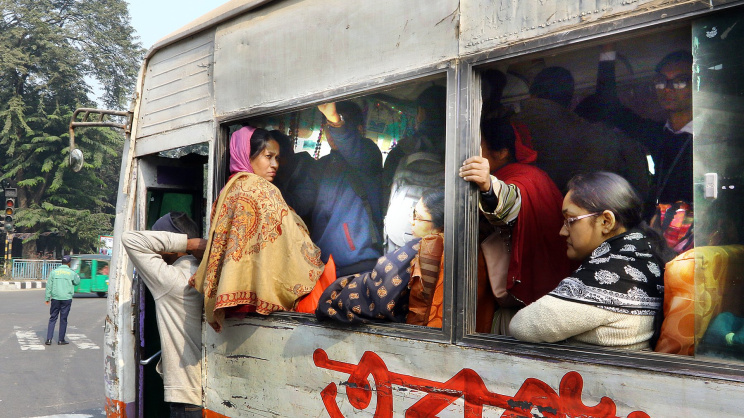
BRTC first put “women-only” buses on four peak-hour Dhaka routes in the early 1980s. The service stopped within days. It returned in July 2008 with five buses on a single route, and the corporation recorded it as a loss almost immediately. A planned expansion to 30 buses from January 2009 never happened, with the failure blamed on a shortage of buses and money. By 2010, BRTC had allocated roughly 22 women’s buses; by 2022, only four were left, and the rest sat idle in depots. A Kalyanpur depot manager described six of them as having been abandoned for five years and, in his words, “useless” (The Business Standard, 2022). When the pandemic hit in March 2020, BRTC suspended its women-only bus service, which never fully resumed. (The Daily Star, 2022).
The 2014 version had 17 buses on 13 routes and ran only during the morning and evening peaks. Even then, the structural flaw was visible: on most routes, a single bus made two trips, one in the morning and one in the afternoon, and spent the rest of the day in ordinary city service. Passengers complained that the buses came late and that men rode them anyway. The private sector tried too. In June 2018, Rangs Group launched “Dolonchapa”, air-conditioned women’s buses fitted with CCTV, first-aid kits and a tracking app. The minister who inaugurated it promised 60 buses in phases. It started with two. By 2022, it had shrunk to a handful of trips on one route and was written off as unprofitable (The Business Standard, 2022).
That amounts to at least five separate launches over four decades, all of which ultimately failed for the same three reasons: too few buses, services limited to peak hours, and financial losses that operators were unwilling to sustain.
The 2026 Pink Bus, with 14 buses for a metropolitan region of more than 20 million people, does not obviously escape any of them.
Why the arithmetic is so difficult
Dhaka runs roughly 7,500 buses across nearly 100 routes, operated by more than a hundred companies, and even that fleet falls short of what the city needs. In a system already struggling with an inadequate supply of buses, creating a separate women-only fleet does not increase overall capacity. It divides what already exists. The operating economics are unforgiving, and BRTC’s own finance officials have described them plainly: a 54-seat bus reserved for women sits mostly empty outside the two peak hours, and the fare it collects does not cover the fuel, let alone the full running cost.
When Dolonchapa’s operators studied their own passengers, they found that only about a quarter were regular working women; much of the rest comprised half-fare students, and demand was concentrated within narrow time windows (The Business Standard, 2022). A service that earns money for two hours and runs nearly empty for the other ten is not a service a company will fight to keep. It is the first thing it quietly withdraws, which is precisely the pattern the last four decades record.
Every time the commuter pool is sliced into a smaller dedicated category, the buses serving that category run less often and cost more to operate for each passenger they carry.
This is the segmentation trap and the heart of the problem. Every time the commuter pool is sliced into a smaller dedicated category, the buses serving that category run less often and cost more to operate for each passenger they carry. A woman who could have caught one of many general buses must now wait for one of the few pink ones. On the 2014 routes, this meant having just one bus available, making only two trips a day.
The city’s own survey data shows why this could be counterproductive, revealing an advantage that the general bus network already offers women but that a separate pink fleet could take away. In the survey of women passengers, about 52 percent said they waited under five minutes for their bus, and another 39 percent waited between five and ten minutes. Roughly nine in ten boarded within ten minutes (Dhaka Transport Coordination Authority, 2025). That short wait is a direct result of high frequency: many buses arriving at short intervals. A women-only fleet of fourteen reverses this advantage. The moment a rider has to wait specifically for a pink bus, rather than take the next available bus, her waiting time could stretch from a few minutes to more than half an hour, as already seen on Dhaka routes where buses run less frequently.
A woman needs to reach her office at the same hour as a man does. A service built to help her would, in practice, make her slower, and a bus that comes after thirty minutes is not a safety measure. It is a reason to give up and climb onto whatever arrives first, which is what women already do.
A woman needs to reach her office at the same hour as a man does. A service built to help her would, in practice, make her slower, and a bus that comes after thirty minutes is not a safety measure. It is a reason to give up and climb onto whatever arrives first, which is what women already do.
There is a second cost, borne by the buses that remain. General buses are required by a 2008 rule to reserve nine seats for women, children, the elderly and the disabled. Enforcement is close to non-existent, and those seats are a daily source of friction. Move the “women’s service” onto a separate pink fleet, and it becomes easier to treat the ordinary bus as a male space and to argue that the nine seats are now somebody else’s concern. Segregation on a few routes can quietly license exclusion on all the rest.
What the women themselves said
No feasibility study or demand survey was published before the Pink Bus initiative was launched. But there is already substantial evidence of what women want from public transport. Detailed travel-behaviour surveys conducted by the Dhaka Transport Coordination Authority (DTCA) under its Bus Route Rationalisation Project offer perhaps the clearest picture.
The passenger survey reached 10,123 bus riders across the city, of whom 1,309, or about 13 percent, were women. A separate office-commuter survey covered 962 working women (Dhaka Transport Coordination Authority, 2025). Their average age was about 30. Around 40 percent were students and a third were homemakers, while roughly a quarter were in paid work; about one in five was travelling to a job at the time of the interview. What almost all of them shared was dependence: 96 percent owned no private vehicle. They have few alternatives to public transport, which is precisely why the quality of the regular service matters so much, and why a limited alternative operating on only a handful of routes can do little for the vast majority of women who cannot access it.
Women rated each aspect of their bus service on a scale from 1 to 5, where 1 means “very dissatisfied”, 3 is neutral, and 5 means “very satisfied”. Higher is better. On that scale, women’s overall satisfaction averaged just 2.35, which sits below neutral, between “somewhat dissatisfied” and the midpoint, and closer to the unhappy end. About two in three women, 65 percent, rated the service in the bottom two categories, dissatisfied or very dissatisfied. Their assessment of safety was almost identical, averaging 2.32, with 63 percent placing it in those same bottom two categories. Comfort, reliability, staff behaviour and the condition of bus stops all landed in the same narrow band, between 2.2 and 2.5 out of 5. In roughly seven out of every ten companies surveyed, women’s average rating fell below 2.5. The picture is not of a service that works well for most women and fails a few; it is of a service that most women find inadequate across nearly every dimension. That is not a problem a fleet of fourteen buses on ten routes can solve.
What women rated as important is just as revealing. Asked to weigh what a bus service should prioritise, on the same 1-to-5 scale where a higher score means greater importance, they placed travel time first, at 4.23, then safety at 4.15 and comfort at 4.12, with priority lanes, payment systems and reliability close behind. Notice what tops that list. Women ranked frequent services and shorter travel times even above safety. That is frequency and reliability, and it is exactly what a 14-bus segregated fleet cannot deliver but a dense, well-run general network can.
The right problem, the wrong tool
The findings on fares require careful reading. Women in Dhaka appear to be looking not simply for cheaper transport, but for better service at a price they can afford. About 92 percent said they were satisfied with existing fare levels. When asked what they would be willing to pay for a genuinely improved service, roughly 44 percent said they would pay the same as they do now, while about 47 percent were willing to pay more, largely if the additional cost brought greater comfort. Only around 9 percent considered existing fares too high and wanted them reduced. Taken together, the findings suggest that women are price-sensitive but willing to pay a modest premium for meaningful improvements in service.
The office survey shows the limits of that willingness. Among working women who said they would use a premium, secure service, 64 percent were willing to spend less than Tk 2,000 a month, while only about 3 percent would spend more than Tk 4,000. This poses a fundamental challenge for a separate, dedicated service: its higher operating costs would have to be recovered from passengers whose own responses show that they have limited capacity to pay more. Previous women-only bus services have faced much the same financial challenge.
The office survey reinforces this point. About three-quarters of the working women surveyed—76 percent—commuted by shared or public transport, including city buses, minibuses, leguna and the metro. Only about one in nine travelled to work by private car, ride-sharing service or motorcycle. When asked whether they would use a hypothetical premium service equipped with CCTV, GPS and fingerprint entry, about 70 percent said yes. There is clearly demand for a safer and more reliable service, but the figures also show that most women cannot afford to pay substantially more for it.
None of this diminishes the seriousness of the safety problems women face on Dhaka’s public transport. Study after study, including research by BRAC, ActionAid, the UN Development Programme, BRAC University’s public health school and the Aachol Foundation, has found that between 63 and 94 percent of women experience harassment on public transport (BRAC, 2018; ActionAid Bangladesh, 2015; United Nations Development Programme et al., 2022; Bari et al., 2025; Aachol Foundation, 2022).
The DTCA data paints a similarly troubling picture, with women’s rating of safety barely above “very dissatisfied” (Dhaka Transport Coordination Authority, 2025). The problem is severe and well-documented. The question is whether a small fleet of Pink Buses can address a problem of this scale, particularly when Dhaka has repeatedly experimented with women-only services without managing to sustain them.
There is genuine value in having women behind the wheel and working as conductors. The visibility matters, as do the employment opportunities, and this aspect of the initiative deserves to be retained and expanded. But addressing an unsafe, unreliable and overcrowded transport system ultimately requires improving the wider network rather than relying on a small parallel service available to only a fraction of passengers on a limited number of routes.
Improving the entire system may be harder and less visible than introducing a fleet of brightly painted buses, but the evidence from Dhaka’s own surveys suggests that it would reach far more women.
That means completing the route rationalisation process the city has pursued since 2004, increasing the number of buses to reduce waiting times, enforcing the reserved seats already required by law, and introducing cameras, better lighting and other safety measures across the general fleet, where the overwhelming majority of women will continue to travel. Improving the entire system may be harder and less visible than introducing a fleet of brightly painted buses, but the evidence from Dhaka’s own surveys suggests that it would reach far more women.
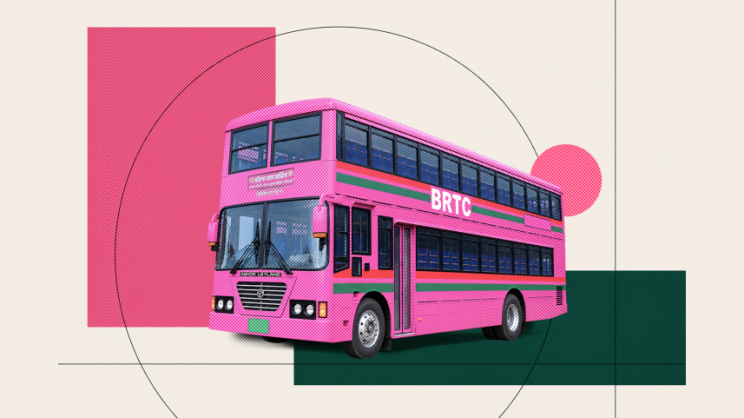
The 14 Pink Buses are now on the road. Whether they last will depend on whether the city can overcome the problems that undermined earlier attempts: too few buses, too few routes, inadequate frequency and an operating model that could not be sustained financially. History provides little reason for complacency. More importantly, women passengers themselves have already provided considerable evidence of what they need from public transport. The challenge now is to build a system around those needs.
A note on the data: Passenger figures are based on the authors’ descriptive analysis of the Dhaka Transport Coordination Authority (DTCA) Bus Route Rationalisation Project surveys—a User Satisfaction Survey of 1,309 women bus passengers and an Office Commuter Survey of 962 working women.
Farah Mahboob is deputy manager at the Social Innovation Lab, BRAC Bangladesh, and Dhrubo Alam is deputy transport planner at the Dhaka Transport Coordination Authority.
Send your articles for Slow Reads to slowreads@thedailystar.net. Check out our submission guidelines for details.

Is Bangladesh’s garment industry ready for the next shock?
Can pink buses make travels safer for women?

Chained majesties: The plight of captive elephants in Bangladesh

Why Bangladesh needs mandatory warning labels on packaged foods

Is Bangladesh going the wrong way on AI?
Bangladesh and the question of indigenous peoples

The invisible crisis: Why Bangladesh must wake up to its data vulnerability
Bangladesh is getting dangerously hotter. Are we ready?