Buried by development: The human cost of river dredging in Dumuria
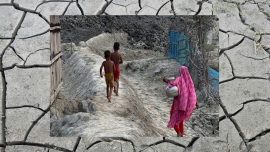
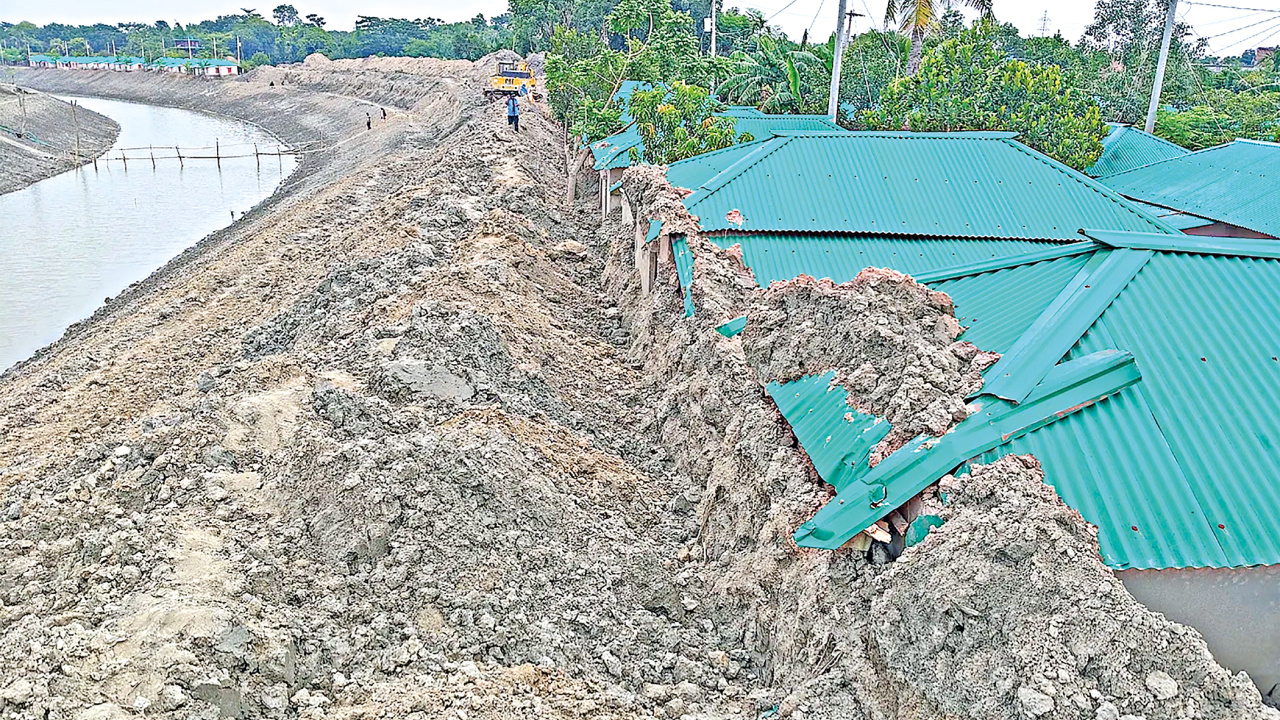
In the heart of Baratia village in Dumuria, a young boy named Dipu lives hemmed in by towering mounds of wet, suffocating riverbed clay. Born into a landless family, Dipu and his parents believed they had finally found a permanent home when the government allocated them a brick house under the flagship Ashrayan-2 housing project. That hope has since been buried beneath a massive state-led river dredging project, which has dumped tonnes of wet silt directly against their home, engulfing their kitchen, blocking their toilets, and leaving deep structural cracks in the brick walls. Their ordeal is emblematic of the experiences of hundreds of riverbank residents across rural Khulna who have been displaced or pushed to the brink by development projects that have advanced with little regard for the people living in their path.
Breaking the livelihood foundations of the displaced
Physical and economic displacement remains the most devastating and immediate challenge for the riverbank communities of Dumuria. In a rural ecosystem where the poor rely on small informal trades and home-based agriculture, the mechanical violence of uncoordinated dredging shatters entire livelihoods overnight. Field observations reveal that fewer than 10% of the displaced families have managed to maintain a steady cash flow after the excavators arrived, leaving hundreds completely destitute.
Dipu’s family mirrors this grim reality. The encroaching silt has entirely wiped out their small homestead plot. Elsewhere in the region, informal businesses such as Sumon’s riverfront grocery shop in Sannyasgacha were flattened by excavators without prior warning. Standing empty-handed on the banks of the river, Sumon stated:
“The house is gone, and the authorities have also buried my shop under the mud, which was my last source of income. I used to provide food for seven mouths with this shop. Now I have no other work but to stand on the riverbank and measure the mud. I see no other way for my family but to die without food.”
The collapse of living infrastructure
The failure to integrate social safeguards into large-scale engineering designs deepens the exclusion of marginalised communities. Uncoordinated dumping, vertical riverbank cutting, and the absence of protective barriers transform safe government housing into structural traps.
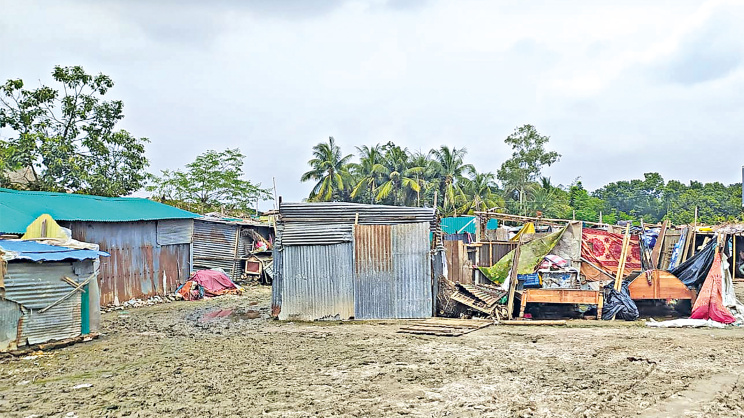
In Chuknagar, the devastation is absolute: 143 out of 145 government-allotted semi-pucca houses were completely dismantled or buried under the weight of riverbed sludge nearly five months ago. The resulting displacement forced more than 1,000 people to set up an informal camp on the bare concrete grounds of the local weekly cattle market. Incorporating rigorous Social Impact Assessments (SIAs) and maintaining scientifically designed dredging slopes could completely prevent this structural violence and infrastructure-induced homelessness.
Structural blindness and failed safety nets
Institutional protection programmes, including emergency relief and basic sanitation support, are meant to serve as vital lifelines for communities affected by development-induced displacement. Yet in Dumuria, the vast majority of displaced families have been left without even the most basic institutional assistance, forced to survive out of sight and out of mind.
In the camp at the Chuknagar cattle market, displaced resident Hajera reported:
“When they came to cut the river, they just pressed and crushed everything down. We couldn’t save our house. We only managed to remove the tin sheets from the roof. Now we are living in the cattle market field, and the leaseholders are telling us to leave.”
The most acute crisis, however, is the collapse of basic water and sanitation services. Because the tube wells and community latrines were swallowed by thirty feet of sludge, access to clean water has become virtually non-existent. Rizia Begum described the dire conditions in the camp:
“The river dredgers completely destroyed our houses. Five to six months have passed since this incident. We are now staying in the cattle market field. We have no house and no toilet. If it rains even a little, the field floods. We are left stranded in the water. There were a few tube wells here, but not a single one remains. Everything is buried under the mud.”
Healthcare and basic safety have completely broken down. In Baratia, where 24 houses have been severely compromised, the risk of physical injury has become a constant reality. Just days ago, a three-year-old child was buried alive by a sudden slide from an adjacent silt heap and was saved only because frantic neighbours clawed through the wet clay with their bare hands. For families living beside these unstable mounds, the danger is no longer hypothetical but immediate. Tapoti Das, a resident of House No. 54, pointed to the systemic negligence:
“Three or four days ago, mud was dumped on top of our house. Our toilet is blocked. No one can use it. Due to the pressure of the mud, the doors and windows of the house cannot be opened. The roof is broken. They are repairing the room now, but no arrangement has been made for the bathroom.”
Commercial exploitation and inescapable debt
Pervasive corruption and local commercial collusion remain deep and unaddressed barriers to justice for the displaced. Local subcontractors frequently prioritise corporate convenience over human safety, allowing private interests to dictate how public development projects unfold.
In Dumuria, traditional power dynamics and profit-driven motives exacerbate the displacement crisis. Excavated river silt is frequently treated as a commercial commodity rather than an environmental hazard and is often sold directly to local brick-kiln owners. To minimise costs and maximise profits, these private buyers allow massive mounds of heavy earth to remain on the doorsteps of the poor for months.
When the heavy rains arrive, these piles liquefy into moving slurry, destroying roofs, jamming doors, and trapping families inside structurally compromised homes.
This physical destruction soon turns into financial bondage. Shukli Bibi described the painful loss of home-based self-sufficiency and the resulting dependence:
“I had planted vegetables in front of the house I received in Chuknagar. There is no space there anymore. They destroyed my house. There is no sign of it left. I have come to my son-in-law’s house in Kaṭhaltala, and my staying here is causing hardship for my daughter’s family.”
To survive the squalor of the cattle market camp, purchase drinking water, or repair buckled tin roofs, vulnerable women are often forced to take high-interest loans from microcredit organisations or turn to dadon (exploitative cash advances) from local middlemen. Every month spent living in the mud translates into months of future financial strain, trapping families in an exhausting cycle of indebtedness.
Achieving the Sustainable Development Goals requires a collective institutional commitment to ensuring that national progress does not become a local disaster. True development is not merely an engineering obligation but a pathway to safeguarding the rights, dignity, and shelter of the poorest. That vision must reshape Bangladesh’s infrastructure policies for generations to come.
Md. Al-Mamun is a Research Associate at the BRAC Institute of Governance and Development (BIGD), BRAC University. He can be reached at md.mamun@bracu.ac.bd
Send your articles for Slow Reads to slowreads@thedailystar.net. Check out our submission guidelines for details.
The lead crisis we cannot see
Who recycles Bangladesh’s garment waste?
Bangladesh running out of options on Rohingya crisis: Is there a way out?
Construction of the Sugandha-Kalatoli beach road / A grave threat to Cox’s Bazar’s sand dunes

Why have Nihar Koli and Samrat been sent back to their alleged abusers?
The reality of vocational training for Bangladeshi women
Can we save young Bangladeshis from deadly Mediterranean crossings?

Breastfeeding in Bangladesh: What is holding mothers back?
Fidel Castro at 100 / Why Fidel Castro’s legacy still haunts Washington