


Roman Vega: The surprise inclusion in Argentina’s post-World Cup squad
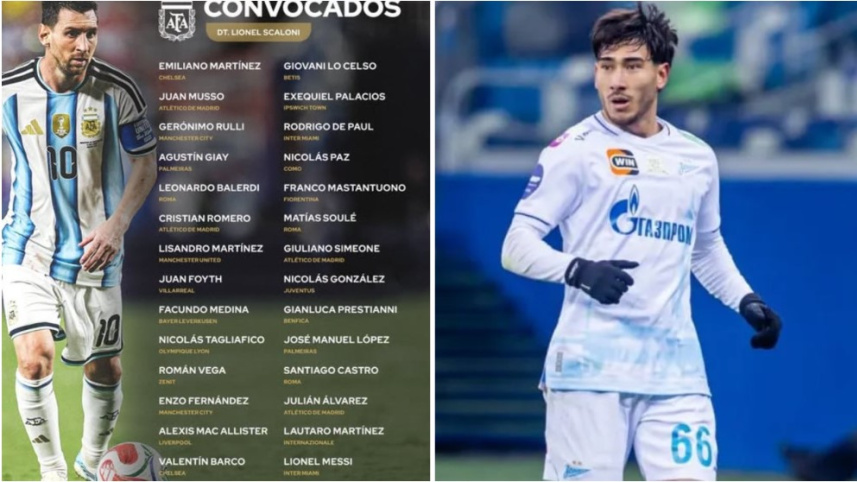
The defeat to Spain in the 2026 World Cup final marked the end of one chapter for Argentina. But as Lionel Scaloni announced his squad for the national team's first three friendlies since that painful night, it became clear that the next chapter would look different.
There was continuity, certainly. But there were also absences, suspensions, returning faces and, most intriguingly, a collection of young players knocking loudly on the door.

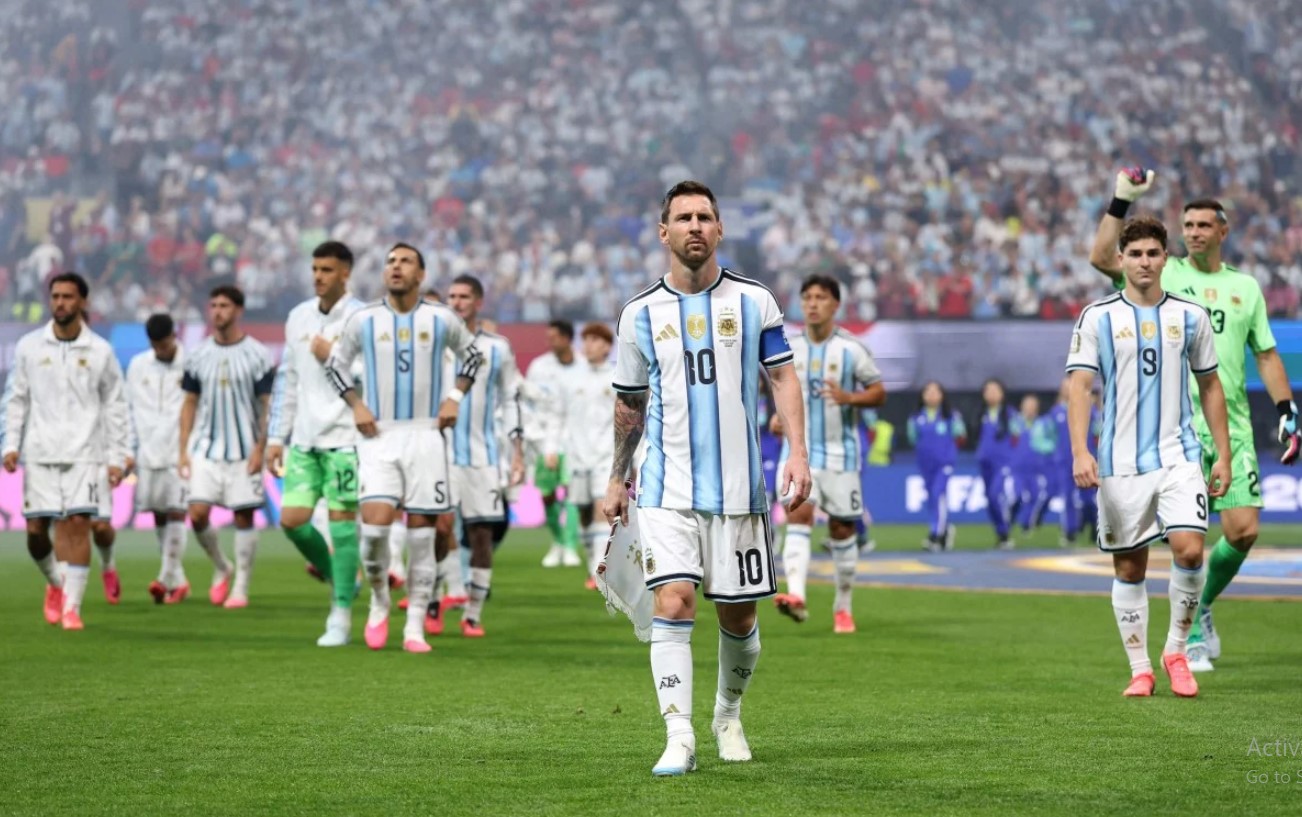
Argentina will begin this new cycle against Bolivia in Córdoba on September 30, followed by Burkina Faso in Buenos Aires on October 3. The third fixture, against Benin at the Monumental on October 6, will be unlike the first two: it is set to become Lionel Messi's farewell to the Albiceleste.
For Scaloni, however, the three matches represent something more than a farewell tour. They are an opportunity to test the depth of a squad that has been forced into change.
A familiar goalkeeping department
The most stable area of the squad is the goalkeeping position.
Scaloni has retained the same goalkeepers who were part of the World Cup squad, providing continuity in a position where Argentina has enjoyed considerable stability in recent years.
The changes begin in front of them.
A defence undergoing reconstruction
The right-back position is one of the clearest examples of Argentina's changing squad.
With Nahuel Molina suspended and domestic-based players still expected to be added later, Scaloni has turned to two different profiles: Agustin Giay of Palmeiras and Juan Foyth of Villarreal.
Giay represents the future.
The former San Lorenzo academy player had already been close to breaking into the World Cup squad after being included in Argentina's pre-tournament preparations. His development has now earned him another opportunity at senior level.
Foyth, meanwhile, represents experience and unfinished business.
The former Estudiantes defender and 2022 World Cup champion returns after the serious injury that ruled him out of the 2026 tournament. His comeback is particularly notable given that he suffered another physical setback only four days before the latest squad announcement.
That makes his inclusion both a sign of Scaloni's faith and a reminder of the uncertainty surrounding the position.
And then there is Molina, whose absence is not tactical at all. His seven-match suspension means Argentina must find alternatives while one of its established starters serves his punishment.
The result is a right-back group that combines youth, experience and necessity.
Roman Vega: the surprise nobody expected
 For all latest news, follow The Daily Star's Google News channel.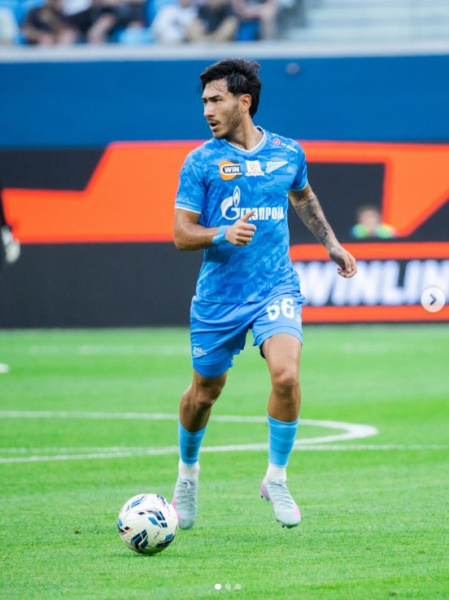
If Giay's inclusion represents a continuation of his rise, Roman Vega's call-up is the squad's biggest surprise.
The left-back receives his first senior Argentina call-up after a career that has taken him from Argentinos Juniors to Barcelona B and, in 2025, to Zenit.
The Russian club reportedly paid nine million dollars for 90 percent of his rights, with Argentinos receiving 6.5 million dollars net from the deal.
Yet Vega is not a completely unknown figure to the Argentine setup.
He already wore the national shirt at youth level, featuring at the Under-20 World Cup alongside players such as Valentín Barco and Giay. His senior call-up therefore feels less like an isolated gamble and more like another step in a pathway Scaloni has been monitoring for some time.
His arrival also adds an intriguing dimension to the left side of Argentina's defence.
The World Cup squad contained established options. Vega's inclusion suggests that Scaloni is looking beyond the players who carried Argentina through the previous cycle and beginning to build the next generation of depth.
The young attackers are knocking
The biggest changes, however, come further forward.
Four Under-23 players who have previously been involved with the senior team return to the picture: Franco Mastantuono, Gianluca Prestianni, Matias Soule and Santiago Castro.
Their presence gives Scaloni a group of young attacking players with very different characteristics.
Mastantuono is perhaps the most intriguing case.
The former River Plate talent wore Argentina's number 10 during the World Cup qualifiers, but his limited playing time at Real Madrid affected his place in Scaloni's plans. He ultimately missed the World Cup squad.
Now, with a new opportunity in front of him, Mastantuono has a chance to remind the coaching staff why he was once considered one of the country's most exciting attacking prospects.
Prestianni's story is different.
He made his Argentina debut against Angola in 2025 but was subsequently ruled out of consideration after a suspension stemming from his controversial Champions League clash with Vinicius.
His current form at Benfica, however, has brought him back into the conversation.
Then there are two players from Roma who could potentially make their senior debuts: Matías Soulé and Santiago Castro.
Soulé, the Mar del Plata-born attacker who previously came through Juventus, has already been close to the action. He was on the bench against Chile during the World Cup qualifiers.
Castro has had a similar experience. The former Vélez youth product was also previously named among the substitutes, coming on as an option during Argentina's victory over Uruguay in Montevideo.
Neither has yet established himself as a senior international.
These friendlies could change that.
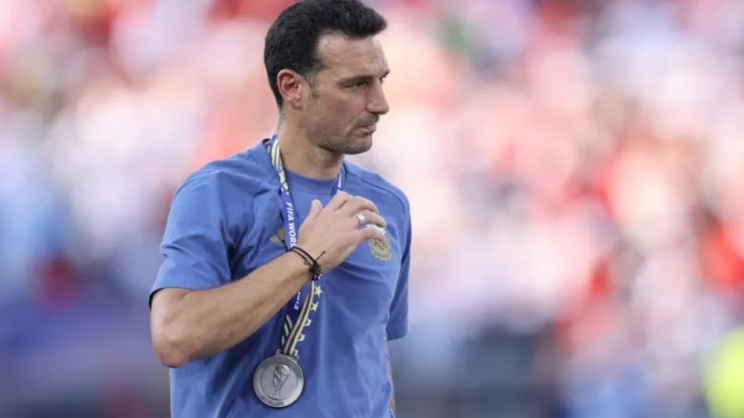
A midfield without some of its usual leaders
The midfield is where Argentina's disciplinary problems have created perhaps the biggest short-term disruption.
Leandro Paredes has received a ten-match suspension following the incidents after the World Cup final, while Enzo Fernández was also sent off shortly before the end of regulation time.
Paredes' absence is particularly significant.
His experience and understanding of Argentina's midfield structure have made him an important figure during Scaloni's tenure. Ten matches is a considerable period, meaning these friendlies are not simply opportunities to experiment — they are part of the process of getting him closer to a return.
Thiago Almada, meanwhile, received a one-match suspension for his involvement in the initial confrontation.
Because these are Class A international friendlies, the matches count toward the disciplinary bans. That gives Argentina a practical incentive to use the fixtures to reduce the number of games remaining on the suspensions.
For Scaloni, it also creates an unusual squad-building problem: he must develop alternatives while simultaneously preparing for the eventual return of players who remain part of his plans.
The squad tells two stories
That is what makes this Argentina squad particularly interesting.
One story is about punishment and absence.
Molina and Paredes remain suspended for several matches. Almada has a shorter ban. Foyth is returning from injury. Enzo Fernández has also been affected by the disciplinary fallout.
The other story is about succession.
Giay is pushing for a place at right-back. Vega has arrived from nowhere — at least at senior international level. Mastantuono is trying to recover the momentum that carried him toward the number 10 shirt during qualifying. Prestianni, Soulé and Castro are waiting for their first major opportunity.
Scaloni therefore has a squad that is simultaneously dealing with the consequences of the previous World Cup and preparing for life beyond it.
And then there is Messi
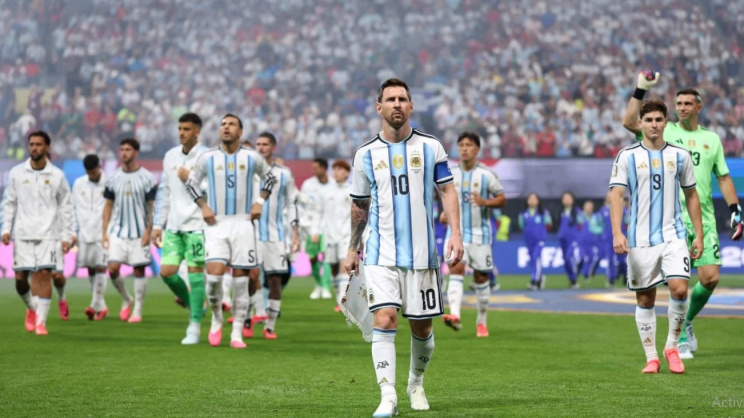
Amid all of this change stands the one player who has defined Argentine football for more than a decade.
Lionel Messi was included for the October 6 friendly against Benin at the Estadio Monumental, where he is expected to make his final appearance for Argentina.
The 39-year-old announced his international retirement in August after a career spanning two decades, during which he won the 2021 and 2024 Copa América titles and the 2022 World Cup.
Argentina Football Association president Claudio Tapia has invited Messi to receive the farewell he believes the captain deserves, while the country's 2022 World Cup winners have also been invited to join him at the Monumental.
If Messi does make his final appearance as expected, it will be his 208th for Argentina.
It will also be the final punctuation mark on an extraordinary international career in which he became the country's record goalscorer with 125 goals.
Yet there is something fitting about Messi's farewell arriving at the same moment that Argentina's next generation begins to emerge.
From one era to the next
The three friendlies therefore carry several meanings at once.
They will allow Argentina to begin clearing suspensions. They will give returning players such as Foyth a chance to rebuild their international standing. They will give Giay and Vega an opportunity to establish themselves as serious options in defence.
And, perhaps most importantly, they will allow Scaloni to see what the younger generation can contribute.
Mastantuono, Prestianni, Soulé and Castro are not simply additional names on a squad list. They represent the next wave of Argentine attacking talent, arriving at a moment when the team is beginning to change around them.
The goalkeeper group remains familiar. The defence is being reshaped. The midfield has been disrupted by suspension. The attack is being refreshed with youth.
And at the centre of the final match stands Messi, preparing to say goodbye.
Argentina's post-World Cup squad is therefore not a complete revolution.
It is something more gradual: the beginning of a transition.
The old core has not disappeared. The new generation has not yet taken over. But for the first time, the shape of the Argentina team after Messi is beginning to become visible.
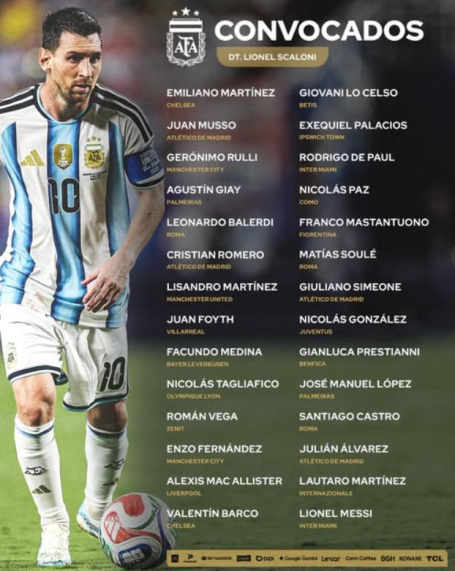
Squad:
Goalkeepers: Emiliano Martinez, Juan Musso, Geronimo Rulli.
Defenders: Agustin Giay, Leonardo Balerdi, Cristian Romero, Lisandro Martinez, Juan Foyth, Facundo Medina, Nicolas Tagliafico, Roman Vega.
Midfielders: Enzo Fernandez, Alexis Mac Allister, Valentin Barco, Giovani Lo Celso, Exequiel Palacios, Rodrigo De Paul, Nicolas Paz, Franco Mastantuono.
Forwards: Matias Soule, Giuliano Simeone, Nicolas Gonzalez, Gianluca Prestianni, Jose Manuel Lopez, Santiago Castro, Julian Alvarez, Lautaro Martinez, Lionel Messi
Comments