


One QR, every wallet

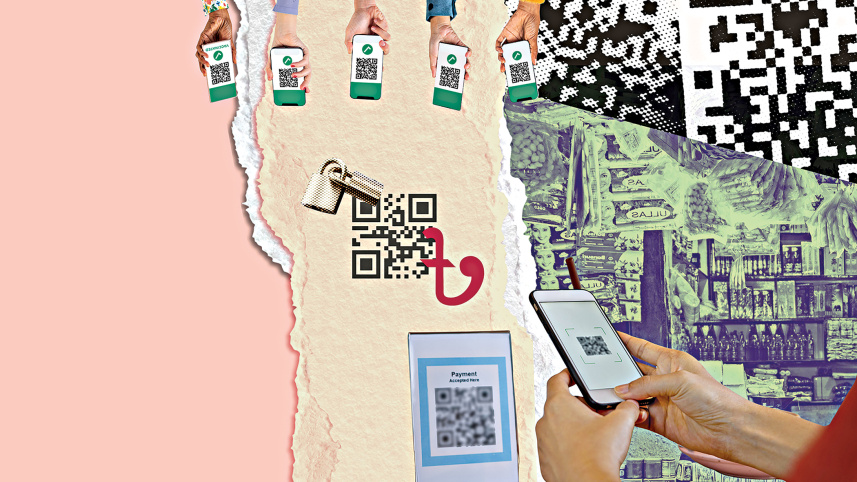
Every merchant counter in Bangladesh, from Gulshan malls to Motijheel tea stalls, is now required to display the same QR code. As of July 1, 2026, Bangla QR, the central bank’s interoperable payment standard built over the past three years, has gone from optional convenience to nationwide mandate.
Ending the QR clutter

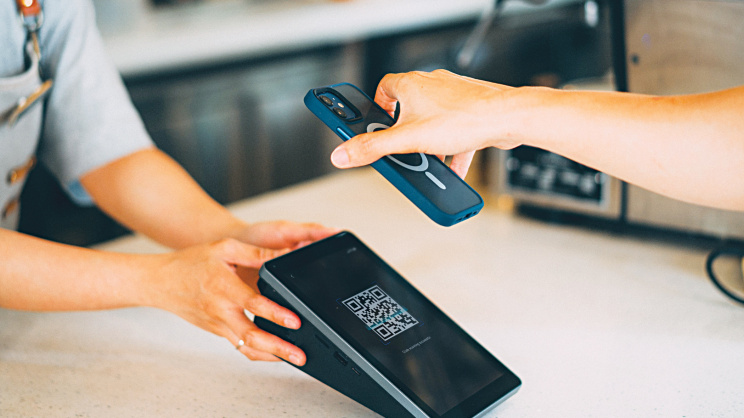
Before Bangla QR, a shopkeeper often displayed five or six separate codes, one for each bank or mobile financial service (MFS) he had signed up with, forcing customers to hunt for a match. Bangla QR replaces that clutter with a single, standardised code that works across any participating bank, MFS or payment service provider (PSP), from bKash and Nagad to more than 46 banks. Tareq Refat Ullah Khan, MD & CEO of BRAC Bank, calls interoperability the platform’s biggest advantage, “customers no longer need to search for a specific bank’s or payment service provider’s QR code while shopping.”
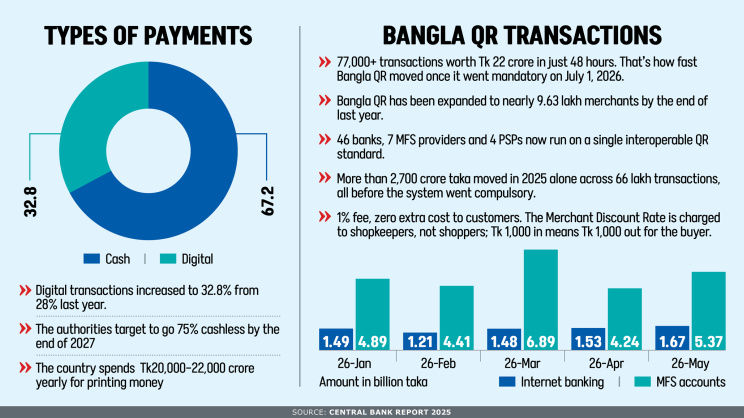
Bangladesh Bank first published Bangla QR guidelines in January 2021 and piloted the interoperable code with 1,200 merchants in Motijheel in January 2023. By the end of 2025, 46 banks, seven MFS providers and four PSPs had joined, reaching 9.63 lakh merchants and processing over Tk 2,700 crore across 66 lakh transactions that year. Instant interoperable settlement began on November 1, 2025, and the central bank made a single QR code mandatory at every merchant point from July 1, 2026. In its first 48 hours, the mandatory system processed more than 77,000 transactions worth over Tk 22 crore.
Banks Race to Onboard
Lenders have moved quickly to expand acceptance. Islami Bank Bangladesh had onboarded 103,465 Bangla QR merchants as of July 12, 2026, including a record 7,037 in a single day, through its branch, sub-branch and agent-banking network, according to Managing Director (Acting) Md. Altaf Hossain. Prime Bank CEO Faisal Rahman said Bangla QR is “a catalyst for expanding digital financial services, particularly among small businesses and underserved segments,” while BRAC Bank has made QR onboarding mandatory for new SME accounts and linked its Astha app, which processes over Tk 25,000 crore monthly, to the network.
The biggest friction point is cost. Bangladesh Bank has fixed a minimum Merchant Discount Rate (MDR) of 1 percent, including VAT, on Bangla QR transactions, deducted from the merchant, not the customer. For a shopkeeper earning Tk 70-80 profit on a Tk 1,000 sale, losing Tk 10 to the fee is significant, and the Bangladesh Micro and Small Payments Consumers’ Association has demanded the charge be scrapped or capped at 0.25 per cent, with a five-year exemption for small businesses. Many informal traders also fear that a digital paper trail will invite tax scrutiny, a concern Khan cites as one of the sector’s central onboarding challenges. Cash still accounted for 35 per cent of formal retail transactions in FY25, underlining how much ground remains.
Security, Trust and Scale
Banks say safety measures are catching up with scale. BRAC Bank uses encryption, data-loss prevention and multi-factor authentication, backed by a round-the-clock Security Operations Centre, while Prime Bank layers its own fraud-monitoring and surveillance systems atop Bangladesh Bank’s regulatory framework. Both banks stress customer vigilance: verifying merchant names and amounts before entering a PIN, and never sharing credentials.
Bangladesh Bank is targeting 80 perc ent digital transactions within a decade and has financed roughly 30,000 smartphones for low-income users to help close the access gap. A fully cashless system could save the government an estimated Tk 20,000 crore a year now spent printing and moving cash, while every QR transaction leaves a digital record small merchants can eventually use to access formal credit. That matters in a country where, per Bangladesh Bureau of Statistics (BBS) data, only 28.3 perc ent of adults hold a bank account, though 47.8 per cent now have an MFS account, a gap Bangla QR is designed to bridge by linking wallets, banks and shopfronts on one rail.
Khan frames the unresolved question sharply, noting the country now faces an important policy decision on how the costs of Bangla QR infrastructure and its Merchant Discount Rate should be shared among government, the central bank, commercial banks, payment networks and merchants. How that balance is struck will decide whether Bangla QR becomes the everyday habit its architects envision, or another well-built system waiting for the economics to catch up.
 For all latest news, follow The Daily Star's Google News channel.
Comments