A valley buried in mud and grief

He was standing beside a dilapidated building on the bank of the Trishuli river, watching journalists photograph and film what remained of Trishuli Bazar.
Then he quietly approached them.

“Can you take my video?” he asked.
The young man, around 25, wore torn, shabby clothes. His eyes were sunken, as though he had not slept properly for days.
“My elder sister was lost from here on that day. Since then, I have been looking for her. I come here every day,” he said.
“If you upload my video, maybe she will see it and know that I am looking for her.”
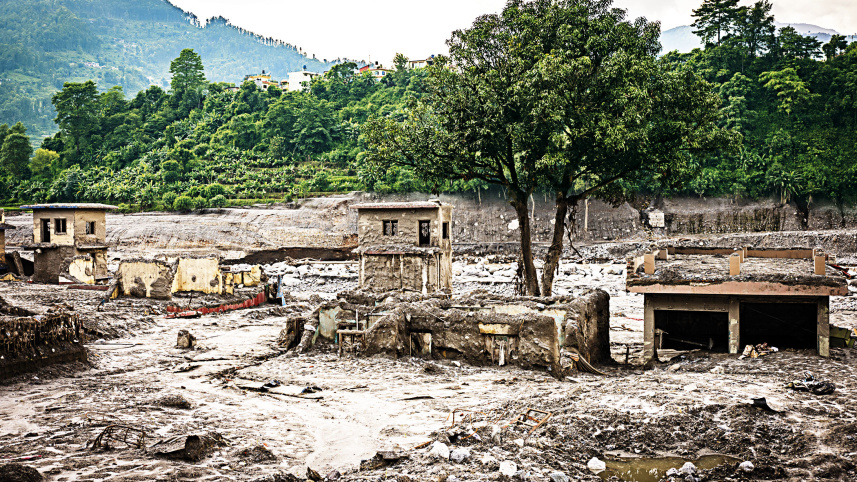
He stared at the building he once called home. The flood had stripped it bare, leaving its skeleton standing amid mounds of mud and debris.
He was speaking in Nepali with Jitendra Bajracharya, a photographer accompanying a 20-member delegation of the International Center for Integrated Moutain Development (ICIMOD).
Asked what the young man had said, Jitendra translated his story.
Almost every household here has a similar story, he said.
Disaster does not discriminate.
The delegation, comprising climate scientists, disaster management experts, an engineer, a meteorologist and journalists, visited the disaster-hit Devighat area, around 70km north of Kathmandhu, on September 15.
On August 26, a massive rock-and-ice collapse on the northern flank of Langtang Lirung in Nepal’s Rasuwa district unleashed a devastating avalanche and flood through the Bhote Koshi–Trishuli river system.
The surge struck border settlements at Rasuwagadhi and Timure before sweeping downstream through Syabrubesi and beyond, leaving destruction across the valley.
Sudan Bikash Maharjan, a remote sensing analyst with ICIMOD’s Cryosphere department, told the delegation at the site that the disaster had originated nearly 70km upstream from Trishuli Bazar.
The water reached the town within minutes, he said.
Water flow in the Trishuli river here usually ranges between 200 and 500 cubic metres per second during the monsoon.
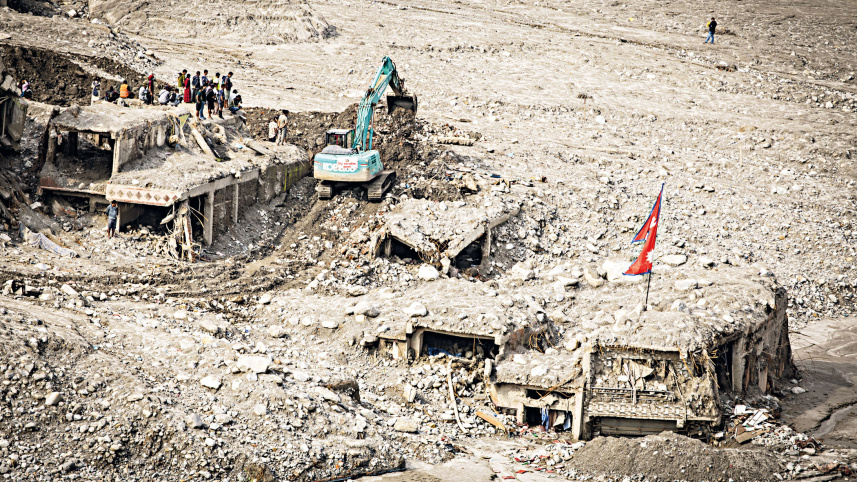
“But on that day, it reached 17,000 cubic metres per second, along with sediment and boulders,” Sudan said.
Many people had no chance to escape.
Those who survived are now living in temporary shelters away from the river or have moved in with relatives elsewhere.
 For all latest news, follow The Daily Star's Google News channel.
 Walking through Trishuli Bazar three weeks after the disaster, the scale of the destruction was difficult to comprehend.
Rescuers were using excavators to remove thick layers of mud, slurry and debris and drain stagnant water. A heavy smell of rot hung in the air.
Trishuli Bazar, once a thriving and colourful marketplace on both banks of the river, was almost unrecognisable.
Mud had reached thirty to forty feet above the river, showing the intensity of the flood.
The township had two motorable bridges connecting business centres on both banks of the Trishuli, along with hydropower plants, a solar power plant, schools, shops and houses. They have either been swept away or buried under mud and debris.
Thick layers of grey mud and slurry covered the market. Shattered buildings, vehicles and other debris lay scattered across the landscape.
The situation was much the same in Devighat, 13km downstream of Trishuli Bazar and around 70km from Kathmandu.
The stench of rot was noticeable immediately upon arriving there, even three weeks after the disaster.
Heaps of mud and stones lined both sides of the road. Broken buildings stood in between. At first glance, the area looked war-torn.
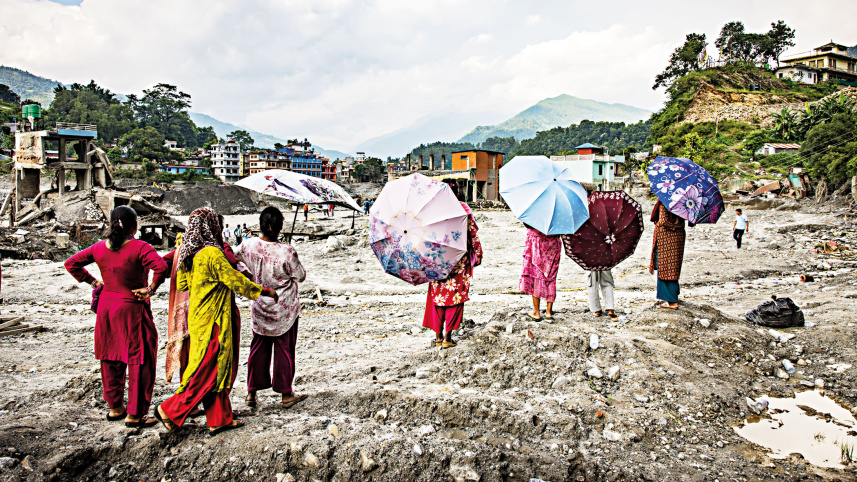
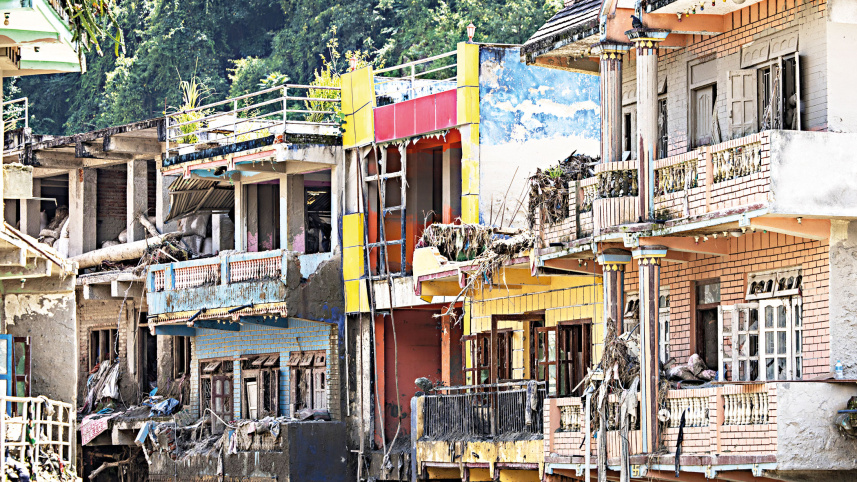
Many were little more than skeletons of buildings, stripped of doors and windows. Not a single person remained in any of the houses.
Devika Podel, a resident of Devighat, said many bodies had washed down the Trishuli River along with vast amounts of mud, boulders and other debris. Remains of humans or animals could still be buried beneath the mud, she said.
Devika used to run a small business in Devighat. She has now lost everything.
The commercial centre of Devighat sits at the confluence of the Trishuli and Tadi rivers. Devika said nearly 600 houses and structures were destroyed there.
Recalling the August 26 flood, she said residents had received warning phone calls from the upstream Betrawati Bazar area at around 9:00am.
Initially, many did not take the warning seriously. They had received an alert the previous year, but it turned out to be a minor flood.
Because of that experience, many people went to the riverbanks to record videos.
“Many of them are missing now,” she said.
Authorities say 657 local and 1,051 people from other districts are missing in Nuwakot, where Devighat and Trishuli Bazar are located.
Across Nepal, the scale of the missing has created another crisis.
According to the last report of Nepal’s National Disaster Risk Reduction and Management Authority (NDRRMA), 1,451 people have been declared dead. Of them, 336 are female and 585 are male, while 530 are human remains that are difficult to identify.
Authorities are collecting DNA samples to match the remains with people whose relatives have been reported missing. So far, 112 bodies have been handed over to relatives.
The report said 5,745 people remain missing, including 636 foreign nationals.
For families still searching for loved ones, hope is fading. But there have been rare moments of extraordinary survival.
“Sometimes miracles happen,” said Bim Prasad Shrestha, a member of the Nepalese delegation in the ICIMOD team.
His wife’s cousin, Chandika Shrestha, was rescued from her house in Betrawati township 11 days after the disaster.
“She was worshipping at the top floor when the disaster came. Family members called her while making sudden escape seeing the disaster from far away, but she did not noticed it,” Bim said.
Chandika was injured and trapped inside the house. Her family thought she had been washed away.
“After 11 days rescuers reached her house and found her alive. She is in hospital now,” said Bim, a professor of Kathmandu School of Engineering.
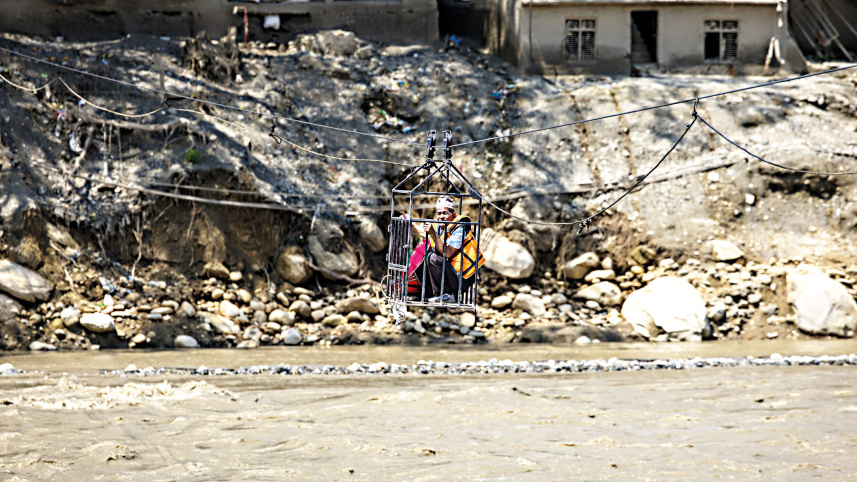
For thousands of other families, however, the uncertainty continues.
Sushil karki, a legal expert, said the disaster was bringing new problems to the fore in Nepal.
Under existing Nepalese laws, if somebody goes missing and there is no evidence of their death, the family has to wait 12 years to have the person declared dead.
With so many people still missing, over five thousand families could face difficulties involving banking, insurance and the transfer of business ownership, he said.
Alongside rebuilding and recovery, Sushil said, “The government would have to work to ease and shorten the process of death declaration and registration immediately.”
Otherwise, he said, “those families will be unable to proceed to claim the insurance and compensations quickly.”
The scale of the physical destruction is equally daunting.
According to the NDRRMA report published last week, 4,800 commercial establishments, 13 hydropower plants, 68 suspension bridges, 37 motorable bridges and 69km of roads were completely destroyed.
Over 7,000 residential buildings were destroyed, let alone semi-pucca and thatched houses.
A total of 1,215 affected people are sheltering in 21 holding centres: 788 in 9 centres in Rasuwa, 306 in 8 centres in Nuwakot, and 121 in 4 centres in Dhading.
“It will take time to estimate the total damage caused by the disaster. Our rescue mission, led by the Nepal Army, is still looking for bodies in the debris. There are some remote places where rescue operations have not yet begun,” said Badri Pyakurel, focal person of NDRRMA.
According to an initial damage and needs assessment, Nepal requires $4.77 billion to fully fund recovery and rebuilding efforts.
The disaster has also raised questions about whether existing warning systems are capable of dealing with events of such speed and intensity.
Mahmud Al Haq Patwary, the Country Focal Point for Bangladesh at ICIMOD, who accompanied the delegation, said a flood alert system had been in place.
“But this disaster was unprecedented, beyond imagination. Flood alert system work as the flood water rise slowly and the sensor send alert to people living in the downstream. But in this case the alert system was suddenly washed away, leaving no clue for downstream people,” he said.
“Nobody thought a disaster of this scale could happen,” he said. “Now scientist need to develop new kind of alert system, for this kind of disaster.”
Scientists from the World Weather Attribution (WWA) group said the disaster was not caused by a single extreme weather event, but was a “compound crisis” shaped by long-term warming, glacier retreat, permafrost thaw and geological instability.
The disaster has left scientists asking how many more sites may be waiting to collapse from the glaciated peaks of the Hindu Kush Himalaya, while disaster management experts are confronting the question of how future losses can be minimised.
Seeking answers, ICIMOD and the Government of Nepal convened a high-level meeting of more than 80 participants, including cryosphere experts, aid workers, diplomats and government officials from Bangladesh, Bhutan, China, India, Nepal and Pakistan, in Kathmandu from September 15-17 September.
Speakers agreed that a hazard forming high in one country’s mountains could rapidly become another country’s emergency, particularly in the Hindu Kush Himalaya region.
Disasters now come in different forms and with new intensity. They do not discriminate, nor do they respect political boundaries.
The discussions therefore centred on transboundary cooperation and information sharing as countries seek ways to prepare for future disasters.
But in Trishuli Bazar, those questions are far removed from the immediate concerns of people still returning to the ruins every day.
For the young man standing beside what remained of his home, there was only one question.
Where was his sister?
And for now, all he could do was keep looking, hoping that somewhere she might see his video and know that he was still searching for her.
Sundarbans: The forest that protects, feeds and sustains
The Santals who made the hills their home
Rajshahi: The story behind Bangladesh’s cleanest city

Bangladesh Fisheries Research Institute / Bringing endangered fish back from the brink
How haor women found self-reliance through duck farming
Once a forest now a landscape of loss

A campus alive with biodiversity
The plunder that never stopped
A growing herd in a shrinking forest