


Al-Nusra splits from Qaeda
The head of Al-Nusra Front in Syria said his jihadist group was breaking ties with al-Qaeda and changing its name, in remarks broadcasted yesterday by Al-Jazeera.
Abu Mohamad al-Jolani said Al-Nusra would change its name to Jabhat Fateh al-Sham (Conquest of Syria in Arabic) and expressed his gratitude to the "commanders of al-Qaeda for having understood the need to break ties".

The announcement came a week after US Secretary of State John Kerry and Russian Foreign Minister Sergei Lavrov said they had agreed on "concrete steps" to save a failing Syria truce and tackle jihadist groups like al-Nusra and the Islamic State group.
Al-Qaeda prepared the ground for the announcement earlier yesterday in an online message urging the affiliate to sever ties to “protects the jihad of the Syrian people”.
Meanwhile, Russia yesterday announced a "large-scale" aid operation to allow civilians and fighters to flee besieged Aleppo.
Government forces have surrounded rebel-held districts in eastern Aleppo since July 17, sparking fears for at least 200,000 people who live there.
Residents have reported food shortages and spiralling prices in rebel districts since regime forces cut off the opposition's main supply route into the northern city earlier this month.
Russian Defence Minister Sergei Shoigu said three humanitarian corridors were being opened "to aid civilians held hostage by terrorists and for fighters wishing to lay down their arms".
He told Russian news agencies that a fourth corridor would be opened to the north of Aleppo for rebels to flee with their weapons.
Medical and food assistance would be provided along the routes for civilians and fighters who lay down their weapons, Shoigu said, adding the operation would get underway later yesterday.
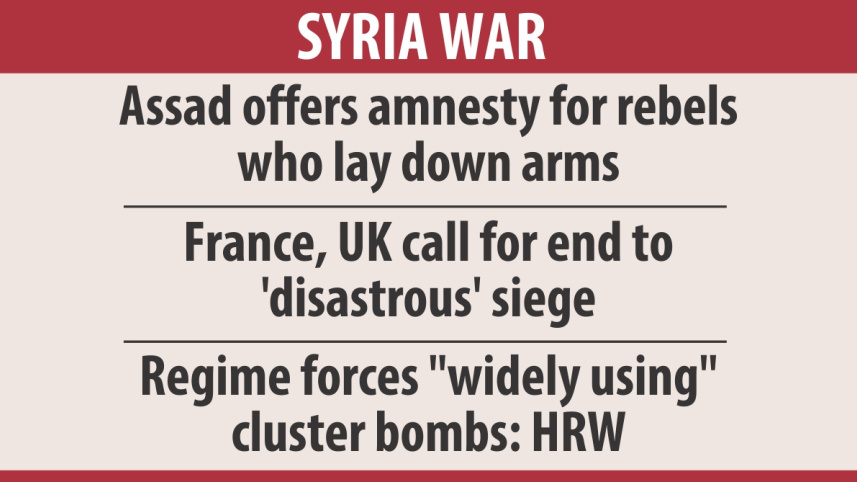
President Bashar al-Assad, meanwhile, issued a decree offering an amnesty to rebels who surrender over the next three months.
As Russia made the announcement, France and Britain renewed demands for an end to the regime's "disastrous" siege of eastern Aleppo.
Meanwhile, Human Rights Watch yesterday said the Russian-backed Syrian government's air campaign against rebels is widely using cluster munitions. The rights group said it had documented 47 cluster munitions attacks, which killed or wounded dozens of civilians in opposition-controlled territory in the last two months.
 For all latest news, follow The Daily Star's Google News channel.
Comments