


China under pressure over South China sea row
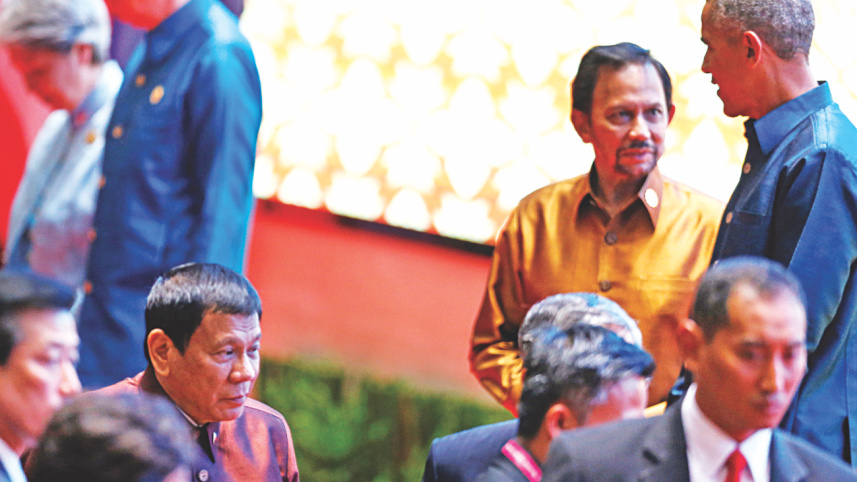
Beijing yesterday came under pressure at an Asian summit over its "illegal" island-building in the South China Sea, after the Philippines produced photos it said showed fresh construction activity at a flashpoint shoal.
Any artificial island at Scarborough Shoal could be a game-changer in China's quest to control the South China Sea and raises the risk of armed confrontation with the United States, security analysts say.

Beijing insists it has not started building at the shoal -- a move that could lead to a military outpost just 230 kilometres from the main Philippine island, where US forces are stationed.
But the Philippines released images which it said showed Chinese ships in the area that were capable of dredging sand and other activities required to build an artificial island.
The photos were released during an annual summit of the 10-member Association of Southeast Asian Nations in Laos, and the bloc voiced alarm.
"We remain seriously concerned over recent and ongoing developments and took note of the concerns expressed by some leaders on the land reclamations," said a joint statement at the end of their two-day summit.
China claims nearly all of the South China Sea, through which $5 trillion in trade passes annually, even waters approaching the coasts of the Philippines and other Southeast Asian nations.
The competing territorial claims have long been a major source of tension in the region, with China using deadly force twice to seize control of islands from Vietnam.
Tensions have escalated sharply in recent years as China built islands and airstrips on reefs and islets in the Spratlys archipelago -- another strategically important location -- that are capable of supporting military operations.
The United States has reacted to that build-up by sailing warships close to the new islands, and sending warplanes over them, deeply angering China.
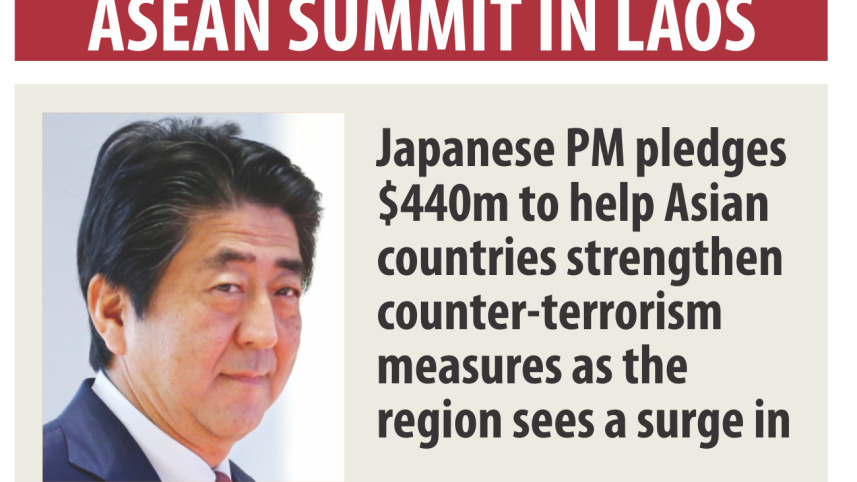
Japanese Prime Minister Shinzo Abe yesterday pledged $440 million to help Asian countries strengthen counter-terrorism measures, a government spokesman said, as the region sees a surge in large-scale attacks.
"As our first ever support for anti-terrorism and anti-extremism steps in Asia, we will carry out an aid programme worth 45 billion yen for the next three years," Japanese Deputy Chief Cabinet Secretary Koichi Hagiuda quoted Abe telling a meeting of leaders of the Association of Southeast Asian Nations (Asean) grouping.
 For all latest news, follow The Daily Star's Google News channel.
Comments