


How Saddam's military officers controll ISIS
When Abu Hamza, a former Syrian rebel, agreed to join Isis, he did so assuming he would become a part of the group's promised Islamist utopia, which has lured foreign jihadists from around the globe.
Instead, he found himself being supervised by an Iraqi emir and receiving orders from shadowy Iraqis who moved in and out of the battlefield in Syria. When Abu Hamza disagreed with fellow commanders at an "Islamic State" meeting last year, he said, he was placed under arrest on the orders of a masked Iraqi man who had sat silently through the proceedings, listening and taking notes.

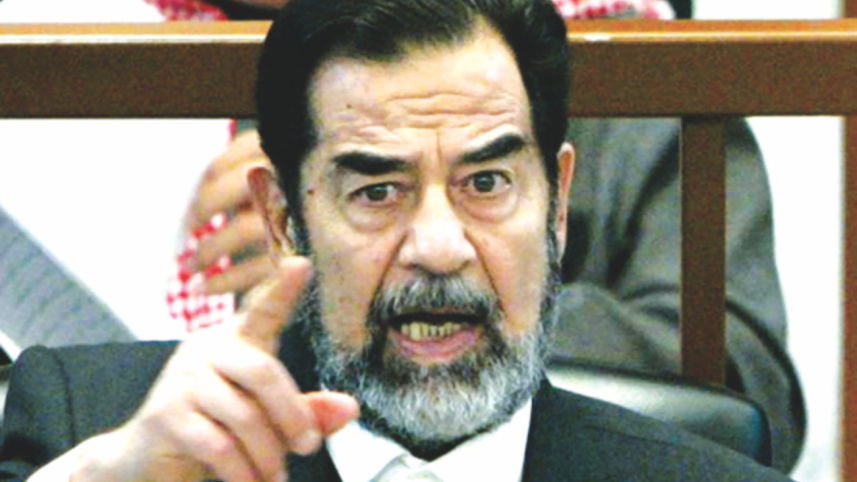
Abu Hamza, who became the group's ruler in a small community in Syria, never discovered the Iraqis' real identities, which were cloaked by code names or simply not revealed. All of the men, however, were former Iraqi officers who had served under Saddam Hussein, including the masked man, who had once worked for an Iraqi intelligence agency and now belonged to the Islamic State's own shadowy security service, he said. US Marines chain the head of a statue of Saddam Hussein before pulling it down in Baghdad's al-Fardous square 09 April 2003, while an Iraqi waves the US flag.
His account, and those of others who have lived with or fought against the Islamic State over the past two years, underscore the pervasive role played by members of Iraq's former Baathist army in an organisation more typically associated with flamboyant foreign jihadists and the gruesome videos in which they star.
Even with the influx of thousands of foreign fighters, almost all of the leaders of the Islamic State are former Iraqi officers, including the members of its shadowy military and security committees, and the majority of its emirs and princes, according to Iraqis, Syrians and analysts who study the group.
They have brought to the organisation the military expertise and some of the agendas of the former Baathists, as well as the smuggling networks developed to avoid sanctions in the 1990s and which now facilitate the Islamic State's illicit oil trading.
In Syria, local "emirs" are typically shadowed by a deputy who is Iraqi and makes the real decisions, said Abu Hamza, who fled to Turkey last summer after growing disillusioned with the group. He uses a pseudonym because he fears for his safety.
"All the decision makers are Iraqi, and most of them are former Iraqi officers. The Iraqi officers are in command, and they make the tactics and the battle plans," he said. "But the Iraqis themselves don't fight. They put the foreign fighters on the front lines."
The public profile of the foreign jihadists frequently obscures the Islamic State's roots in the bloody recent history of Iraq, its brutal excesses as much a symptom as a cause of the country's woes.
The raw cruelty of Hussein's Baathist regime, the disbandment of the Iraqi army after the US-led invasion in 2003, the subsequent insurgency and the marginalization of Sunni Iraqis by the Shia-dominated government all are intertwined with the Islamic State's ascent, said Hassan Hassan, a Dubai-based analyst and co-author of the book Isis: Inside the Army of Terror.
 For all latest news, follow The Daily Star's Google News channel.
Comments