


ISIS enshrines a theology of rape in Syria, Iraq
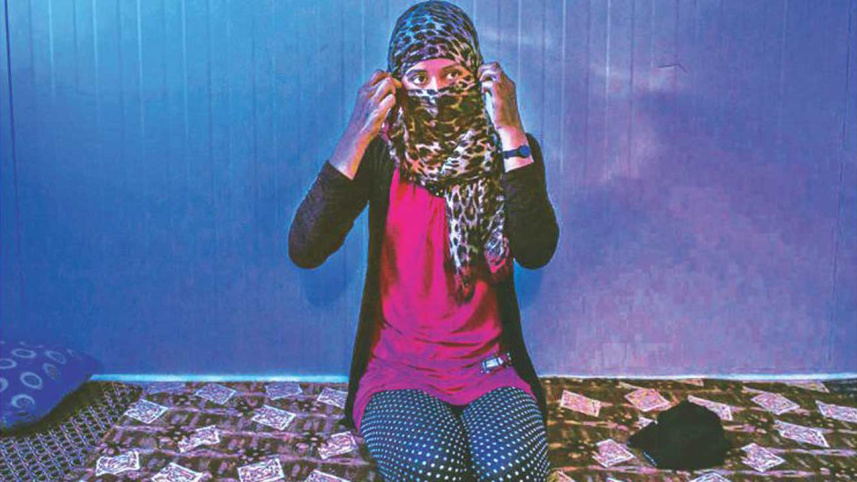
In the moments before he raped the 12-year-old girl, the Islamic State fighter took the time to explain that what he was about to do was not a sin. Because the preteen girl practiced a religion other than Islam, the Quran not only gave him the right to rape her — it condoned and encouraged it, he insisted.
He bound her hands and gagged her. Then he knelt beside the bed and prostrated himself in prayer before getting on top of her. When it was over, he knelt to pray again, bookending the rape with acts of religious devotion.

"I kept telling him it hurts — please stop," said the girl, whose body is so small an adult could circle her waist with two hands. "He told me that according to Islam he is allowed to rape an unbeliever. He said that by raping me, he is drawing closer to God," she said in an interview alongside her family in a refugee camp here, to which she escaped after 11 months of captivity.
The systematic rape of women and girls from the Yazidi religious minority has become deeply enmeshed in the organization and the radical theology of the Islamic State in the year since the group announced it was reviving slavery as an institution. Interviews with 21 women and girls who recently escaped the Islamic State, as well as an examination of the group's official communications, illuminate how the practice has been enshrined in the group's core tenets.
A total of 5,270 Yazidis were abducted last year, and at least 3,144 are still being held, according to community leaders. To handle them, the Islamic State has developed a detailed bureaucracy of sex slavery, including sales contracts notarized by the ISIS-run Islamic courts. And the practice has become an established recruiting tool to lure men from deeply conservative Muslim societies, where casual sex is taboo and dating is forbidden.
A growing body of internal policy memos and theological discussions has established guidelines for slavery, including a lengthy how-to manual issued by the Islamic State Research and Fatwa Department just last month. Repeatedly, the ISIS leadership has emphasized a narrow and selective reading of the Quran and other religious rulings to not only justify violence, but also to elevate and celebrate each sexual assault as spiritually beneficial, even virtuous.
The Islamic State's formal introduction of systematic sexual slavery dates to Aug 3, 2014, when its fighters invaded the villages on the southern flank of Mount Sinjar, a craggy massif of dun-colored rock in northern Iraq.
Its valleys and ravines are home to the Yazidis, a tiny religious minority who represent less than 1.5 percent of Iraq's estimated population of 34 million.
The offensive on the mountain came just two months after the fall of Mosul, the second-largest city in Iraq. At first, it appeared that the subsequent advance on the mountain was just another attempt to extend the territory controlled by Islamic State fighters.
Almost immediately, there were signs that their aim this time was different.
Survivors say that men and women were separated within the first hour of their capture. In village after village, the men and older boys were driven or marched to nearby fields, where they were forced to lie down in the dirt and sprayed with automatic fire.
The women, girls and children, however, were hauled off in open-bed trucks.
Detailed reports by Human Rights Watch and Amnesty International reach the same conclusion about the organized nature of the sex trade.
The Islamic State's sex trade appears to be based solely on enslaving women and girls from the Yazidi minority. As yet, there has been no widespread campaign aimed at enslaving women from other religious minorities, said Samer Muscati, the author of the recent Human Rights Watch report. That assertion was echoed by community leaders, government officials and other human rights workers.
Barber, of the University of Chicago, said that the focus on Yazidis was likely because they are seen as polytheists, with an oral tradition rather than a written scripture. In the Islamic State's eyes that puts them on the fringe of despised unbelievers, even more than Christians and Jews, who are considered to have some limited protections under the Quran as "People of the Book."
Months later, the Islamic State made clear in their online magazine that their campaign of enslaving Yazidi women and girls had been extensively preplanned.
"Prior to the taking of Sinjar, Shariah students in the Islamic State were tasked to research the Yazidis," said the English-language article, headlined "The Revival of Slavery Before the Hour," which appeared in the October issue of Dabiq.
The article made clear that for the Yazidis, there was no chance to pay a tax known as jizya to be set free, "unlike the Jews and Christians."
"After capture, the Yazidi women and children were then divided according to the Shariah amongst the fighters of the Islamic State who participated in the Sinjar operations, after one fifth of the slaves were transferred to the Islamic State's authority to be divided" as spoils, the article said.
 For all latest news, follow The Daily Star's Google News channel.
Comments