


Jihadists using human shields
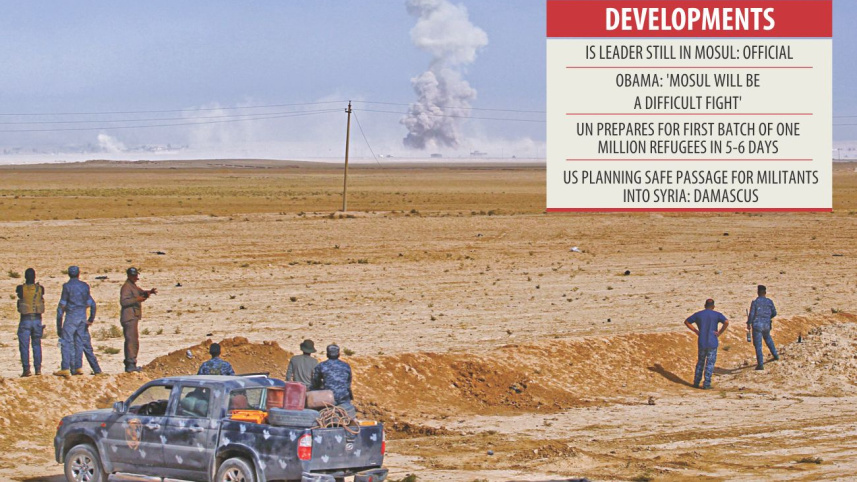
Residents of Mosul said Islamic State was using civilians as human shields as Iraqi and Kurdish forces captured outlying villages in their advance on the jihadists' stronghold.
The leader of Islamic State and one of its main explosives experts were reported to be among thousands of the hardline militants still in Mosul, suggesting the group would go to great lengths to fend off any ground attack within the city limits.

With the attacking forces still between 20 and 50 km (12-30 miles) away, residents reached by telephone said more than 100 families had started moving from southern and eastern suburbs most exposed to the offensive to more central parts of the city.
Islamic State militants were preventing people fleeing Mosul, they said, and one said they directed some towards buildings they had recently used themselves.
"It's quite clear Daesh (Islamic State) has started to use civilians as human shields by allowing families to stay in buildings likely to be targeted by air strikes," said Abu Mahir, who lives near the city's university and offered food to the displaced.
Around 1.5 million people are still living in Mosul and the International Organisation for Migration said it was preparing gas masks in case of chemical attack by the jihadists, who had used such weapons previously against Iraqi Kurdish forces.
The fall of Mosul would signal the defeat of the ultra-hardline Sunni jihadists in Iraq but could also lead to land grabs and sectarian bloodletting between groups which fought one another after the 2003 overthrow of Saddam Hussein.
For US President Barack Obama, the campaign is a calculated risk, with US officials acknowledging that there is no clear plan for how the region around Mosul will be governed once Islamic State is expelled.
Obama yesterday warned of a tough battle.
"There will be ups and downs in this process, but my expectation is that ultimately it will be successful," he told a joint news conference with Italian Prime Minister Matteo Renzi.
But the US leader warned of a challenging road ahead.
"Mosul will be a difficult fight. There will be advances and there will be setbacks," he said.
Obama said he expected "significant displacement" of civilians from Mosul, and that the US-led coalition, in conjunction with the United Nations and major aid organizations was prepared to respond to it.
France said it would co-host a multilateral meeting with Iraq on Oct 20 to discuss how to stabilise Mosul and its surroundings once Islamic State has been defeated.
However, the Syrian army yesterday accused the US-led coalition of planning to allow safe passage into Syria for Islamic State militants fleeing the city, saying it would combat this with all forces at its disposal.
The Iraqi army and Peshmerga forces from autonomous Iraqi Kurdistan began moving towards the city at dawn on Monday under air cover from a US-led coalition set up after Islamic State swept into Iraq from Syria in 2014.
Islamic State leader Abu Bakr al-Baghdadi, and explosives expert Fawzi Ali Nouimeh were both in the city, Hoshiyar Zebari, a senior Kurdish official, said. He described the information as "solid" intelligence.
A total of 20 villages were taken from the militants east, south and southeast of Mosul by early yesterday, according to statements from the two forces, fighting alongside one another for the first time.
The operation had been planned since July with US and other coalition forces and Western and Iraqi officials, mindful of the civil war that followed Saddam's fall, say plans for administering the mainly Sunni city and accommodating those who flee the fighting are in place.
The United Nations has said up to a million people could flee the city and that it expected the first big wave in five or six days, indicating fighting would reach the city then.
 For all latest news, follow The Daily Star's Google News channel.
 But some residents said Islamic State was making sure people did not leave. Anwar said he fled his Sumer district, which lies near Mosul airport, fearing ground forces and ariel bombing.
Fighting is expected to take weeks, if not months, as some 30,000 government forces, Sunni tribal fighters and Kurdish Peshmerga first encircle the city then attempt to oust between 4,000 and 8,000 Islamic State militants. More than 5,000 US soldiers are also deployed in support missions, as are troops from France, Britain, Canada and other Western nations.
Comments