


World will be watching
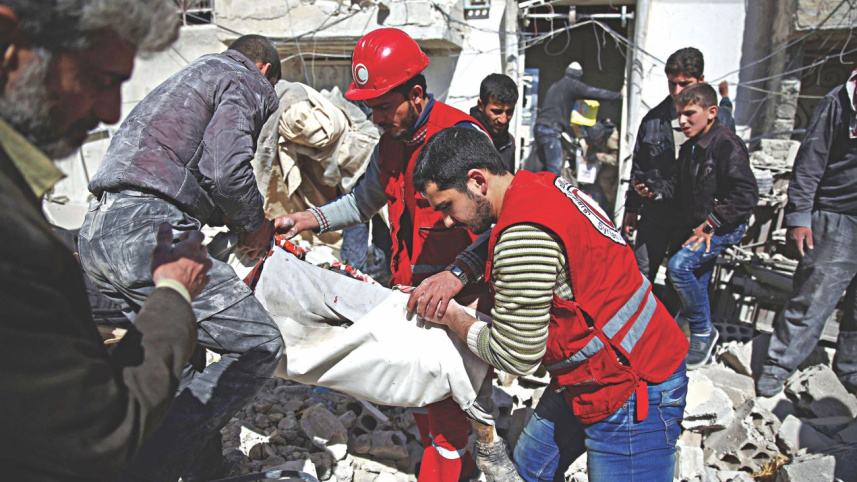
US President Barack Obama has warned Damascus and key ally Moscow that the "world will be watching" their commitment to a looming ceasefire as intense Russian air strikes battered rebel bastions across Syria yesterday just hours before the midnight deadline.
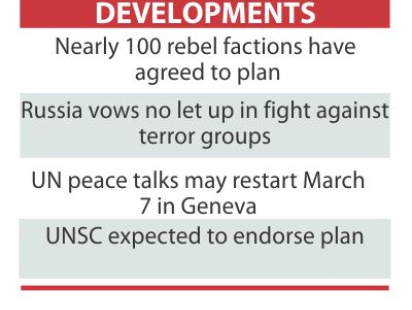
Both President Bashar al-Assad's regime and the main opposition body have agreed to the deal -- which allows fighting to continue against the Islamic State group and other jihadists.

The agreement brokered by Russia and the United States marks the biggest diplomatic push yet to help end Syria's violence, but has been plagued by doubts after the failure of previous peace efforts.
Members of the 17-nation group backing the process were to meet in Geneva yesterday to work out further details of the so-called "cessation of hostilities", which is then expected to be endorsed by the UN Security Council, diplomats said.
The Syrian Observatory for Human Rights, a Britain-based monitor, said Russia and the regime had launched a wave of attacks on non-jihadist rebel areas ahead of the deadline.
"It's more intense than usual," Observatory head Rami Abdel Rahman said.
The Observatory said there had been Russian strikes overnight on rebel bastions including the Eastern Ghouta region outside Damascus, the north of Homs province and the west of Aleppo province.
There were at least 26 air strikes on Eastern Ghouta including 10 on its main city of Douma which was facing heavy regime shelling, he said.
Meanwhile, Russian President Vladimir Putin insisted Moscow would continue targeting "terrorist groups".
"The decisive fight against them will, without doubt, be continued," Putin said in televised remarks.
"We understand fully and take into account that this will be a complicated, and maybe even contradictory process of reconciliation, but there is no other way," Putin said.
The intensified attacks prompted Turkey, a key supporter of opposition forces, to express worries over the viability of the ceasefire.
"We are seriously concerned over the future of the ceasefire because of the continuing Russian air raids and ground attacks by forces of Assad," presidential spokesman Ibrahim Kalin told reporters in Ankara.
The complexity of Syria's battlefields -- where moderate and Islamist rebel forces often fight alongside jihadist groups like the al-Qaeda affiliated Al-Nusra Front -- has raised serious doubts about the feasibility of a ceasefire.
Diplomats are reported to be working to define areas that will fall under the partial truce and to set up monitoring mechanisms.
The UN's Syria envoy has said he hopes the agreement will lead to a resumption of peace talks which collapsed earlier this month in Geneva. A Russian Foreign Ministry official said on condition of anonymity that talks may restart in Geneva on March 7.
Syria's top opposition grouping -- the Riyadh-based High Negotiations Committee (HNC) – yesterday said that 97 opposition factions had signed on "to respect a temporary truce" but reiterated that it was only agreeing to an initial period of two weeks.
Iran, another key Assad ally, has said it is confident the regime will abide by the agreement.
Huddling with his national security advisors in Washington on Thursday, Obama put the onus firmly on the regime and Russia.
 For all latest news, follow The Daily Star's Google News channel.
 He said he was not "under any illusions" about possible pitfalls, but that the ceasefire could help bring about an end to the war.
"A lot of that is going to depend on whether the Syrian regime, Russia, and their allies live up to their commitments," Obama said. "The coming days will be critical, and the world will be watching."
Comments