


Govt to shore up remittance
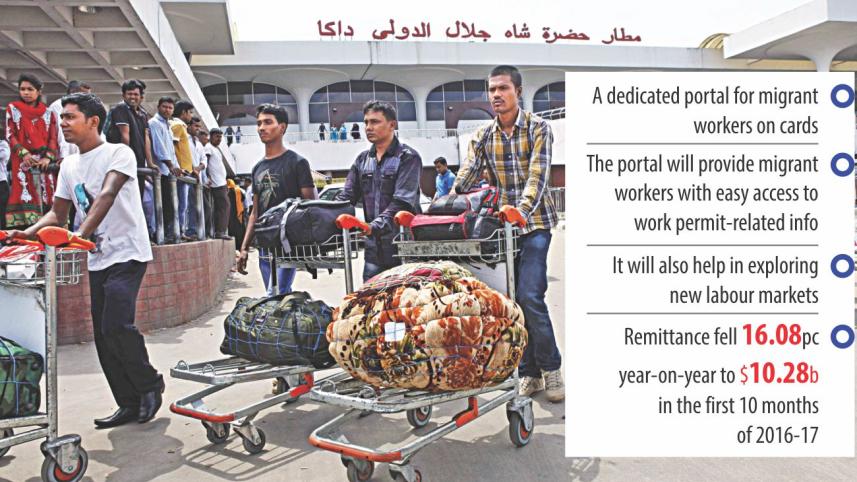
The government is set to put in place a dedicated portal for migrant workers as part of the efforts to boost the remittance inflow, which has been on the wane for the past two fiscal years.
Remittance, which is the largest source of foreign exchange for Bangladesh after export receipts, declined 16.08 percent year-on-year to $10.28 billion in the first 10 months of fiscal 2016-17.

From the portal, migrant workers will have easy access to work permit-related information of their host countries, while prospective ones can get visa-related particulars as well.
The government will also encourage the private sector to explore new labour markets and send workers abroad at low cost under state initiative.
The other measures include developing training infrastructure and imparting training to migrant workers to better meet the job requirements of their host countries.
Finance Minister AMA Muhith yesterday said remittance inflow may rise in the incoming fiscal year thanks to the various government initiatives and continued recovery of the global economy.
As of now, the government has brought down the cost of remittance transfer and improved the efficiency of overseas banking units and exchange houses to bump up the inflows to Bangladesh.
Step was also taken to strengthen drawing arrangement between Bangladeshi banks and the local banks of the countries where expatriates are working and motivating the workers to remit through Probashi Kallyan Bank (Expatriates Welfare Bank).
“I firmly believe that all these initiatives together with the increasing trend of global growth will have a positive impact on our remittance inflows,” Muhith said.
The decline in remittance flow from the six Gulf Cooperation countries, the largest labour market for Bangladesh, mainly accounts for the slump. Remittance inflow from Bahrain, Kuwait, Oman, Qatar, Saudi Arabia and the United Arab Emirates declined 17 percent to $5.26 billion in the July-March period of the fiscal year.
This stands in stark contrast to the huge number of Bangladeshi nationals taking up jobs in the six GCC countries in recent years.
For instance, in 2016 manpower export to the six countries soared 52 percent year-on-year to 572,028 workers, according to the Bureau of Manpower Employment and Training.
Money sent by Bangladeshi workers, which accounted for about 6 percent of the gross domestic product in fiscal 2015-16, supports growth through their impact on household income and consumption.
 For all latest news, follow The Daily Star's Google News channel.
Comments