


Bangladesh building first research vessel to explore the Bay

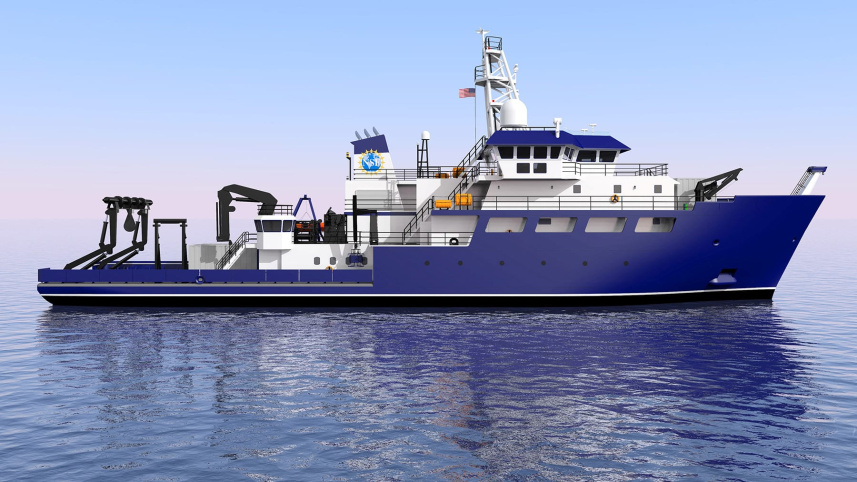
Bangladesh is building its first oceanographic research vessel at Khulna Shipyard, which will allow the country’s marine scientists to explore the deep waters of the Bay of Bengal by 2028.
The 32-metre-long vessel, with an 8-metre beam and a 4-metre draught, has been designed by UK-based Keel Marine. Its scientific equipment is being sourced from several European countries and China.

The ship will travel at a top speed of 14 miles per hour and will be fitted with advanced laboratories and high-tech sensors. It will enable scientists at the Bangladesh Oceanographic Research Institute (BORI) to study deep-sea mineral resources, marine biodiversity and climate change.
The construction has officially begun at Khulna Shipyard Limited on June 16, and is scheduled to be completed by 2028. The vessel will replace the small fishing boats currently used for coastal data collection.
Commodore Sheikh Shahid Ahmed, director general of the Bangladesh Oceanographic Research Institute, said the institute’s current research is limited to observations of the ocean surface and cannot capture conditions in deeper waters. As the country remains far behind in ocean research, he said people now know more about Mars than about their own sea.
The new vessel is expected to change that. Equipped with a wide range of advanced scientific instruments, it will allow researchers to move beyond coastal observations and carry out deep-sea exploration. After winning two international legal disputes with Myanmar and India in 2012 and 2014, Bangladesh secured sovereign rights over more than 118,813 square kilometres of maritime territory in the Bay of Bengal. The maritime area is almost as large as the country’s land territory.
In 2016, the Bangladesh Oceanographic Research Institute was established in Ramu of southeastern district Cox’s Bazar. However, a lack of research infrastructure has prevented the country from fully exploring the potential of its blue economy.
Referring to the country’s growing focus on that economic prospect, Commodore Shahid said Bangladesh must increasingly look to the sea as land-based resources become depleted.
He stressed the need for sustainable management of marine resources, saying the country is overfishing without fully understanding the condition of its fish stocks.
Scientists using the new vessel will be able to identify fish concentrations and their distribution across the Bay, study marine biodiversity, and conduct research on seaweed and other marine resources.
The vessel will also be capable of seabed mapping, geological exploration, water column analysis, biological studies, and environmental and climate research. It will feature onboard laboratories and advanced scientific technology. The ship will accommodate 23 scientists and crew, allowing them to conduct round-the-clock research missions lasting eight to 10 consecutive days.
It will have three specialised laboratories -- a wet lab, a dry lab and a data analysis lab -- enabling researchers to test and analyse samples immediately while still at sea. Using satellite technology, scientists will be able to transmit data directly from the vessel to land-based oceanographic data centres.
However, Commodore Shahid said the vessel’s relatively small size means it will not be capable of operating in all weather conditions and will be able to carry out research for only three to four months each year.
Apart from the research ship, the Tk 160 crore project also includes two high-speed cabin boats, a 36-metre-long and 10-metre-wide pontoon, a 250-metre jetty and a gangway. These facilities will be set up in Maheshkhali Channel area of Cox’s Bazar.
Khulna Shipyard Limited, which is run by the Bangladesh Navy, is one of the country’s oldest and largest state-owned shipyards. It has built more than 800 new vessels and repaired more than 2,500.
Still, Rear Admiral Maksud Alam, managing director of Khulna Shipyard Limited, described the project as an “incredible one”. “Research vessels have been built before, including fisheries research vessels, but those were built abroad, including in Malaysia.”
According to Rear Admiral Maksud, the vessel will significantly strengthen the country’s capacity for marine research and scientific surveys while generating valuable data on the marine environment and its resources.
 For all latest news, follow The Daily Star's Google News channel.
Comments