


Bangladesh collects only half as much corporate tax as peers

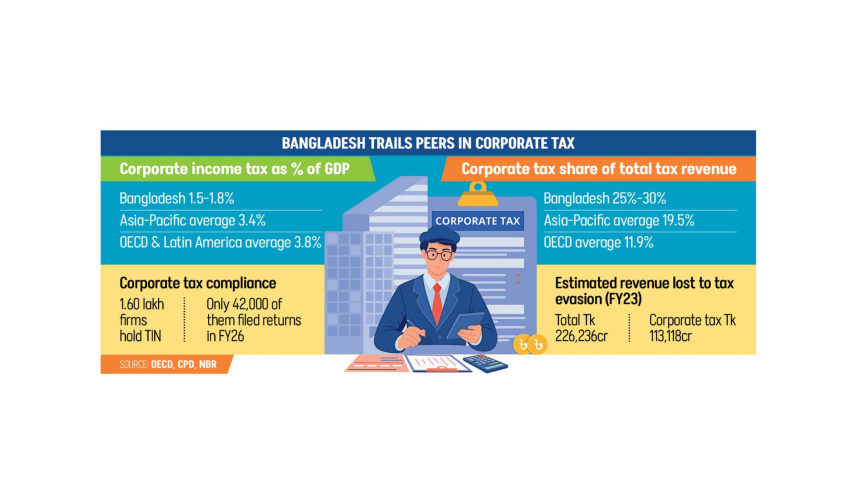
Although corporate tax contributes around one-quarter of the country’s total tax revenue, the government collects relatively little from companies compared with the size of the economy.
Corporate income tax revenue in Bangladesh stands at around 1.5-1.8 percent of gross domestic product (GDP), around half the level of many peer economies, according to the latest report by the Organisation for Economic Co-operation and Development (OECD).

Bangladesh also trails several small economies in Latin America and the Caribbean, the report showed.
The poor collection leaves the government with less money to fund public services and increases its reliance on value-added tax (VAT), customs duties and borrowing. Ordinary people ultimately bear the cost of that dependence.
Business leaders and economists blame the weak collection on underreporting, the large informal economy, poor tax audits and weak enforcement. They also question the government’s generous tax exemptions for businesses every year.
For example, companies in the power, readymade garments, export processing zones and electronics sectors received Tk 73,989 crore in corporate tax exemptions in fiscal year 2022-23. Tax exemptions and reduced rates together amounted to 69 percent of the total direct tax collected that year.
The OECD findings come at a time when Bangladesh is under growing pressure to strengthen domestic revenue collection.
With one of the world’s lowest tax-to-GDP ratios, the National Board of Revenue (NBR) has repeatedly missed its annual targets, while the IMF reform programme calls for stronger domestic resource mobilisation.
WHY COMPANIES PAY LESS TAX
The country’s large informal economy is one of the main reasons corporate tax collection remains weak, as many businesses operate outside the tax net.
Nearly two-thirds of businesses still operate in the informal economy and remain outside the tax net, making formalisation the government’s first priority, according to Khondaker Golam Moazzem, research director at local think tank Centre for Policy Dialogue (CPD).
Meanwhile, compliance is weak even among registered companies. According to the NBR, about 1.60 lakh companies have tax identification numbers (TIN), but only 42,000 submitted tax returns in FY26.
Pointing to this widespread tax evasion and avoidance, Moazzem cited a CPD study estimating that Bangladesh lost about Tk 1.13 lakh crore in corporate tax revenue in FY23.
The revenue loss was equivalent to around 17 percent of the national budget that year.
The study also found that corporate tax evasion had risen steadily over the years from Tk 96,503 crore in 2012.
Moazzem said even among registered taxpayers, many companies fail to fully report their financial position.
“Incomplete or inaccurate financial statements, aided by weak auditing and, in some cases, collusion between auditors and tax officials, mean firms often pay less tax than their actual financial capacity warrants,” he said.
On the weak collection, Rupali Haque Chowdhury, president of the Foreign Investors’ Chamber of Commerce and Industry (FICCI), pointed to two possible reasons.
She said either many companies are genuinely unprofitable and pay only the minimum tax, or profitable firms are underreporting earnings or failing to comply with tax laws.
“A company may not make a profit in a particular year, and that is understandable. But if a company has been operating for 10 or 20 years without ever paying corporate tax, it points to a serious compliance issue that deserves scrutiny,” she said.
 For all latest news, follow The Daily Star's Google News channel.
 She urged regulators to strengthen enforcement, develop mechanisms to identify VAT and corporate tax evaders, and closely examine long-operating businesses that consistently report no taxable profits, in the interest of a level playing field for honest taxpayers.
A SMALL TAX BASE, HEAVY RELIANCE
Despite collecting relatively little corporate tax, Bangladesh depends heavily on it because the country’s overall tax collection is weak.
Corporate income tax accounts for about one-quarter of total tax revenue, compared with 19.5 percent across Asia-Pacific economies and 11.9 percent in OECD countries, according to the OECD report.
“It’s because Bangladesh’s overall tax collection is low, not because the corporate tax system is particularly strong,” Moazzem said.
“A sound tax structure should rely primarily on direct taxes, with direct taxes contributing about two-thirds of total revenue. Bangladesh still depends heavily on indirect taxes, indicating that the tax system remains structurally weak,” he added.
Others say weak corporate profitability has also held back tax collection.
Sabbir Ahmed, president of the Institute of Chartered Accountants of Bangladesh (ICAB), said successive economic shocks had squeezed company profits.
“Corporate income tax is levied on profits. Since the Covid pandemic, businesses have faced multiple headwinds -- from the Russia-Ukraine war and currency depreciation to high inflation -- which have eroded profitability. Lower corporate tax collection is therefore not unexpected,” he said.
Sabbir said Bangladesh has also failed to broaden its tax base, with many sole proprietorships and informal businesses still running outside the formal reporting framework despite recent digitalisation efforts.
Non-listed companies currently pay a corporate tax rate of 27.5 percent, one of the highest statutory rates in the region, while listed companies pay 22.5 percent under the five-year corporate tax roadmap announced in this year’s budget. Banks, insurance companies and other financial institutions pay 37.5 percent.
Asked whether Bangladesh’s relatively high corporate tax rate discourages compliance, Sabbir said the statutory rate is “not the major issue”.
“The bigger concern is the minimum tax, which raises the effective tax burden even when companies earn little or no profit,” he said, adding that many businesses continue to struggle with high costs and weak profitability.
He also called for faster digitalisation of tax administration, greater automation to reduce contact between taxpayers and officials, and stronger engagement between the NBR and professional bodies to improve compliance and revenue collection.
TAX EXEMPTIONS TAKE A TOLL
The country’s extensive tax incentives are also reducing corporate tax collection, according to Apurba Kanti Das, a former member of the NBR.
Over the years, the government has offered tax holidays and reduced tax rates to a wide range of industries, including businesses in economic zones and high-tech parks, power generation companies, electronics manufacturers and the readymade garment sector.
“When so many major sectors enjoy tax exemptions or concessional rates, it is only natural that corporate income tax collection remains relatively low compared with many other countries,” Apurba said.
Apurba said the country’s graduation from the least developed country (LDC) category should prompt a gradual shift in tax policy.
“As Bangladesh becomes a developing country, domestic revenue will have to play a much bigger role. The government should gradually move away from the culture of widespread tax exemptions and bring businesses under a more uniform corporate tax regime,” he said.
Apurba, also a former commissioner of the Large Taxpayers Unit (LTU), said tax holidays should be reserved for genuinely new industries rather than sectors that have long been established.
“This cannot happen overnight,” he said. “The government should adopt a clear five to ten-year roadmap to gradually phase out unnecessary tax exemptions instead of making abrupt policy changes.”
Snehasish Barua, director of SMAC Advisory Services Limited, said Bangladesh’s narrow tax base, generous tax incentives and large informal economy meant a relatively small group of compliant taxpayers bore a disproportionate share of the tax burden.
“The high VAT rate encourages underreporting of sales, while generous tax exemptions and sector-specific incentives continue to erode the revenue base,” he said.
Snehasish also pointed to weak enforcement and the lack of integration between income and asset databases as major obstacles to improving tax compliance.
Comments