


BB sees room to ease inflation further
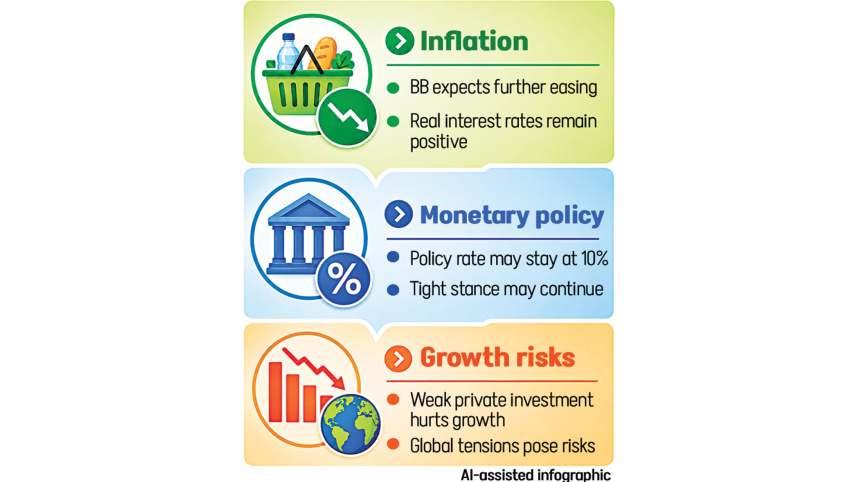
The Bangladesh Bank (BB) expects inflation to ease further in the coming months, saying its tight monetary policy has kept real interest rates positive and close to their estimated natural level, even as subdued private investment and mounting external uncertainties weigh on growth.
The findings are part of the central bank’s Monetary Policy Review 2025-26, which compared the current policy stance with a model-based estimate of the natural rate of interest.
 For all latest news, follow The Daily Star's Google News channel.
 The review comes as BB is set to unveil the Monetary Policy Statement (MPS) for the July-December period at 3:00pm today at its headquarters, with the rate widely expected to remain unchanged at 10 percent, according to officials.
BB has kept the policy rate, the rate at which commercial banks borrow from the central bank, unchanged at 10 percent since October 2024, following 11 consecutive hikes between May 2022 and October 2024.
“To curb persistent inflation, stabilise the foreign exchange market, and preserve the resilience of the external sector, Bangladesh Bank maintained its contractionary monetary policy stance by keeping the policy rate at 10 percent throughout the January 2025–June 2026 period,” BB Governor Md Mostaqur Rahman said in the report.
The report credited improving domestic supply conditions, together with its restrictive stance, for helping bring down inflation after more than two years of persistent price pressure. Point-to-point headline inflation fell to 8.49 percent in December 2025, from 10.89 percent a year earlier, though it remained above BB’s 7 percent target ceiling.
More recent data, however, suggest that progress has partly reversed.
In the report’s foreword, BB Governor Md Mostaqur Rahman said inflation stood at 9.42 percent in May 2026, up from 8.48 percent in June 2025.
He said Bangladesh’s economy had shown resilient signs of recovery in FY26 despite domestic structural challenges and dual global headwinds, including escalating geopolitical tensions and reciprocal tariff measures.
The review noted that the global economy performed better than expected in 2025, supported by strong demand, resilient trade, fiscal stimulus in major economies, and increased investment in technology and artificial intelligence.
However, it cautioned that growth prospects remain constrained by weak private investment, slowing export momentum, and external headwinds arising from external headwinds.
As per the report, geopolitical tensions in the Middle East continue to pose significant short-term risks. Global inflation is also expected to edge up in 2026 due to disruptions in energy supplies, higher commodity prices, renewed exchange-rate pressures, and rising transportation costs.
As a commodity-importing economy, it said, Bangladesh remains exposed to global energy and food price shocks that could push up import costs and strain the external sector.
Despite these challenges, BB remains optimistic that government social protection programmes, continued support for productive sectors, and its Tk 60,000 crore stimulus package would boost domestic consumption, encourage private investment, and support exports.
The central bank said it would continue to closely monitor both domestic and external developments to maintain price stability and safeguard macroeconomic stability.
The governor expects Bangladesh’s economic outlook to improve significantly, supported by the successful implementation of ongoing initiatives, structural and institutional reforms undertaken by the current government, and well-coordinated monetary and fiscal policies.


Comments