


Mida targets fisheries, marine economy for fresh investment
The Maheshkhali Integrated Development Authority (Mida) has stepped up efforts to attract investment in Bangladesh’s fisheries and marine economy by identifying four priority sectors and planning follow-up engagement with investors and relevant government agencies.
These matters were discussed at a seminar on “Investment Potential in Fisheries and Marine Economy in Bangladesh”, jointly organised by Mida, under the Prime Minister’s Office, and the Japan International Cooperation Agency (Jica) Bangladesh at Pan Pacific Sonargaon in Dhaka yesterday.

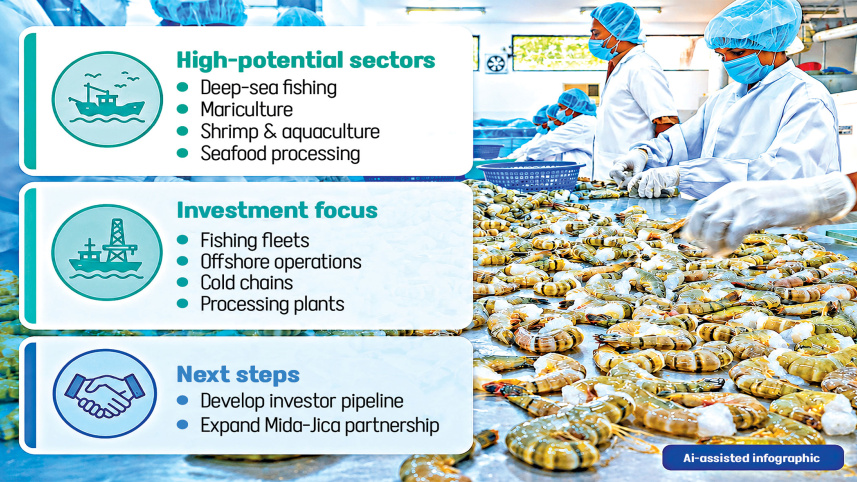
The seminar identified deep-sea fishing, mariculture, aquaculture and shrimp, and seafood processing as four high-potential sectors in which Bangladesh has significant resource potential but limited commercial-scale operations.
Discussions highlighted investment opportunities in industrial fishing fleets, offshore operations, landing and logistics systems, commercial mariculture, certified shrimp value chains, cold-chain infrastructure, and modern seafood processing facilities.
Mida Executive Chairman Ashik Chowdhury said Bangladesh’s marine economy has significant potential, but investors need a clearer pathway from opportunity to implementation.
As a follow-up to the seminar, Mida will develop a pipeline of investor interest based on expressions of intent from private-sector actors and development finance institutions seeking to pursue specific investment concepts
“We discussed the regulatory, infrastructural and institutional constraints that still need to be addressed, as well as the policy support and government commitment required to unlock investment. Important steps have already been taken, but Mida’s role now is to work with relevant agencies, investors and partners to turn the sector’s potential into bankable projects,” he said.
Ashik said that over the past few months, Mida had held several consultations and worked to help steer Bangladesh towards becoming “a genuine fishing exporting nation”.
“What I can guarantee you is that there is definitely a genuine intent on the part of the new leadership to make a much more coordinated effort across ministries to address investors’ challenges,” he said.
According to BSS, Ashik Chowdhury described Matarbari and Maheshkhali as strategic hubs for future marine industrial development, adding that Mida is working to align policies across the ministries concerned to create an integrated investment package tailored to private sector needs.
As a follow-up to the seminar, Mida will develop a pipeline of investor interest based on expressions of intent from private-sector actors and development finance institutions seeking to pursue specific investment concepts.
It will also consolidate the policy and regulatory bottlenecks identified through the presentations and panel discussions and take them forward through structured engagement with the relevant ministries.
The seminar also laid the foundation for continued collaboration between Mida and Jica on technical assistance and investment facilitation in the fisheries sector, with Mida set to follow up with interested investors through its investment desk.
Maritime expert and former secretary (Maritime Affairs Unit) at the Ministry of Foreign Affairs, Rear Admiral (Retd) Md Khurshed Alam, delivered the keynote address on investment opportunities in Bangladesh’s blue economy.
He said Bangladesh currently generates around $6 billion from its marine resources but has the potential to double or even triple that figure through sustainable exploitation of ocean resources, according to BSS.
Takahashi Naoki, deputy chief of mission and minister at the Embassy of Japan in Bangladesh, said the Japan-Bangladesh Economic Partnership Agreement, signed in February, had created an important foundation for expanding trade, investment and broader economic cooperation between the two countries.
He said both countries had reaffirmed the importance of promoting trade, investment and public-private cooperation in the food sector, including fisheries, while making full use of the opportunities created by the agreement.
Bangladesh’s fisheries and marine economy are not only traditional strengths but also promising frontiers for future investment, export diversification and regional development, he added.
The seminar brought together policymakers, senior government officials, development partners, fisheries experts, industry leaders, entrepreneurs and prospective investors to explore ways to unlock higher-value investment in Bangladesh’s fisheries and marine economy.
 For all latest news, follow The Daily Star's Google News channel.
Comments