


Budget goals hinge on deep institutional reforms: experts
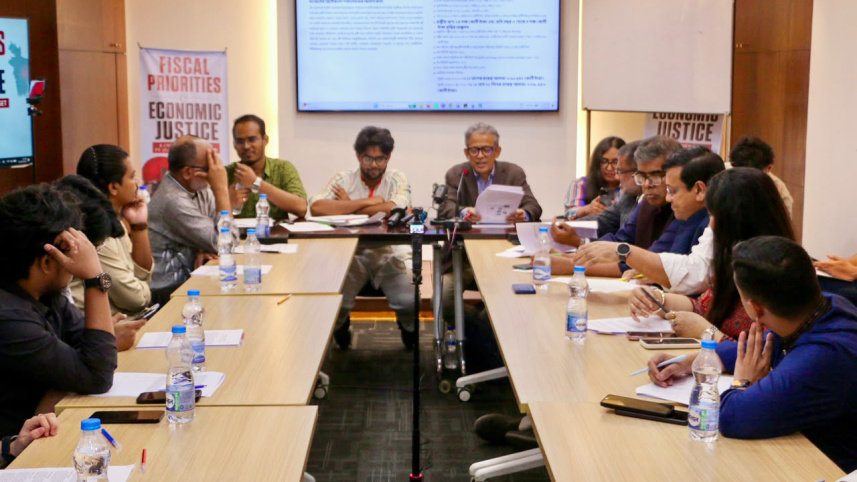
While the proposed national budget contains several positive signals, including business-friendly measures, tax incentives and investment promotion initiatives, experts have questioned whether its ambitious targets can be achieved in the current economic climate.
They said the budget’s success hinges on deep structural reforms in key institutions, particularly the National Board of Revenue (NBR) and the Anti-Corruption Commission (ACC). Without such reforms, implementation of the government’s fiscal agenda could prove difficult.

Economists, journalists and business leaders made the observations at a discussion titled Fiscal Priorities and Economic Justice: A Critical Review of the FY 2026-27 National Budget, organised by the Bengal Institute of Peace and Economic Development in Dhaka yesterday.
“Although the budget contains several encouraging measures for businesses and investors, the overall fiscal targets are highly ambitious. Achieving these goals without fundamental institutional reforms will be difficult,” said AKM Waresul Karim, a dean at North South University.
He said the budget sets aggressive targets for growth, investment and public expenditure, but the governance and institutional reforms needed to achieve them remain largely unaddressed.
In particular, the modernisation and digital transformation of the NBR are essential. Unless millions of taxpayers -- both individuals and businesses -- are brought under an automated tax administration system, the ambitious revenue target may remain unrealistic.
“In our view, unless tax administration is modernised and automation is expanded significantly, the government’s revenue targets may prove difficult to achieve.”
Failure to meet revenue targets could force the government to rely more heavily on domestic and foreign borrowing, increasing debt-servicing costs, weakening the country’s credit rating, creating pressure on private investment and reducing policy flexibility.
If revenue collection falls short, excessive borrowing could create long-term macroeconomic risks, including rising interest burdens and reduced fiscal space, he added.
Another concern lies in the banking sector. Although the government acknowledges political influence and non-performing loans, a clear reform roadmap remains absent. The government’s plan to borrow Tk 112,000 crore from the banking system could further crowd out private-sector investment.
The scale of borrowing may reduce credit availability for private businesses and discourage fresh investment, he added.
Towfiqul Islam Khan, an additional director for research at the CPD, said the government’s success should be judged by long-term implementation and the quality of expenditure rather than short-term budgetary targets.
A major systemic issue, he said, is the persistent reliance on inflated projections and the NBR’s conflicting dual role as policymaker and tax collector.
He stressed that although some revenue measures appear business-friendly, the budget contains unnecessary “fat”.
Kazi Jesin, a broadcast journalist and television talk show host, supported reforms such as cashless banking to curb rampant tax evasion. She criticised traditional metrics, noting that previous governments’ GDP growth failed to prevent widespread financial hardship, looting or poverty.
Urging political factions to stop making immediate calls for the government’s downfall, she argued that restoring investment and building trust require stability and unity.
“To make the budget effective, critics need to offer constructive suggestions rather than just predicting failure.”
Ultimately, true development lies in maximising human capital and technical training, she added.
Zina Tasreen, a senior sub-editor at The Daily Star, said the budget was not drafted with current realities in mind, failing to recognise that Bangladesh’s economy is experiencing stagflation.
“So there isn’t any workable way out of our current economic situation. The budget assumed that we can spend our way out of any problem, as in Western nations. But our reality is different: strained reserves.”
 For all latest news, follow The Daily Star's Google News channel.
 “The moment we go on expansion, our dollar reserves will deplete fast, and what will happen to inflation then? This is an elementary flaw of the budget.”
She said the budget also leaned too heavily towards a welfare-state model, meaning it does not sufficiently encourage capitalism, productivity and success.
“Can a nation move forward with that sort of a mindset? Globally, all successful welfare states are moving away from that, as it’s not sustainable. But, we, a poor and overpopulated nation, are heading that way.”
Fahim Mashroor, CEO of Bdjobs, said the budget measures have the touch of heart but lack the application of brainpower, reflecting good intentions and empathy while falling short in strategic thinking and practical execution.
Comments