


Exports falter, remittances rise: What does this tell us?
The policy puzzle is uncomfortable. Bangladesh ended FY2025-26 with a strong export rebound in June, yet the full-year export performance still slipped.
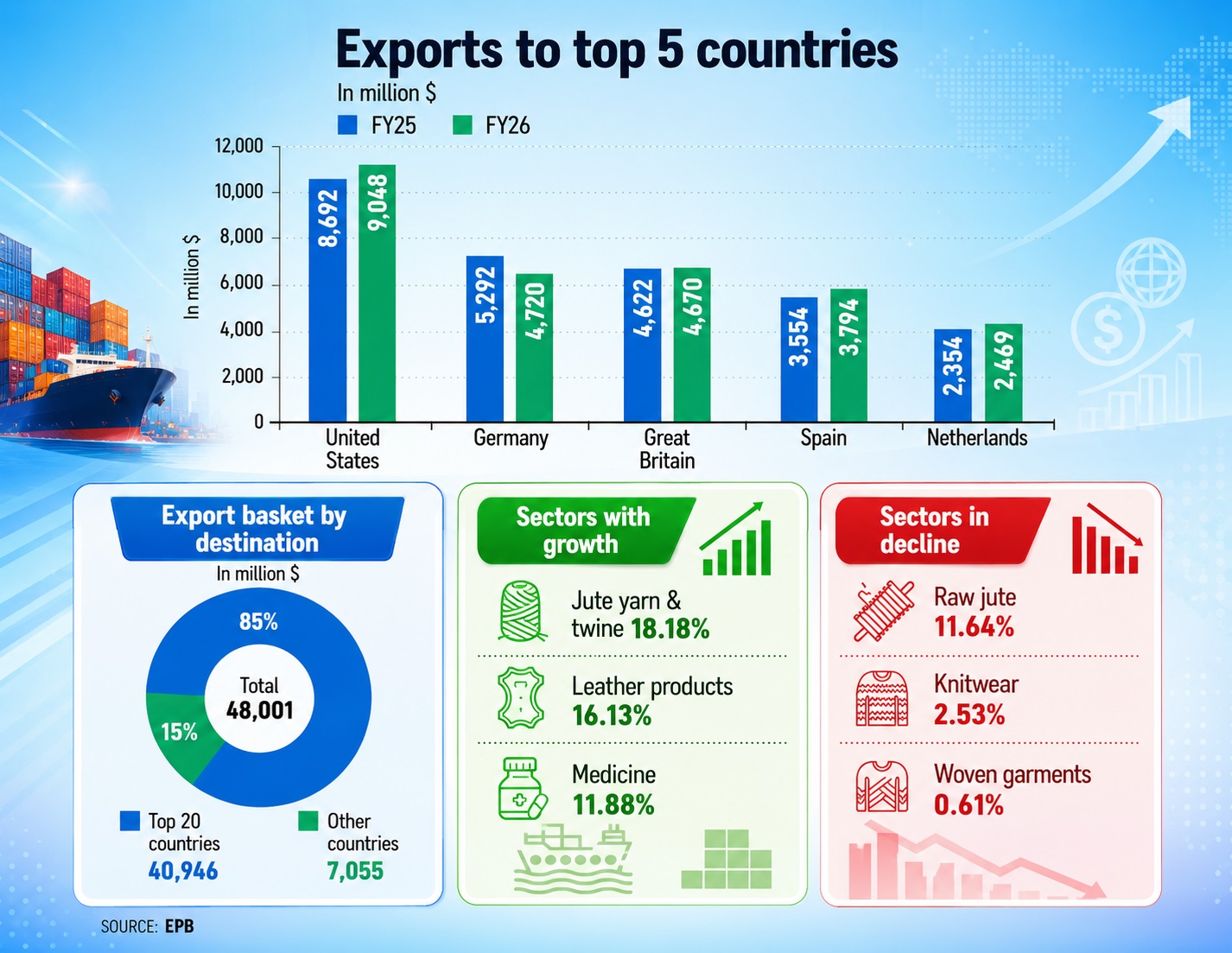
Exports stood at around $48 billion, down by 0.58 percent from the previous year, despite a sharp June increase. This means the rebound came too late to change the annual picture. It may signal some recovery in orders, delayed shipment adjustments, or short-term buyer confidence. But it does not prove that the export sector has regained strength.

The more serious issue is that the country’s main export engine, readymade garments, remains vulnerable. RMG earnings declined by about 1.64 percent, while non-RMG sectors showed some gains but remained too small to alter the overall trend. Bangladesh still exports too few products, to too few markets, through too narrow a production base.
This should not surprise us. For many years, export diversification has been discussed as a national priority, but the incentive structure has not changed sufficiently. Garments continue to dominate because the sector has scale, networks, buyers, and policy attention. New sectors face much higher barriers. They struggle with finance, certification, logistics, customs, technology, and market access. Smaller exporters often find that policy support exists on paper but not in practice. The political economy of exports is therefore central.
Established sectors receive protection and attention; emerging sectors receive speeches. As LDC graduation approaches, this gap will become more costly. Preference erosion, stricter compliance rules, carbon-related standards, and buyer pressure for traceability will test Bangladesh’s export model more severely than before.
The contrast with remittances is striking. Remittance inflows reached a record level in FY26, rising by more than 17 percent. This provided much-needed relief to the external sector. It helped ease pressure on the balance of payments, supported foreign exchange supply, and strengthened household purchasing power.
The shift towards a more market-based exchange rate and tighter control over informal channels may also have pushed more flows through formal systems. But this should not be mistaken for a structural solution. Remittances stabilise the economy; they do not transform it. They are earned through the labour of millions of migrants, many of whom work under difficult conditions abroad. The economy benefits, but the domestic production base does not automatically become more competitive.
The combined message is therefore mixed. Bangladesh’s external sector is not in crisis in the narrow sense, because remittances have provided a strong cushion. But it is also not secure.
A country cannot build long-term external resilience by relying mainly on low-wage garment exports and migrant workers’ earnings. Both channels are exposed to external shocks. A prolonged Middle East crisis could affect labour demand, recruitment, wages, and remittance flows. It could also raise global energy prices, increasing import costs and fiscal subsidy pressures.
At the same time, weak export growth limits job creation, investment, and industrial upgrading at home. This means the external account may appear manageable, while the underlying productive capacity remains fragile.
For FY2026-27, the export outlook should be cautious. A reasonable forecast would be modest growth of around 3 to 5 percent, taking exports to roughly $49.5 billion to $50.5 billion. A stronger outcome is possible if apparel orders recover steadily, energy supply remains stable, logistics improve, and non-RMG exports gain some momentum.
But there are clear downside risks: uncertain global demand, geopolitical tensions, energy shocks, and domestic cost pressures. The real task is not to celebrate one month of strong exports or take comfort from record remittances.
FY27 should be treated as a year of export repair. Bangladesh needs credible exchange-rate management, faster customs reform, lower logistics costs, more disciplined export incentives, stronger support for non-RMG sectors, and serious preparation for LDC graduation. Otherwise, the economy may remain externally afloat, but not externally strong.
The writer is a professor of economics at Dhaka University, and the executive director of Sanem.
 For all latest news, follow The Daily Star's Google News channel.
Comments