


FY26 exports slip despite $4.2b June rebound
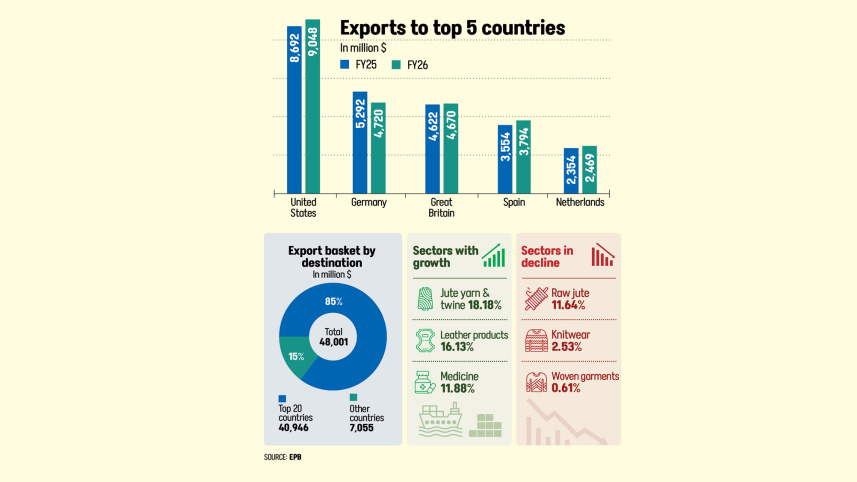
Bangladesh’s exports rebounded sharply in June, but the late surge was not enough to offset weak demand earlier in the year, leaving export earnings for FY2025-26 slightly lower than the previous year.
The country exported goods worth $4.2 billion in June, the last month of the fiscal year, marking a 26 percent jump from $3.33 billion a year earlier, according to provisional data released by the Export Promotion Bureau (EPB) yesterday.

Despite the strong finish, total export earnings for FY26 stood at $48 billion, a marginal decline of 0.58 percent from FY25.
The data came as Bangladesh recorded another milestone in remittance earnings, another major source of its foreign currency reserves. Inflows from overseas Bangladeshis exceeded $35.5 billion in the just concluded fiscal year, setting a new annual record.
The drop in exports came against the backdrop of a challenging global environment characterised by geopolitical tensions, persistent inflation, supply chain disruptions, energy market volatility and subdued consumer demand in major export destinations.
The EPB said the sector’s ability to hold earnings close to the previous year’s level reflected its resilience and adaptability.
The strong June performance was driven by growth across major sectors, including ready-made garments (RMG), leather and leather products, jute and jute goods, home textiles, engineering products and agricultural products.
The RMG sector, which accounts for more than four-fifths of Bangladesh’s export earnings, generated $38.70 billion in FY26, down 1.64 percent from the previous fiscal year.
However, some traditional export sectors performed better. Exports of leather and leather products, as well as jute and jute goods, recorded growth, reflecting improving demand and ongoing diversification efforts.
The United States remained Bangladesh’s largest export market, with shipments rising 4.1 percent year-on-year to $9.05 billion. Germany retained its position as the second-largest destination despite a 10.8 percent decline in imports from Bangladesh to $4.72 billion.
Exports to the United Kingdom increased 1 percent to $4.67 billion, while shipments to Spain rose 6.7 percent to $3.79 billion. The Netherlands completed the top five markets, with exports increasing 4.9 percent to $2.47 billion.
Fazlee Shamim Ehsan, executive president of the Bangladesh Knitwear Manufacturers and Exporters Association (BKMEA), said the sharp increase in June exports was largely due to the timing of Eid-ul-Azha rather than a recovery in global demand.
Knitwear exports rose 19.49 percent and overall apparel exports 21.52 percent in June, but the industry still experienced a 2.53 percent decline for the full fiscal year on weak global demand and low buyer prices, he said.
At the same time, production costs rose sharply. Wages increased by 9 percent, yarn prices by 10 percent, and the cost of dyes and chemicals by 15 to 50 percent, alongside higher energy and operating expenses.
“The situation has forced many factories to operate at a loss, while others have shut down altogether,” Shamim said.
Looking ahead, he said the outlook would depend significantly on US trade policy under President Donald Trump.
He expressed cautious optimism that the industry could begin recovering from September as buyers gradually rebuild inventories after two years of reduced purchases.
Md Nasir Khan, chairman and managing director of Jennys Shoes, said exports from the leather and leather goods sector increased only marginally as manufacturers continued to face rising production costs and financial pressures.
“Considering the increase in business expenses and borrowing costs, the improvement is not significant,” he said.
However, Nasir said the sector has substantial growth potential if longstanding business bottlenecks are removed. Simplifying business procedures, licensing requirements and regulatory processes would significantly improve competitiveness, he added.
 For all latest news, follow The Daily Star's Google News channel.
 Economists reading the numbers were similarly cautious. Selim Raihan, professor of economics at the University of Dhaka and executive director of Sanem, said the June rebound came too late to reverse the overall weakness in FY26.
“The increase in June may reflect delayed shipments or a temporary improvement in orders, but it does not necessarily signal a sustained recovery,” he said.
Raihan said the decline in garment exports highlighted the vulnerability of Bangladesh’s export sector. Although some non-RMG sectors recorded growth, their contribution remained too small to alter the overall trend.
He stressed the need for export diversification, lower logistics costs, customs reforms and stronger support for non-RMG sectors.
Abdur Razzque, chairman of the Research and Policy Integration for Development (RAPID), said June’s strong performance should also be viewed against a weak base, as exports in June last year were only $3.34 billion.
He added that the US Supreme Court’s ruling against President Donald Trump’s reciprocal tariff measures may have reduced uncertainty among US importers, prompting some apparel buyers to release delayed orders or accelerate shipments.
Bangladesh is likely to see a modest recovery rather than rapid expansion, Razzque said. To sustain export growth, the country must improve competitiveness through reliable energy supplies, better logistics, lower business costs and measures to address the erosion of price competitiveness caused by persistent inflation.


Comments