


Fertiliser subsidies eat up budget as livestock, poultry starve
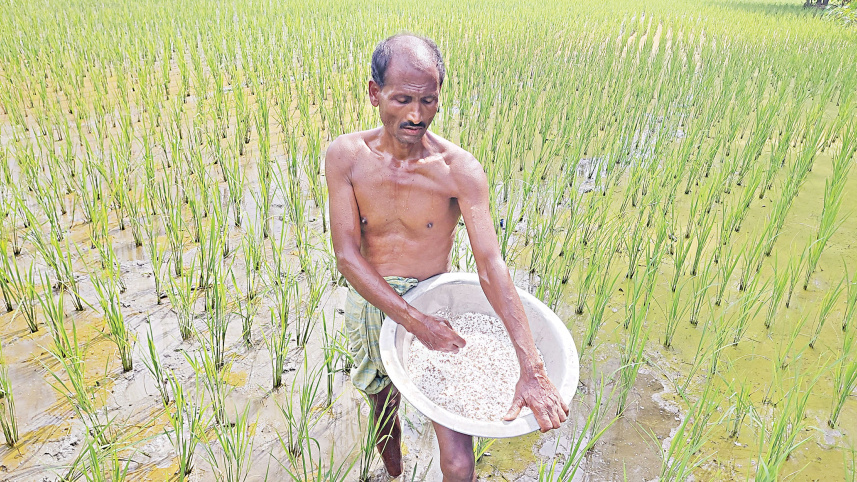
Fertiliser subsidies consume nearly 80 percent of the agriculture ministry’s budget, while faster-growing subsectors such as livestock, poultry and fisheries receive little to no direct subsidy, according to a recent policy note by the International Maize and Wheat Improvement Center (CIMMYT).
In the note titled “Fertilizer, Fiscal Risk, and Food Security: Rationalizing Bangladesh’s Subsidy System in an Era of External Shocks”, CIMMYT’s Dr Ravi Nandi and Dr Wais Kabir, former executive chairman of the Bangladesh Agricultural Research Council, call for a gradual reform of the fertiliser subsidy system.

Calling the subsidy system inefficient, inequitable and fiscally unsustainable, the report explains that giving such a large cut of the fertiliser subsidy to rice farming not only disproportionately benefits large farmers, but it also takes away investment that could otherwise be used for higher-return areas -- such as research, irrigation, livestock, poultry, fisheries, and climate resilience.
The report recommends moving away from blanket subsidies towards targeted support, balanced nutrient management, stronger extension services and greater agricultural diversification, while protecting food security and farmers’ livelihoods.
A GLARING BUDGET IMBALANCE
The agriculture sector’s share of the national budget has declined over the years, while fertiliser subsidies have continued to account for a large share of the allocation.
The June 2026 World Bank assessment cited in the CIMMYT note says fertiliser subsidies absorb nearly 80 percent of the agriculture ministry’s entire allocation.
At the same time, the crop sector has recorded average growth of around 2.5 percent, compared with about 3.5-5 percent for fisheries, livestock and poultry.
The crop sector receives about 85-90 percent of total agricultural subsidies, according to the note. Fisheries, livestock and poultry, meanwhile, receive little to no direct subsidy and instead rely on indirect support measures such as tax holidays, electricity rebates and feed import duty waivers.
Fisheries and livestock together account for around 39 percent of agricultural GDP and have continued to grow faster than the crop sector, highlighting what the authors describe as an investment-productivity gap.
THE EXTERNAL-SHOCK RISK
Bangladesh imports around 75-80 percent of its fertiliser and fixes retail prices before each season. This means global price shocks can translate directly into higher pressure on the public budget.
The 2026 disruption in the Strait of Hormuz pushed urea prices up by 70-80 percent, while five of the country’s six urea factories closed because of gas shortages, according to the CIMMYT note.
The Bangladesh Chemical Industries Corporation responded by arranging emergency purchases and identifying alternative sources, underscoring the vulnerability of the subsidy system to disruptions in global markets and domestic gas supply.
The authors also argue that blanket price subsidies can encourage excessive fertiliser use, increasing consumption without generating proportional gains in crop yields.
Meanwhile, changing consumption patterns are creating greater demand for high-value, protein-rich foods. The report says urbanisation and rising incomes are contributing to a gradual shift away from cereal-dominated diets, although the diversification of agriculture remains slow.
WHY REFORM MATTERS
The authors draw on a 2021 study by the International Food Policy Research Institute and CIMMYT covering Bangladesh, India, Nepal and Sri Lanka to outline key lessons for subsidy reform.
They say reforms must be fiscally sustainable and politically feasible, noting that previous ambitious measures were reversed amid political resistance and food security concerns. Changing fertiliser prices alone is insufficient; farmers also need information, advisory services, appropriate incentives and better access to soil testing.
The authors cite Sri Lanka’s abrupt shift towards organic fertiliser in 2021 as a cautionary example. Two studies published in 2026 found that the reform, introduced without adequate preparation, was followed by harvest declines for 44 percent of farmers, food price inflation of more than 50 percent and consumption cutbacks in 90 percent of households.
 For all latest news, follow The Daily Star's Google News channel.
 For Bangladesh, the report recommends a gradual, well-sequenced transition, combining diversified fertiliser supply sources, targeted subsidies, incentives for balanced nutrient use and greater investment in research, extension, irrigation, livestock, fisheries and climate resilience.
The 2026 crisis offers an opportunity to begin these reforms before another global shock, the authors conclude, warning that inaction could undermine not only fiscal sustainability but also long-term agricultural productivity, equity and resilience.
Comments