


The answer to children’s online risks is not a social media ban

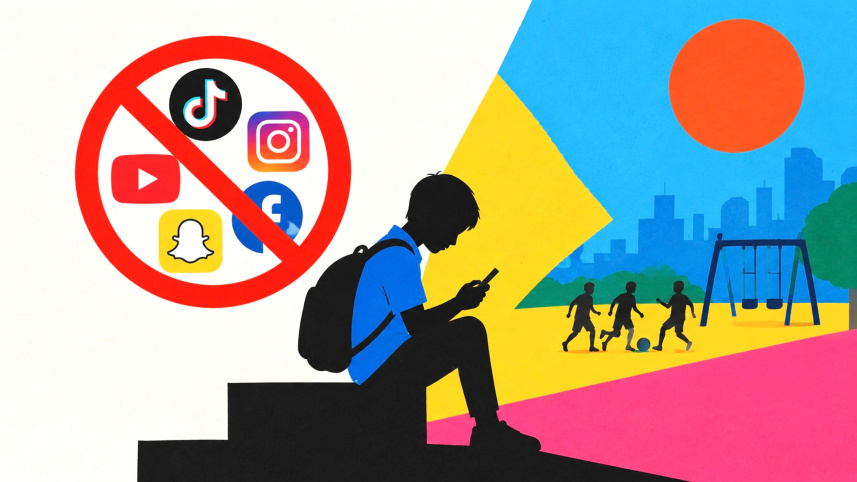
The killing of 13-year-old Ishiat Shahriar Oprotim in Cumilla has ignited a debate, among others, over children’s access to digital media, with some asking: is it time for Bangladesh to ban social media for children under 16? Oprotim was abducted and killed allegedly by a 19-year-old who was trying to build a gang recruited through TikTok and who wanted his iPhone. So, the case has become a symbol of a larger fear that platforms built for adults are now shaping, and sometimes ending the lives of children who perhaps should not have been using those platforms in the first place. The instinct to reach for a ban is easy to understand. That said, everywhere this has been tried so far, the evidence says it does not actually work.
Australia banned social media accounts for under-16s in December last year and similar restrictions quickly followed or are being developed, in different forms, by several countries including Denmark, Spain, Indonesia, Malaysia, Turkey, Austria, Brazil, the United States and the United Arab Emirates. Britain’s version is expected to arrive early next year, and the European Union is drafting a continent-wide EU Kids Act, restricting under-15s to supervised accounts. Each of these rests on the same diagnosis: platforms like Facebook, TikTok, Instagram, Snapchat and YouTube are built to be addictive, expose children to predators and harmful content, and damage adolescent mental health in ways research increasingly confirms. While almost nobody disputes the diagnosis anymore, what remains very much in dispute is whether a ban is the right treatment.

In March, three months after Australia’s ban, the country’s eSafety Commission found that roughly seven in 10 parents whose children already had accounts said their teenagers were still using the very platforms they were supposed to have lost. According to a report in June, journalists testing the facial-recognition checks used by TikTok, Instagram and Facebook found teenagers beating those with a sibling’s face, or even a printed photograph. Indonesia and Malaysia have struggled to get global platforms to comply at all, and France’s ban was struck down by its highest court within weeks, on free-expression grounds. Mizuko Ito, who has studied teenagers and technology at the University of California, Irvine for 30 years, puts it simply: social media behaves less like a contaminant that can be removed than a circulatory system that finds new channels when one is blocked.
If wealthy, well-resourced states are struggling to enforce this kind of law, Bangladesh is likely to struggle far more. The first problem is leverage. Our government has almost no real hold over the platforms it would need to police, since none of them are bound by Bangladeshi law or answerable to its courts in any serious way. The European Union can threaten Meta or TikTok with fines worth 6 percent of their global revenue. But the Bangladesh Telecommunication Regulatory Commission can, at best, ask nicely, without expecting anything significant in return. So, perhaps the only real alternative is monitoring citizens’ online activity for potential dangers or warning signs, which, however, could help build the kind of surveillance apparatus that already worries rights groups in Bangladesh.
Verification itself would fail on more basic grounds. Even Australia, with a dedicated regulator and a working national identity system, relies mainly on facial-age-estimation software that Tony Allen, of the UK’s Age Check Certification Scheme, has said can be spoofed roughly one time in 20 on any single attempt, and considerably more often with a little preparation. Bangladesh has nothing like the European Union’s proposed age-verification app, and our birth registration and national identity systems, while improving, still have real gaps, particularly for children in poorer or more remote households. A ban built on this foundation would end up policing only the children who are easiest to track, those in visible, documented, middle-and-upper-class homes, while leaving everyone else just as exposed. That is not protection, but the appearance of protection, handed out unevenly.
The main force pushing our children onto phones is, if anything, stronger than in the countries now trying to legislate this away. Dhaka and other cities have chronically few playgrounds, parks or safe public spaces. In fact, 10,740 schools across the country reportedly have no playground at all. So, a screen becomes, in practice, the only “outdoors” many children get. According to a study, children spend an average of 4.6 hours a day on screens, including smartphones, computers, TVs and gaming devices. Without creating proper alternatives for how children can spend their leisure time, restricting social media may only make their lives even more miserable. The increasing reliance on some social media platforms for educational purposes complicates things further.
Such a restriction would also not directly address what supposedly created the conditions for Oprotim’s death. Cities like Cumilla have had loosely armed teenage gangs—with distinct names, hierarchies, motorcycles and turf—for quite a few years now, long before short-form video existed in its current form. Social platforms like TikTok gave that old phenomenon a digital opening and a new stage to perform status on, but they did not invent it. Cumilla’s Superintendent of Police noted that most arrested gang members are juveniles who are released quickly and drift back to the same groups, because Bangladesh has neither the social workers nor the juvenile justice capacity to intervene. In fact, over 600 members of teen gangs have been detained in drives conducted in Cumilla following Oprotim’s death. But as the super mentioned, such detentions have little impact in preventing the formation of new gangs. Removing one recruitment channel while leaving the vacuum of alternatives untouched only leads to recruitment elsewhere. It simply becomes less visible to parents and eventually to regulators too.
But of course, this is not to suggest that Bangladesh should or can do nothing. It just means being honest about which responses might actually work. Proper digital literacy in schools could give children tools that remain useful even when they switch apps. Pressure on platforms to redesign the features that make them addictive, rather than simply restricting who may open an account, is what the United Nations’ human rights chief, Volker Türk, has urged in place of blanket bans, because it targets the business model rather than the child. Investment in playgrounds, youth clubs and after-school activity addresses the actual reason so many children end up alone with a phone in the first place. Dismantling the culture of political patronage enabling teen gangs to operate with impunity is also part of the answer. None of these delivers a clean win, but combining them seems more realistic.
Jannatul Naym Pieal is a writer, researcher, and journalist. He can be reached at jn.pieal@gmail.com
Views expressed in this article are the author's own.
Follow The Daily Star Opinion on Facebook for the latest opinions, commentaries, and analyses by experts and professionals. To contribute your article or letter to The Daily Star Opinion, see our guidelines for submission.
 For all latest news, follow The Daily Star's Google News channel.
Comments