


Govt may drop planned wealth tax, bike and rickshaw AIT

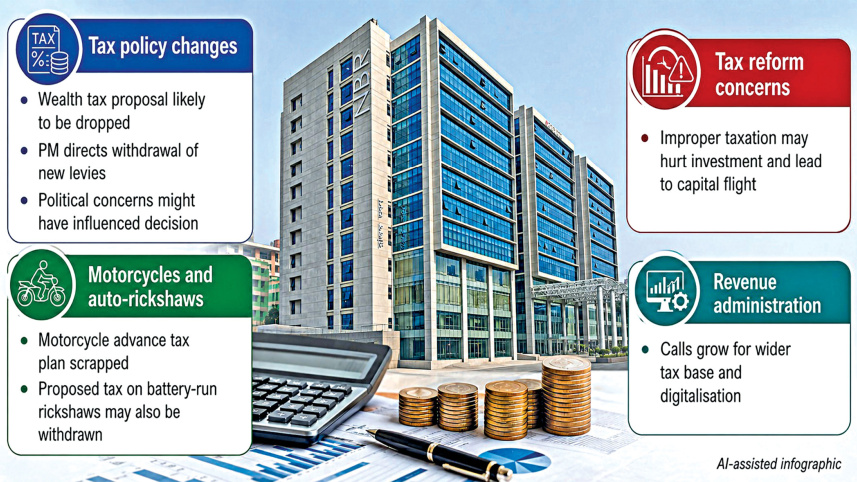
The government is set to backtrack from its plans to reintroduce a wealth tax and impose a first-ever advance income tax (AIT) on motorcycles and battery-run auto-rickshaws in the upcoming budget for fiscal year 2026-27, according to officials familiar with the matter.
The development follows Prime Minister Tarique Rahman’s directives to scrap the proposed levies, they said.
 For all latest news, follow The Daily Star's Google News channel.
 The planned AIT sparked public backlash and street demonstrations by motorcycle owners and ride-share drivers. Such pressure might have contributed to the reversal, finance ministry officials said. On the wealth tax, officials did not disclose specific reasons for the decision but hinted that political considerations may have played a role.
“We worked extensively on the wealth tax and developed what we believe was one of the most comprehensive proposals aligned with global standards. However, the government did not accept it,” said a senior official of the ministry, requesting anonymity.
The proposed wealth tax had been designed to be calculated on net wealth declared in tax returns, given the difficulties in assessing market values of assets. The National Board of Revenue had also planned to gradually build a system for valuing assets at market prices.
Under the proposal, net wealth up to Tk 4 crore would have been exempt, in line with the existing wealth surcharge threshold. Wealth between Tk 4 crore and Tk 6 crore would have been taxed at 0.25 percent, followed by 0.50 percent on the next Tk 5 crore, 0.75 percent on the subsequent Tk 5 crore, and 1 percent on wealth exceeding Tk 16 crore.
Mustafizur Rahman, distinguished fellow at the Centre for Policy Dialogue (CPD), said Bangladesh already has a wealth surcharge in place, but a separate wealth tax could still be justified if its slab structure is carefully designed.
“The government may be taking additional time to study the proposal, particularly its impact on the overall tax burden,” he said.
He noted that the outcome would depend largely on how the slabs are structured and whether further technical refinement is needed.
Rahman observed that while a wealth tax was intended to align with international standards, its rationale is already partly reflected in the existing surcharge system.
He said a surcharge differs structurally from a wealth tax, as it is applied on top of tax liabilities rather than directly on wealth.
The policy expert cautioned that any shift toward a wealth tax must account for the fact that wealth is often accumulated from already-taxed income, and should be designed to avoid discouraging investment or triggering capital flight.
At the same time, he said there is merit in moving toward a more formal and structured wealth taxation framework.
On broader reforms, he stressed the need to expand the tax base and strengthen enforcement, noting that although many taxpayers hold Taxpayer Identification Number (TIN), only about a quarter actually pay taxes.
He also called for greater digitalisation, reduced human interface in tax administration, and improved governance to enhance revenue collection.
AIT on motorcycles, rickshaws
The proposed AIT on motorcycles above 110cc sparked protests outside the NBR last week, with bikers and ride-sharing workers staging demonstrations against the planned measure.
The proposal also drew widespread criticism on social media, with users arguing that motorcycles have become an essential means of daily transportation and livelihood, not merely recreational vehicles.
In response, Prime Minister Rahman first directed that the proposed tax be halved, and later ordered it withdrawn entirely, said officials familiar with the matter.
Owners of motorcycles with engine capacities above 150cc will, however, still be required to obtain a TIN.
The tax authority had also planned to impose AIT on the growing fleet of battery-run auto-rickshaws.
Under that proposal, such vehicles operating in city corporation areas would have faced an annual AIT of Tk 5,000, those in municipal areas Tk 2,000, and those in union parishad areas Tk 1,000.
The government is now expected to drop that proposal as well amid concerns over public backlash, according to officials involved in the process.
Comments