


Govt repurchases Tk 1,716cr T-bonds in first-ever buyback auction
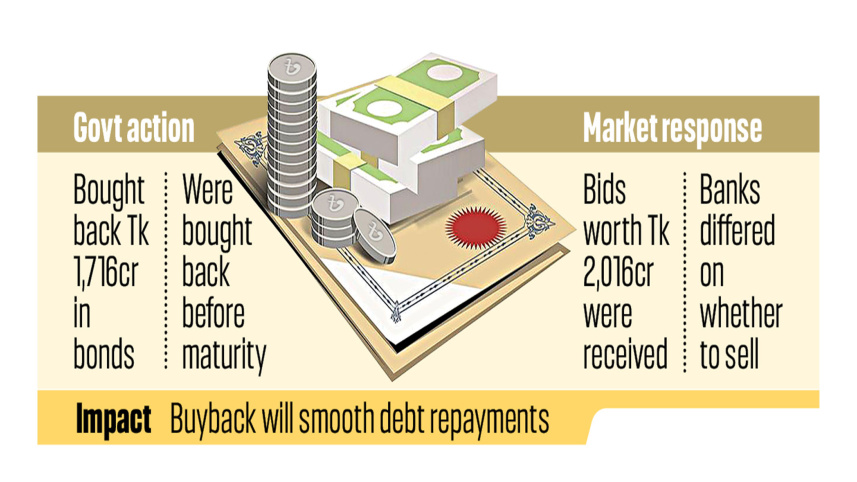
The government has bought back Tk 1,716 crore worth of two-year treasury bonds before their maturity in the country’s first-ever government bond buyback auction, opening a new way for it to manage when and how its debt is repaid.
It means the government can now reduce the amount of debt that comes due at a particular time instead of waiting for all the bonds to mature and repaying investors in one go. Besides, such repurchases could help spread out future repayments and give the government more flexibility in managing its borrowing costs and risks.

The Bangladesh Bank conducted the buyback auction yesterday on behalf of the Finance Division. The bonds were issued on November 4, 2024 and were due to mature next month.
The central bank invited bids to buy back up to Tk 6,666.58 crore of the bonds through a multiple-price reverse auction.
It received 56 bids worth Tk 2,016.14 crore and accepted bids worth Tk 1,716.14 crore at the rates set by the auction committee.
The settlement is scheduled for October 12.
A buyback allows the government to repurchase bonds it has already sold before they mature. In effect, investors get their money back early, while the government reduces the amount it will have to repay when the bonds reach maturity.
The central bank described yesterday’s auction as a new, market-based approach to managing public debt.
It said the move would make the maturity structure of government debt more balanced, provide greater flexibility in future borrowing and create scope to manage borrowing costs and risks more effectively.
The central bank said further buyback auctions would be held when necessary, depending on market conditions, liquidity, investor demand and the structure of government borrowing.
A Bangladesh Bank official said the government normally repays such bonds only when they mature. “Usually, the government has to pay interest until maturity. Since these bonds were bought back about a month early, the government will not have to pay interest for that month,” he said.
But the bigger benefit, according to the Finance Division, is managing the repayment schedule rather than simply saving a month’s interest.
The finance ministry said the buyback would reduce the burden of large repayments falling due at the same time, lower refinancing risk and help make the government securities market more efficient.
“A buyback allows the government to repurchase outstanding securities from the market before maturity, and it is a widely recognised Liability Management Operation (LMO) tool,” the ministry said in a statement.
As of March 2026, the government’s outstanding debt through treasury bonds and special purpose treasury bonds stood at Tk 6,28,168 crore. Debt through shariah-based bonds, or sukuk, stood at Tk 36,500 crore, according to finance ministry data.
The ministry said the buyback marked a step towards more active, modern and market-based debt management and was part of efforts to balance the cost and risk of public borrowing.
The government may conduct more buyback auctions in line with its Medium-Term Debt Management Strategy, taking into account market conditions, liquidity, investor demand, its cash position and the structure of public debt, the ministry said.
The auction also gives banks another option for managing their holdings of government bonds. Banks that need cash can sell some of their bonds before maturity, while those that are comfortable holding them can wait for repayment.
Market reaction, however, has been mixed. Some banks, especially those facing liquidity shortages, are interested in selling, while others prefer to hold the bonds until maturity.
Md Ezazul Islam, director general of the Bangladesh Institute of Bank Management (BIBM), said the government was buying back the bonds to reduce its interest burden and the number of bonds in the market.
 For all latest news, follow The Daily Star's Google News channel.
 But he questioned the timing. “It is not a wise decision to start buybacks just a month before maturity,” Ezazul said. “Most banks now have excess liquidity because of weak loan demand, so they would not be interested in selling their bonds.”
Comments