Bangladesh’s solar growth: Will the incentives be enough?

Bangladesh is betting on rooftops to help power its energy future—but will the promise of a guaranteed payment be enough to make people invest? In 2026, the government launched a special incentive package for rooftop solar, particularly systems paired with battery storage. The ambition is bold: expand renewable energy, ease pressure on the national grid, and strengthen energy security. Under the scheme, eligible consumers can sell surplus electricity to the grid for Tk 10.50 per unit. That rate starts with a benchmark generation cost of Tk 8, then adds a 20 percent profit margin and an 11.25 percent premium. Consumers who can generate power for less than the benchmark cost keep the difference as extra profit. But behind the attractive headline rate lies a bigger question: can this incentive deliver the solar growth Bangladesh is counting on?
The incentive is time-limited. Rooftop systems installed by February 28, 2027, qualify for the tariff, with payments continuing for three years, until February 28, 2030. The scheme also requires solar equipment—including panels, batteries, inverters and meters—to meet technical standards set by the Bangladesh Standards and Testing Institution and the Sustainable and Renewable Energy Development Authority. Distribution utilities will record electricity supplied to and received from the grid, and incentive payments will be made through bank accounts or mobile financial services.
A tariff alone, however, cannot overcome the financial, regulatory and practical risks that shape investment decisions. Several features of this policy may limit how much solar growth it produces.
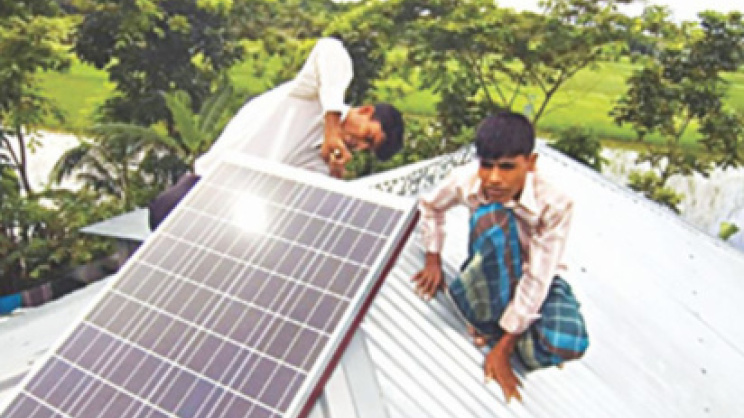
Tk 10.50 may not be enough to justify the investment
The first question is whether Tk 10.50 per unit offers a strong enough return to encourage consumers and businesses to invest. The figure may look attractive, but the purchase tariff is only one part of the investment calculation. Rooftop solar systems with battery storage require substantial upfront capital. Investors must also account for financing costs, equipment replacement, maintenance, installation and the possibility that project costs will rise.
The return also depends on how much electricity a system can supply to the grid. A household or business will generally use some of its solar power on site; only the surplus is eligible for the purchase tariff. The resulting revenue may therefore be lower or less predictable than the headline rate suggests. Battery storage adds cost, and its performance and replacement needs affect the project’s long-term economics.
Investors also consider the opportunity cost of their capital: money spent on solar cannot be used for other business or household purposes. A three-year guaranteed payment may not be enough to compensate for the upfront investment and the risks involved, particularly if the project’s overall financial return depends on what happens after the guaranteed period ends.
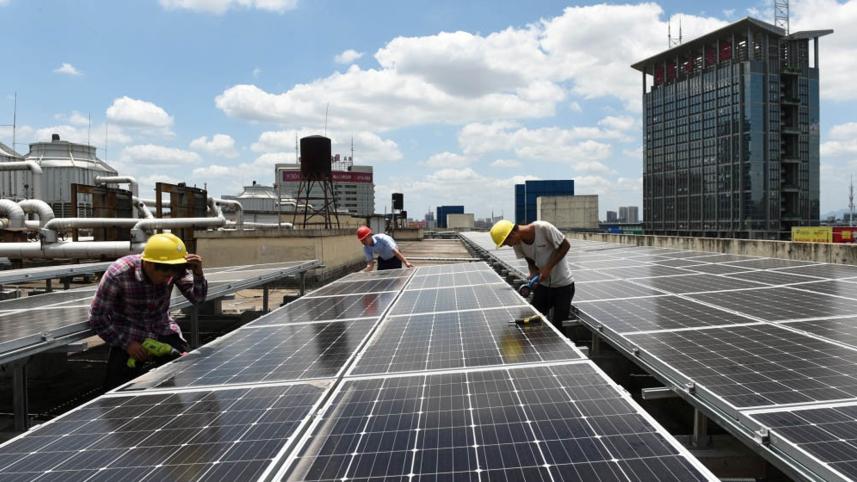
A short eligibility window can discourage careful investment
The second concern is the short time available to qualify. The scheme applies to systems installed by February 28, 2027, giving consumers a limited window to decide, secure finance, obtain approvals, procure compliant equipment and complete installation. A deadline can prompt action, but it can also encourage rushed decisions or exclude viable projects because of delays beyond investors’ control.
The timing compares unfavourably with approaches that give developers more time to respond. Vietnam, for instance, offered a time-bound feed-in tariff for one year. A longer eligibility window can give households, businesses and installers time to understand the rules, arrange financing and build projects without sacrificing quality. In Bangladesh, where procurement, approvals and installation can take time, a short deadline may reduce participation rather than accelerate it. Projects rushed to meet the deadline may also fall short of the required standards and end up as stranded investments.
A limited window is especially problematic when investors are uncertain about what happens after it closes. Consumers may be reluctant to make a major purchase if the guaranteed tariff is available only to systems completed by a particular date, because a project started in good time may still finish late. Short deadlines may also create bottlenecks, as applicants all seek approvals and equipment in the run-up to the deadline.
Three years of revenue certainty may not be enough
The third issue is the duration of the guaranteed price. The scheme offers Tk 10.50 per unit for three years, through February 2030. That commitment provides some predictability, but rooftop solar systems and batteries are long-term assets. Investors need to consider returns over a much longer period than the tariff’s guaranteed term.
Vietnam’s feed-in tariff was guaranteed for 20 years, giving investors a far longer period of revenue certainty. Such commitments helped make projects financeable, particularly as solar technology costs gradually declined. When investors can estimate revenue over many years, they can compare it more confidently with installation costs, financing payments and operating risks.
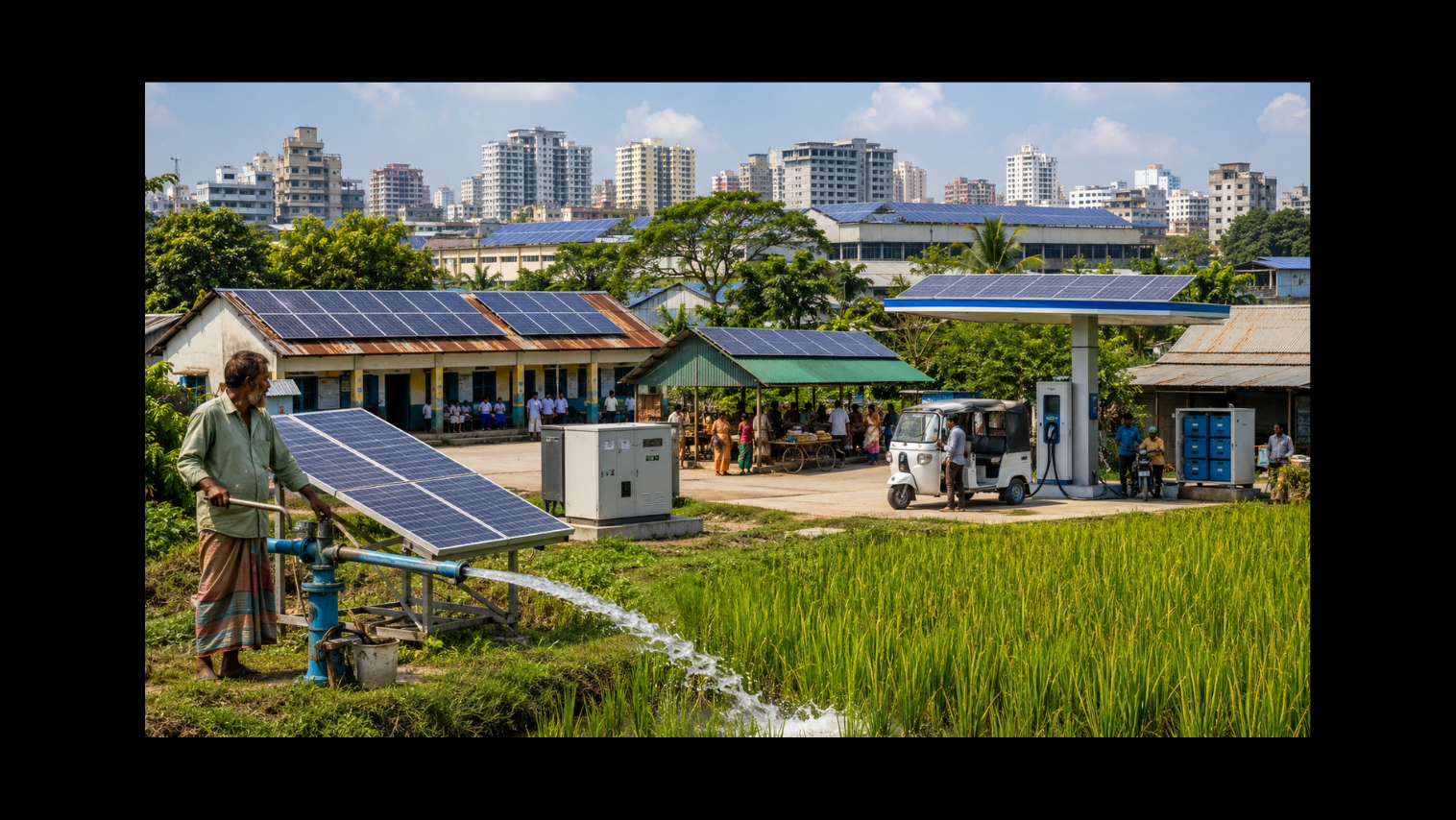
In Bangladesh, uncertainty about future electricity prices complicates that calculation. The government has recently increased oil and furnace-oil prices, while coal prices remain exposed to international volatility and geopolitical disruption. If the cost of conventional electricity rises, the government may eventually increase the price consumers pay for electricity or revise the value of power supplied to the grid. Investors may therefore wonder whether Tk 10.50 will remain attractive. If electricity prices rise above that level in the next few years, a three-year guarantee may seem too short to justify investing now.
This uncertainty creates two kinds of risk. Investors might expect higher future electricity prices but have no assurance that the solar purchase tariff will rise with them. They may also fear that a change in policy will alter the terms under which their project was approved. A predictable long-term framework is often more valuable than a nominally attractive tariff whose future is uncertain.
Incentives cannot substitute for risk-reducing policy
The fourth issue is the wider investment environment. Financial incentives can influence a decision, but they are most effective when supported by clear rules that reduce risk. In Bangladesh, prospective investors may still face uncertainty about future electricity prices, potential cost escalation, bureaucratic delays, the time required to complete projects and the process for receiving payments.
These risks matter because an incentive’s headline value is not the same as guaranteed profit. A business calculates expected earnings after considering the chance that costs will rise, approvals will be delayed or a project will miss the eligibility deadline. Unclear procedures may raise financing costs, while delays can postpone revenue and undermine returns. Requiring compliant equipment is sensible for safety and performance, but standards and certification processes must be transparent and readily accessible.
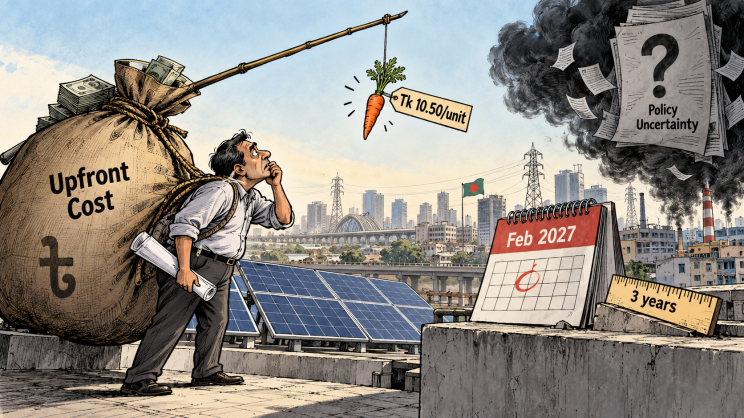
The government could strengthen the scheme by clarifying application procedures, setting predictable timelines for approvals and payments, and explaining how tariff eligibility will be treated when delays are outside an applicant’s control. It should also communicate what happens after February 2030 and whether future projects will receive a similar arrangement. Such steps can lower perceived risk without necessarily increasing the purchase tariff.
Merchant solar faces additional barriers
The incentive package must also be assessed alongside the challenges faced by merchant power plants—solar projects built to sell electricity to buyers, unlike rooftop systems that mainly serve their owners. These projects may need land, grid access and dependable buyers. Acquiring agricultural land for large solar plants raises concerns about competing land uses, livelihoods and food production. Even where suitable sites exist, developers need clear rules and a credible process for obtaining land and permits.
Open-access rules allow private generators to use the grid to deliver power to customers, in return for wheeling charges. But those charges can erode solar’s price advantage. The 2026 framework lists transmission wheeling charges of about Tk 0.46 per unit at 230 kV, Tk 0.49 at 132 kV and Tk 0.79 at 33 kV. Additional distribution and injection charges are reported at Tk 0.97–1.58 per unit, depending on voltage. These fees may reflect network costs, but they add to the delivered price and complicate project economics.
A proposed benchmark price of Tk 6.48 per unit for solar merchant power plants may also be too low to attract investment. Developers must absorb land, financing, grid and administrative costs, and they bear risks that the benchmark may not reflect.
The incentive fails to account for solar’s cost advantage over other energy sources
The case for solar becomes clearer when its price is viewed alongside the cost of other electricity sources. Recent estimates put furnace-oil generation at roughly Tk 20.69–27.39 per unit, with higher costs reported during peak or emergency use. Coal-based generation is estimated at around Tk 13.20–15 per unit. Domestic gas-fired electricity can cost about Tk 7.09 per unit. Electricity produced with imported or spot LNG is far more expensive: estimates range from Tk 30 to Tk 50 or more per unit. These estimates are not perfectly comparable, as costs vary by plant, contract, fuel prices and operating conditions. Still, they show that solar, at a benchmark generation cost of Tk 8 per unit, can be cheaper than several of the alternatives Bangladesh relies on.
The power system may therefore pay for the availability of fossil-fuel plants as well as for the electricity they generate. Solar investors, by contrast, put up their own capital and are paid only for the electricity they actually supply.
The comparison matters even more because many conventional power plants receive capacity charges for keeping generating capacity available, even when they are not producing electricity. Rooftop solar receives no capacity payment. The power system may therefore pay for the availability of fossil-fuel plants as well as for the electricity they generate. Solar investors, by contrast, put up their own capital and are paid only for the electricity they actually supply.
Solar’s lower generation cost and the absence of a capacity charge should make it attractive from the perspective of system costs. Yet the Tk 10.50 purchase tariff, the short eligibility window and the limited three-year guarantee may not provide enough certainty or return to attract investment at scale. The low cost of solar does not automatically translate into a strong business case for households and firms if they bear substantial upfront costs and risks.
Policy certainty is essential for growth
Bangladesh’s 2026 rooftop solar package is a welcome effort to create demand and reward consumers who supply surplus electricity to the grid. It recognises that solar can help diversify the power mix and reduce reliance on costly imported fuels. Yet its impact will depend on more than the purchase tariff. Investors need to know that revenues can justify capital costs and risks, that rules will be applied consistently, and that projects can be completed and connected on time.
The country’s broader energy plans also matter. If the government intends to add more coal-based power plants and LNG terminals, it sends a mixed signal to solar investors. It may suggest that the long-term strategy remains centred on fossil fuels, even as the government offers incentives for renewables. That ambiguity can weaken confidence in the durability of solar support.
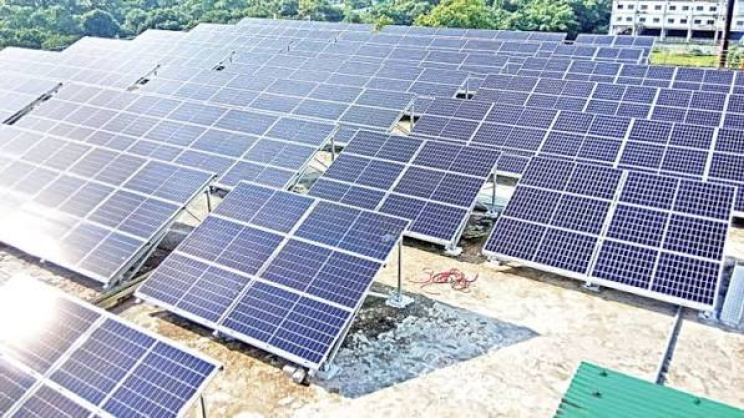
This tension is especially significant in a country with excess generation capacity, where consumers already face high electricity prices driven partly by capacity charges. New generating assets may add to system costs even when they are not fully used. Expanding solar is therefore not only a matter of offering an incentive; it is also a question of whether planning, procurement and grid policy consistently favour least-cost and reliable options.
The three-year Tk 10.50 tariff and limited eligibility period may help some consumers install rooftop systems, but they may not be enough to trigger growth at scale. A stronger policy would combine fair compensation with longer-term predictability, efficient approvals, transparent grid-access rules and a credible plan for integrating renewable energy into future power planning. Policy certainty is essential. Without it, even a promising incentive may fail to turn solar potential into a significant investment.
Dr Moshahida Sultana is an energy researcher and Associate Professor in the Department of Accounting at the University of Dhaka.
Send your articles for Slow Reads to slowreads@thedailystar.net. Check out our submission guidelines for details.

The missing link in Bangladesh's innovation economy

Dhaka’s battery rickshaw problem is economic, not just about traffic

The staircase between our mothers and care

Is Bangladesh prepared for the next food shock?
From more power to better power: Rethinking Bangladesh’s energy future

Growing out of LDC status: Bangladesh’s real negotiation at COP31
What is holding back solar in Bangladesh’s garment industry?

Confessions of a finance professor: The danger of putting profits first

The making of a cup of tea: Plantation, empire and the pursuit of quality