


Haor Boro loss 1.25 lakh tonnes higher than govt estimate: CPD

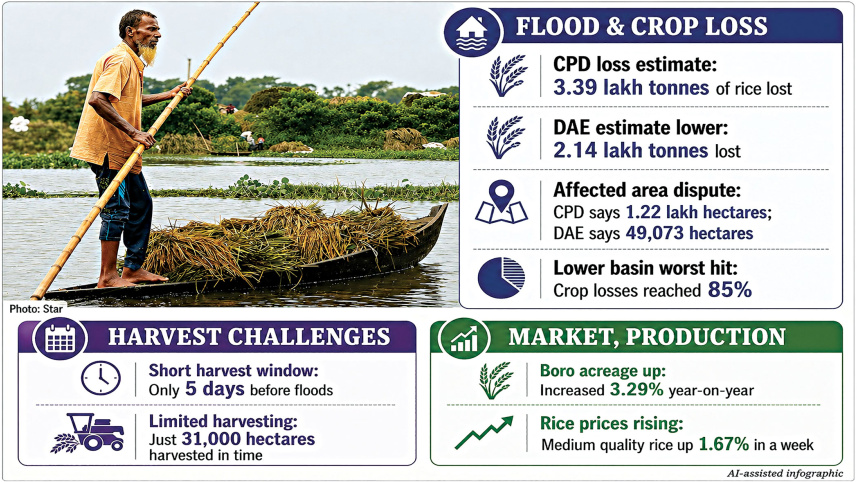
Bangladesh’s haor regions suffered rice losses of around 3.39 lakh tonnes, approximately 1.25 lakh tonnes higher than the estimate of the Department of Agricultural Extension (DAE), according to a report by the Centre for Policy Dialogue (CPD).
DAE data show that rainfall, flooding and upstream water inflows between April 26 and May 4 caused an estimated loss of 2.14 lakh tonnes of rice.
 For all latest news, follow The Daily Star's Google News channel.
 Abu Saleh Md Shamim Alam Shibly, senior research associate at CPD, told The Daily Star that the discrepancy between the two estimates stems mainly from differences in methodology and the timing of assessments.
CPD has urged the government to adopt a rapid hybrid flood-loss assessment system integrating DAE surveys, satellite verification, Bangladesh Water Development Board data and community reporting to ensure accurate estimates
He said the DAE estimate is based on field surveys conducted by upazila-level officers, who reported visible damage as floodwaters expanded, resulting in progressively revised figures.
CPD’s estimate, by contrast, is based on a broader analytical framework incorporating cultivated area data, flood forecasts, water-level information and historical flood patterns, he said.
According to Shibly, the haor region’s tiered topography results in varying levels of crop damage, with the lower basin suffering losses of around 85 percent due to complete inundation, while losses in the middle basin ranged from 20 percent to 50 percent.
He added that the five-day harvesting window before the floods, despite advance warnings, was insufficient. Even with the full deployment of machinery and labour, only about 31,000 hectares could be harvested.
Additional constraints, including waterlogged fields, machinery delays caused by muddy conditions and adverse weather, further reduced harvesting capacity. Some farmers managed to salvage part of their crop, estimated at 8,000 to 11,000 hectares, he said.
CPD’s estimate corresponds to roughly 5.2 lakh tonnes of paddy losses, equivalent to around 3.39 lakh tonnes of rice based on a standard milling recovery rate of 65 percent.
CPD estimated the affected area at 122,016 hectares. DAE put the figure at 49,073 hectares, or about 10.78 percent of total haor cropland.
Md Obaidur Rahman Mondol, director of DAE’s Field Services Wing, said the department’s crop-loss estimates are based on ground-level assessments conducted by upazila officers. The figures represent rice losses, and standard conversion rates should be considered when comparing them with other estimates.
Echoing Shibly, he said differences with other estimates arise largely from the contrast between field-based observations and model-based analyses. He emphasised that DAE relies on reported losses collected from farmers and field surveys submitted through official channels.
According to DAE data, Boro has been cultivated on 4.55 lakh hectares across the country’s seven haor districts, with harvesting completed on 80 percent of the area so far.
The Boro cultivation area reached 50.5 lakh hectares in fiscal year 2025-26, marking a 3.29 percent year-on-year increase, according to provisional DAE data.
Production rose from 2.01 crore tonnes in FY22 to 2.13 crore tonnes in FY25. DAE has set a production target of 2.24 crore tonnes of Boro rice for the current season.
Economist Abdul Bayes, former vice-chancellor of Jahangirnagar University, said government figures are compiled through DAE officers and field personnel nationwide, making official statistics the primary reference point during crises.
While independent organisations may complement official data through sample-based or qualitative surveys, differences between estimates are generally within a range of 5 to 10 percent, he said.
CPD has urged the government to adopt a rapid hybrid flood-loss assessment system integrating DAE surveys, satellite verification, Bangladesh Water Development Board data and community reporting to ensure more accurate and timely estimates of crop damage.
It also recommended increasing financial support for affected farmers through enhanced compensation packages, input subsidies and low-interest credit facilities to support recovery and preparation for the next planting season.
To stabilise the rice market, CPD recommended increasing imports, suspending import duties for private rice importers, and strengthening oversight of stock holdings and pricing practices to curb volatility.
Domestic rice prices remain elevated and disconnected from global trends, indicating market concentration, weak oversight and rent-seeking behaviour within the supply chain, CPD said.
According to data from the Trading Corporation of Bangladesh (TCB), the retail price of medium-grain rice rose by 1.67 percent over the past week, increasing from Tk 52-Tk 68 per kg to Tk 54-Tk 68 per kg. The retail price of coarse rice also rose by 1.85 percent during the same period, from Tk 48-Tk 60 per kg to Tk 50-Tk 60 per kg.
TCB data also show that, compared with a year earlier, the prices of coarse and medium-quality rice increased by 4.76 percent and 6.09 percent, respectively.
Bayes said rice prices should not be rising at this time, as it is both the peak harvest season and the period for Aman cultivation.
However, he acknowledged that short-term market constraints may exist and that millers can at times influence market conditions.
Comments