


ICAB lauds tax reforms, warns against harassment by officials
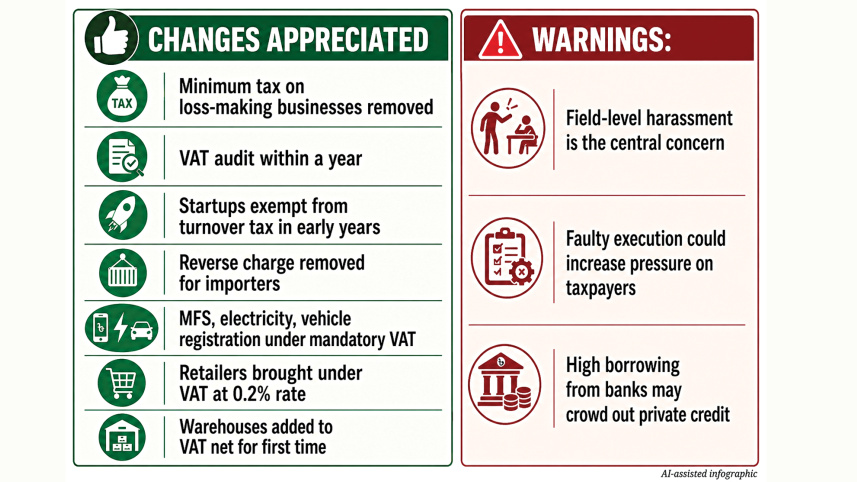
The proposed budget introduces a sweeping set of changes to how taxes are collected, filed, and enforced -- which chartered accountants say are largely business-friendly but will only work if officials on the ground do not use them to harass taxpayers.
They made the comments at an event where the Institute of Chartered Accountants of Bangladesh (ICAB) laid out its assessment of the proposed budget for fiscal year 2026-27 at CA Bhaban in Dhaka yesterday.

The government has proposed a national budget of Tk 9,38,000 crore, equivalent to 13.7 percent of GDP, with a revenue collection target of Tk 6,95,000 crore, ICAB President NKA Mobin stated.
Mobin said the proposed budget reflects the government’s commitment to maintaining macroeconomic stability, enhancing revenue mobilisation, generating employment, expanding investment, and fostering private-sector growth.
“ICAB believes that raising the tax-to-GDP ratio while ensuring greater transparency and accountability in tax administration is essential for sustaining long-term economic growth,” he said.
Other ICAB members described that to hit the budget target, the government needs more people and businesses paying taxes, and it needs them to pay correctly. The budget takes two routes to get there. The first is making compliance easier and cheaper for businesses that already pay taxes. The second is pulling more people and sectors into the tax net for the first time.
EASIER FOR BUSINESSES
Speaking at the event, CA Sarker Nahidul Islam, director of Tax and Advisory Services at Rahman Rahman Huq, said several income tax changes reduce the burden on businesses.
The minimum tax — a levy businesses had to pay even when making losses -- has been removed. Rules around what companies can claim as expenses have been relaxed, including on staff benefits and marketing costs.
The budget also relaxes limits on perquisites and promotional expenses, allows interest expenses without strict conditions, and removes the penalty for withholding tax failures. Startups pay zero turnover tax in their early years.
Significant changes have also been made to VAT – the tax added at each stage of production and sale.
Businesses can now claim VAT credit on labour and transport costs, which they previously could not, Islam said.
The process for filing VAT returns has been simplified, and a mechanism called the reverse charge – which required importers to self-assess and pay VAT on certain transactions – has been removed, cutting a layer of paperwork, he said.
VAT audits, which could previously drag on indefinitely, must now be completed within one year, he added.
Meanwhile, mandatory filing requirements have been tightened, tax audits will be more frequent, and penalties for late filing have been increased. Businesses must now submit proof that they have withheld and deposited tax on payments to suppliers and employees – a requirement that previously existed but was not strictly enforced.
“These changes are expected to reduce the cost of doing business and improve cash flow,” Islam said.
DISPUTING A TAX DEMAND JUST GOT CHEAPER
Nahidul also noted that appeals against tax decisions have been made simpler, payment requirements in certain cases have been reduced, and there has been an overall shift toward faster and more structured VAT compliance.
Under the current system, a business disputing an income tax assessment must deposit 10 percent of the disputed amount just to file a first appeal, 10 percent to go to the Tax Appeal Tribunal, and 25 percent to approach the High Court -- money that is locked up for the duration of the legal process regardless of whether the business ultimately wins.
In the proposed budget, the government has sought to cut these rates to 1 percent at the first appeal stage, 3 percent at the Tax Appeal Tribunal, and 10 percent at the High Court.
 For all latest news, follow The Daily Star's Google News channel.
 WIDENING THE TAX NET
At the same time, the budget is widening the tax net. Islam noted that VAT registration is now mandatory for mobile financial services providers, as well as businesses that provide electricity connections and vehicle registration services.
Retailers, who have largely operated outside the VAT system, are being brought in at a reduced rate of 0.2 percent. Warehouses have also been brought under VAT for the first time.
“These measures are expected to broaden VAT collection without significantly increasing tax rates,” Islam said.
However, he cautioned that some regulatory burdens remain, including no reduction in dividend tax rates, reduced rebates for individuals, and stricter record-keeping requirements of up to 12 years for companies. Increased scrutiny on expatriate employment and certain transactions may also raise compliance costs for businesses.
IMPLEMENTATION IS THE REAL TEST
CA Snehasish Barua, partner at Snehasish Mahmud and Co, said the government’s primary objective with the budget is to control inflation, and that duty reductions at the import stage were introduced with that goal in mind.
“These measures aim to provide relief to consumers, particularly as electricity and utility costs continue to rise,” he said.
But he said the main concern among practitioners is what happens at the field level. “The NBR must take practical steps to address this issue. Otherwise, revenue collection pressure will continue to fall on existing taxpayers rather than through an expansion of the tax base and the inclusion of new taxpayers in the system,” Snehasish said.
ICAB members also described the Document Verification System (DVS) -- a joint initiative between NBR and ICAB that allows tax authorities to verify the authenticity of financial documents submitted by taxpayers -- as a significant tool that has already helped curb evasion and should be expanded further.
ICAB members also noted that achieving the revenue collection target of Tk 6,95,000 crore will require comprehensive reforms and coordinated implementation efforts.
The budget projects a fiscal deficit of Tk 2,43,000 crore, of which Tk 1,12,000 crore is to be financed through domestic borrowing from the banking sector.
The institute cautioned that such reliance on bank financing could constrain credit availability for the private sector and potentially discourage private investment at a time when the government is simultaneously trying to encourage it.
Comments