


Inflation falls to 10-month low of 8.26%

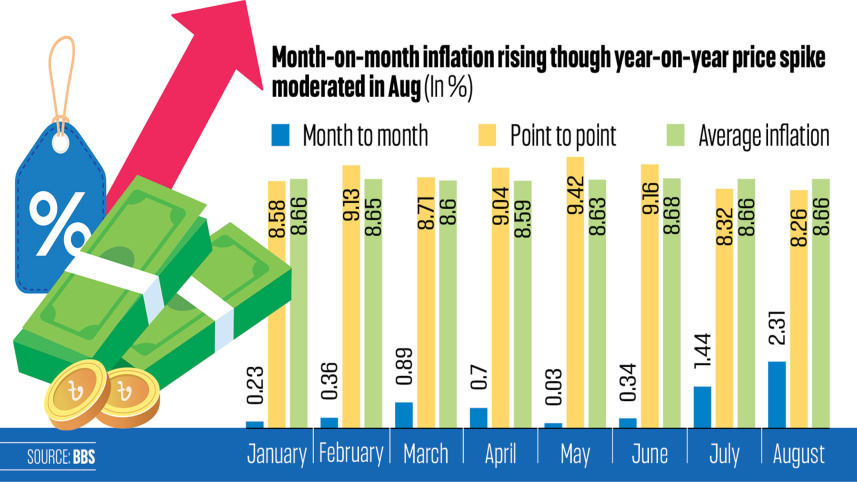
Inflation fell for the second consecutive month in August, dropping to 8.26 percent, its lowest level in the past ten months, according to the data published by the Bangladesh Bureau of Statistics (BBS).
Food inflation fell sharply, while non-food inflation edged up. In August, food inflation stood at 7.02 percent, down from 7.16 percent in July, according to BBS data.

Non-food inflation, meanwhile, rose to 9.32 percent last month from 9.28 percent in July.
Point-to-point inflation of 8.26 percent means goods or services that cost Tk 100 in August last year cost Tk 108.26 in August this year.
The government has set a target of keeping annual average inflation at 7.5 percent in fiscal year 2026-27, which began on 1 July.
‘WHERE HAS COST OF LIVING FALLEN?’
AHM Shafiquzzaman, president of the Consumers Association of Bangladesh, said the latest figures do not reflect the reality of price increases.
“Electricity, fuel and essential commodity prices have all increased. There should be some reflection of that,” he said.
He pointed to recent price increases in sugar and rice, and noted that the pay scale for government employees has not yet been implemented.
“Where has the cost of living actually fallen?” he questioned, stating that people are cutting back on many things, including healthcare and medicines.
“In reality, people are simply eating less. If children do not receive adequate nutrition, we are creating an unhealthy generation,” he added.
SLOWER GROWTH DOESN’T MEAN FALLING PRICES
A BBS official, speaking on condition of anonymity, explained that the lower year-on-year rate does not mean commodity prices are declining.
“Prices are continuing to increase, but the rate of increase is comparatively slower than it was a year ago,” the official said, adding that prices had risen across almost all 12 major expenditure groups, with only isolated, seasonal exceptions.
Residential hotel rents fell in some cases due to the off-season, some electronics saw seasonal clearance discounts, and certain winter clothing items were marked down as they moved out of peak season.
The official, however, said these were isolated cases that did not change the broader trend of rising prices, and that a detailed sector-wise analysis would be needed to pinpoint the precise drivers of current inflation.
NO CLEAR SIGN INFLATION IS EASING
Md Deen Islam, professor of economics at the University of Dhaka, cautioned against reading the year-on-year dip as a sign that inflation is genuinely coming down.
“I would say that it is coming to a steady state,” he said, adding that the effects of the central bank’s contractionary monetary policy may still be working their way through the economy due to a lag in policy transmission.
The professor also commented that the rise in monthly inflation was concerning.
 For all latest news, follow The Daily Star's Google News channel.
 If the government wants to meet its FY27 inflation target of 7.5 percent, he said, the monthly rate would need to fall to around one percentage point.
If the monthly rate remains around two percentage points, achieving the government’s inflation target will become difficult, he added.
The economist linked elevated non-food inflation partly to the prolonged energy crisis, and warned that recent wage increases for lower-income government employees could add further demand-side pressure on prices in the coming months.
He called for better coordination between the government’s energy, monetary and exchange-rate policies, along with clearer efforts to manage inflation expectations.
“The government needs to demonstrate that the policies are actually working and that the problems are being addressed. At this point, we are still not seeing any clear sign that inflation expectations are coming down,” he said.
Comments