


Karnaphuli EPZ: From a defunct steel mill to an export hub

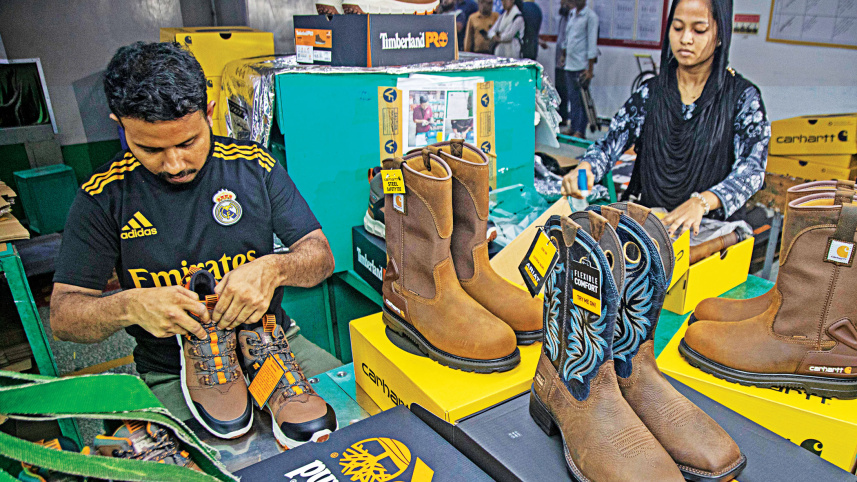
Safety shoes made by Bangladeshi workers in Chattogram are being used by workers in the oil and gas extraction and pipeline industries in the United States, miners in China and mountaineers in Europe.
The shoes are produced by Xin Chang Shoes (BD) Limited, a Taiwanese company that has been operating in the Karnaphuli Export Processing Zone (EPZ) since 2010.

Xin Chang runs two units in the EPZ, employing around 6,000 workers and staff and producing 4.2 million pairs of safety shoes a year.
“Last fiscal year, our export volume stood at over $100 million,” the company’s operations manager Tony Hsieh said yesterday.
According to him, 60 percent of the company’s products go to the US market, 30 percent to the EU and 10 percent to Asian markets.
The plant has nine production lines and plans to add four more over the next three years, he added.
The zone was inaugurated on September 12, 2006, and is operated by the Bangladesh Export Processing Zones Authority (BEPZA).
At a press briefing yesterday marking Karnaphuli EPZ’s 20-year journey, its Executive Director Mahbub Ahmed Siddique said the zone has attracted $787.33 million in investment, generated more than $14.15 billion in exports and created direct employment for about 80,000 people over the last 20 years.
Md Tanvir Hossain, member (Investment Promotion) of BEPZA, said the transformation of Karnaphuli EPZ reflects BEPZA’s broader contribution to Bangladesh’s export-led industrialisation.
BEPZA operates eight export processing zones and two economic zones covering 3,550.33 acres -- just 0.01 percent of the country’s total land area, he said.
Despite this limited footprint, the zones contributed 17.51 percent of Bangladesh’s total export earnings in the 2025-26 fiscal year, Tanvir said.
Located in North Patenga, near Chattogram Port and Shah Amanat International Airport, the 209.06-acre zone offers logistical advantages to export-oriented manufacturers.
The land once housed the state-owned Chittagong Steel Mills, which began commercial production in 1967.
The mill was badly damaged by the 1991 cyclone and later struggled with mounting losses, technological limitations and rising production costs. It was placed under lay-off in 1998 and permanently closed in 1999, leaving thousands unemployed.
In 2004, the steel mill site was handed over to BEPZA in two phases, paving the way for the EPZ.
All 258 industrial plots have now been allocated to investors, said the ED.
Investors from Bangladesh and 13 other countries, including China, South Korea, Japan, India, Sri Lanka, the United Kingdom, the United States, Malaysia and the Netherlands, have established industries in the zone, said Muhammed Khaled Chowdhury, additional executive director of the EPZ.
Exports from KEPZ began on November 5, 2007, when Paolo Footwear (BD) Ltd made its first shipment. Exports grew from $9.86 million in 2007-08 to a cumulative $14.156 billion by the end of August 2026.
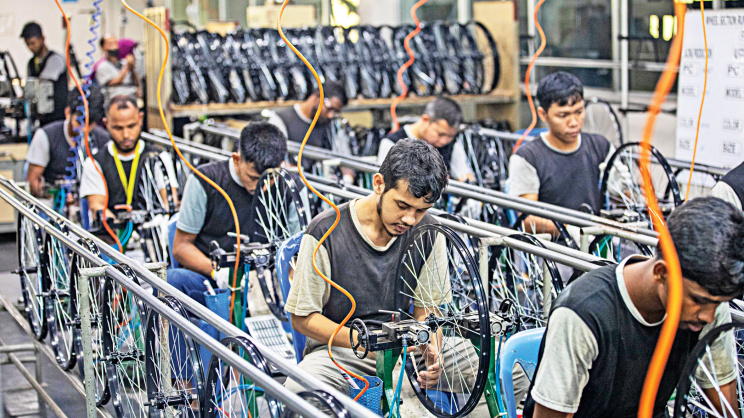
The zone has since expanded beyond garments to produce footwear, bicycles, leather goods, furniture, bags, tents and camping equipment for international brands such as Nike, Adidas, H&M, Zara, Uniqlo, Puma and Decathlon.
Karnaphuli EPZ began operations in the 2006-07 fiscal year with $1.91 million in investment and has attracted $787.33 million cumulatively as of August 2026.
 For all latest news, follow The Daily Star's Google News channel.
 Its workforce has grown from 174 workers at the start to nearly 80,000, with women accounting for around 60 percent.
Xin Chang is among 41 operational factories in the zone, comprising 29 wholly foreign-owned enterprises, three joint ventures and nine locally owned companies. Five more factories are under implementation.
Another major employer is Hirdaramani Bangladesh, a subsidiary of Sri Lanka-based Hirdaramani Group. It runs three units under the name Kenpark Bangladesh Apparel (Pvt) Ltd, employing around 11,000 workers and staff, the highest number among factories in the zone.
Comments