


Manufacturing, services lift Apr-Jun GDP growth to 4.6%

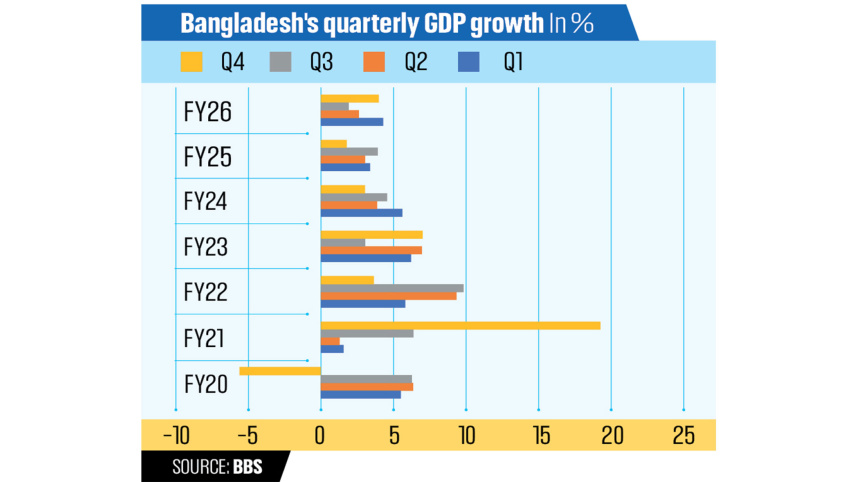
Bangladesh’s economic growth more than doubled to 4.6 percent in the final quarter of fiscal year 2025-26 (FY26) from 2.05 percent a year earlier, driven by a strong recovery in manufacturing and services, according to the Bangladesh Bureau of Statistics (BBS).
The growth estimate, however, comes against a backdrop of weak private-sector credit, energy supply constraints and financial-sector vulnerabilities, prompting economists to caution against interpreting the rebound as a broad-based acceleration of the economy.

Industrial production grew 6.52 percent in the April-June quarter, compared with just 0.92 percent in the same period a year earlier, the BBS reported in its quarterly estimate of the country’s gross domestic product (GDP).
GDP is a measure of the final value of goods and services produced in an economy over a certain period.
A robust rebound in manufacturing and construction drove the industrial uptick, offsetting the slump in utility supply services, according to the national statistical agency.
Manufacturing was the main driver, with growth surging to 8.66 percent from 3.28 percent a year earlier. It was the highest growth in the sector in six quarters.
The construction sector also returned to positive growth, expanding 1.69 percent in the fourth quarter after contracting 4.47 percent in the same quarter of FY25.
The services sector, which accounts for the largest share of the economy, grew 4.28 percent in April-June, nearly doubling from 2.26 percent a year earlier.
The rebound in industry came despite continued weakness in electricity, gas and water supply services, which contracted 2.41 percent in the fourth quarter following a 3.56 percent decline in the previous quarter.
Agriculture, meanwhile, recorded slower growth of 1.73 percent in the fourth quarter, down from 3.19 percent a year earlier.
INTERPRET CAUTIOUSLY: ECONOMISTS
Abdur Razzaque, chairman of Research and Policy Integration for Development (RAPID), said the strong manufacturing growth warrants careful scrutiny.
“It is not immediately easy to reconcile such strong manufacturing growth with the broader conditions prevailing during the period, including energy supply constraints and the continued weakness of private-sector credit growth,” he said.
While stating that the fourth-quarter GDP figure appears relatively strong, he said that it should be viewed against the unusually weak performance a year earlier.
In the same quarter of FY25, growth was exceptionally weak at just 2.05 percent.
“When economic activity recovered from that unusually low level, the year-on-year growth rate naturally appeared much higher. The latest figure does indicate some recovery, but it should not be interpreted as evidence of a broad-based or particularly strong acceleration in the economy,” he said.
One possible explanation, he said, is that confidence improved, at least temporarily, following the February 2026 election, supporting some recovery in production and investment-related activity.
“If the manufacturing estimate is borne out by subsequent data, that may have contributed meaningfully to the stronger overall GDP number. Even so, the scale of the reported manufacturing rebound remains difficult to fully explain at this stage, and a clearer assessment will require more detailed sectoral and high-frequency data,” Razzaque said.
M Masrur Reaz, chairman and CEO of Policy Exchange Bangladesh, said the quarterly growth could be described as moderately encouraging compared with the average growth recorded over the past two fiscal years.
He, however, added, “It is still far below what Bangladesh needs and what the economy is capable of achieving.”
 For all latest news, follow The Daily Star's Google News channel.
 The Purchasing Managers’ Index (PMI) also points to an improvement in economic activity during the quarter. The average PMI rose to 56.8 in the fourth quarter from 54.4 in the previous quarter.
Reaz said the manufacturing sector showed some improvement in July, but momentum weakened in August and September.
Meanwhile, Ashikur Rahman, principal economist at the Policy Research Institute of Bangladesh, said fourth-quarter growth typically receives a boost from higher execution of the Annual Development Programme, as the government settles bills and seeks to meet year-end targets.
“But we have to be very cautious that the structural problems hindering our growth are very real, especially those stemming from the banking sector and the energy sector. Without serious commitment to reform, I think the outlook is not very great for growth to enjoy a serious positive turnaround,” he said.
The BBS released the data a day after the World Bank estimated that Bangladesh’s economy grew 3.4 percent in FY26.
The multilateral lender also forecast 3.4 percent growth for the current fiscal year, citing a deepening energy crisis, financial-sector vulnerabilities and global uncertainties.
The World Bank’s forecast would mark a fourth consecutive year of slowing economic expansion.
Comments