


Nine hurdles keeping FDI away
Foreign investors have to wait for up to a year just to secure basic business approvals. For imports and exports, they face port waiting times that are more than double those in neighbouring South Asian countries.
On the financial front, a fragile banking system poses another major challenge, while fragmented institutions leave investors moving from one desk to another across 23 government agencies.


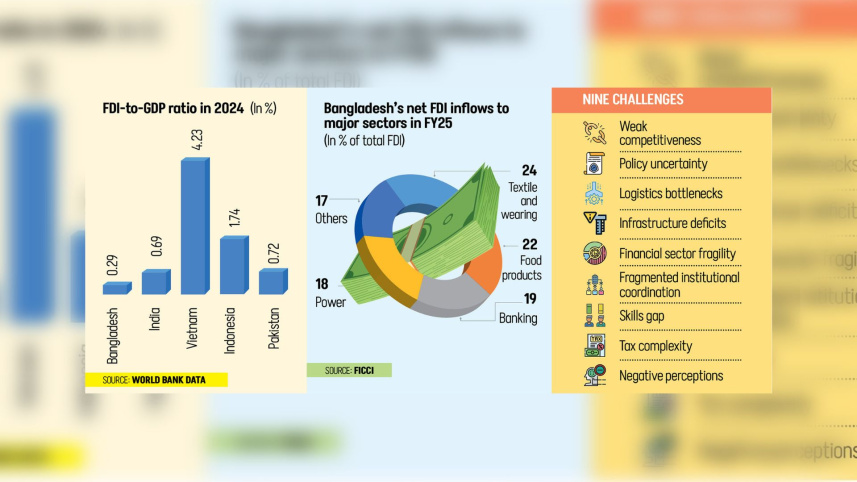
The Foreign Investors’ Chamber of Commerce & Industry (FICCI) has identified such nine barriers that foreign companies face throughout the investment lifecycle in Bangladesh -- from entry and establishment to operation, expansion and exit.
At a conference at the Bangladesh-China Friendship Conference Centre in Dhaka yesterday, FICCI said these constraints are not isolated inefficiencies but form an interconnected web of obstacles.
As a result, Bangladesh trails many of its regional competitors in attracting foreign direct investment (FDI), the chamber said in its publication, titled “FDI for a New Bangladesh: Roadmap for a $15 Billion Vision”.
The nine structural challenges include the country’s weak competitive position, policy and regulatory uncertainty, logistics bottlenecks, infrastructure deficits, financial sector fragility and fragmented institutional coordination.
The list also includes skills and productivity constraints, tax complexity, and reputational challenges that undermine investor confidence.
FICCI grouped the challenges into four broad categories -- regulatory, infrastructure, financial and institutional.
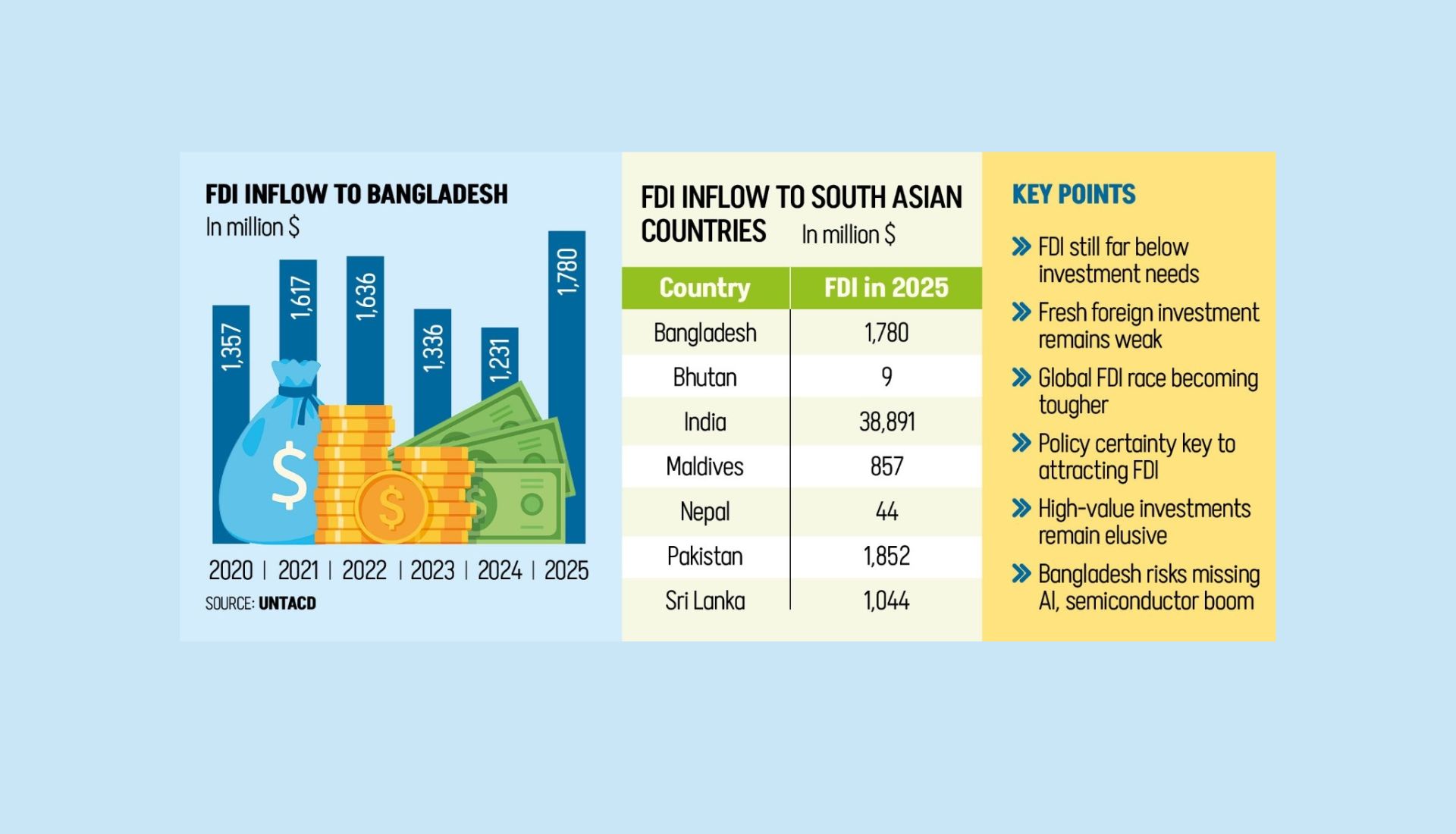
According to data from the UN Trade and Development (UNCTAD), Bangladesh attracted only $1.78 billion in foreign direct investment, far below the levels recorded in India, Vietnam and Indonesia.
India received $38.89 billion, Indonesia $21.44 billion and Vietnam $20.35 billion during the same period. Cambodia attracted $5.10 billion, while Pakistan received $1.85 billion.
On Bangladesh’s weak competitive position, the apex body of foreign investors said the country ranks near the bottom in most global business climate assessments.
The World Bank’s Business Ready 2024 report, the successor to the Doing Business series, measures economies across 10 pillars of business readiness, from business entry to insolvency resolution.
Bangladesh performs relatively well in business entry and business location. However, it lags behind Vietnam and Nepal in the areas that matter most for long-term business operations and exit, including dispute resolution, market competition and business insolvency, where it scores among the lowest of its peer economies.

APPROVAL TAKES A YEAR, INVESTORS NAVIGATE 23 AGENCIES
On policy and regulatory uncertainty, FICCI said an official approval process that is meant to take 76 days often stretches to between six months and a year in practice.
It also noted that transferring a land title takes 260 days in Bangladesh.
Logistics are another major bottleneck. Container dwell time at Chattogram Port is eight to 10 days, compared with three to four days in Vietnam, according to FICCI.
On infrastructure, it said the country supplied 2,580 mmcfd of gas in FY2024-25 against demand of 3,800 mmcfd.
 For all latest news, follow The Daily Star's Google News channel.
 FICC said foreign investors also suffer due to the country’s fragile financial sector, with the banking sector’s non-performing loan ratio standing at 32.26 percent.
Institutional coordination is also fragmented, forcing businesses to secure approvals from 23 agencies. The process is often slowed by red tape, delays and uncertainty.
The apex body of the foreign investors said Bangladesh also faces a severe skills and productivity gap, ranking 96th out of 100 countries on the global skills index.
On tax complexity and administrative burdens, FICCI said the effective tax burden on companies can reach 43 to 48 percent, despite the statutory corporate tax rate of 27.5 percent.
Beyond policy, infrastructure and institutional constraints, it noted that Bangladesh also faces a perception problem that influences investor sentiment and investment decisions.
The country’s sectoral distribution of foreign direct investment also points to a heavy reliance on a handful of industries, while several promising sectors have struggled to sustain investment momentum.
The textile and garment industry attracted the largest share of net FDI in FY25, accounting for 24 percent, supported by well-established supply chains and competitive labour costs.
The food products industry received 22 percent, while the banking sector accounted for 19 percent. As Bangladesh seeks to diversify its energy sources, the energy sector attracted 17 percent of net FDI inflows during FY25.
SEQUENCED REFORM A MUST
FICCI said the nine challenges are not insurmountable. With focused, sequenced and sustained reforms, Bangladesh can turn each of these constraints into a competitive advantage and establish itself as a credible destination for higher-value foreign direct investment.
To achieve that, reforms must be introduced in a strategic sequence, with short-term gains creating momentum for bigger structural changes. They must also be practical, taking into account existing institutional capacity and resource constraints.
FICCI said reforms should be coordinated across government, with clear accountability and monitoring mechanisms. They should also be investor-centric, addressing the barriers foreign companies face at every stage of the investment lifecycle.
Moreover, reforms must be sustained over time, requiring political commitment that extends beyond electoral cycles and withstands short-term pressures.
In the short term, Bangladesh should focus on the most immediate constraints, including fragmented institutions, unpredictable policy changes and opaque approval processes, through administrative action, regulatory clarification and targeted institutional strengthening that does not require new legislation.
Over the medium term, the country should establish a fully functional one-stop service, modernise customs and border management, strengthen governance and service delivery in economic zones, restore financial sector stability, resolve non-performing loans, rationalise investment incentives and strengthen the institutional capacity of Bida.
In the long term, the government should pursue deeper trade integration through free trade and preferential agreements, promote venture capital and private equity investment, build a future-ready workforce and innovation ecosystem, and modernise tax administration to improve predictability.
Comments