


Steelmakers pin hopes on revival of govt projects

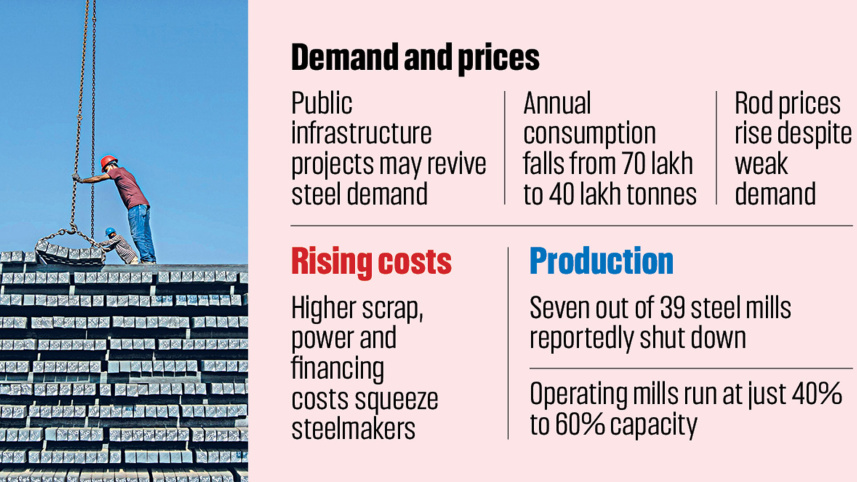
The resumption of public infrastructure projects has raised hopes of a recovery among steelmakers, who have been struggling with weak demand, rising costs and financial pressure. However, a lasting recovery will depend on whether renewed construction activity translates into stronger steel sales.
Steel demand declined mainly because public construction and government infrastructure projects slowed after the political changeover in August 2024, said Sumon Chowdhury, secretary general of the Bangladesh Steel Manufacturers Association (BSMA).

“The steel sector has been struggling for nearly two and a half years as the domestic economy and construction activity remain sluggish,” said Md Mamun Kabir, director of sales and marketing at KSRM.
Manufacturers said the prolonged downturn had exposed the industry’s heavy dependence on public spending. Sluggish property development and weak private construction have added to the pressure.
Annual domestic steel consumption has fallen to an estimated 40 lakh tonnes from around 70 lakh tonnes previously, Sumon said. The government’s share of steel consumption has also dropped from around 60 percent to 20 percent, he added.
At the same time, steelmakers are facing higher raw material and utility costs, expensive bank loans and a shortage of working capital.
International scrap prices have risen by around $20 per tonne, while electricity prices have increased by 18 percent. Gas and power shortages have also disrupted production. However, weak demand has prevented manufacturers from passing on the full increase in costs to customers, Mamun said.
Despite these challenges, steel rod prices have increased. According to the Trading Corporation of Bangladesh, prices of 60-grade mild steel rods rose to Tk 92,500 to Tk 94,500 per tonne on October 5, from Tk 83,500 to Tk 86,000 a year earlier.
Prices of 40-grade rods also climbed to Tk 89,000 to Tk 91,000 per tonne from Tk 75,000 to Tk 79,000 over the same period.
Higher selling prices, however, have not translated into better profit margins. Rising production costs and weak sales have left manufacturers struggling to cover operating expenses and repay loans.
RISING COSTS PUSH MILLS INTO FINANCIAL DISTRESS
GPH Ispat’s financial performance reflects the industry’s difficulties. Its gross revenue fell nearly 25 percent to Tk 3,320 crore in the first nine months of fiscal 2025-26, from Tk 4,400 crore a year earlier.
The company reported a loss of Tk 10.65 crore during the period, compared with a profit of Tk 30.31 crore in the same period a year earlier.
With liabilities of around Tk 12,000 crore, the company has sought a four-month waiver or relaxation of Credit Information Bureau requirements from Bangladesh Bank to restructure its debt with more than two dozen banks and financial institutions.
“Rising raw material, fuel and transport costs continue to squeeze margins,” said Mohammed Jahangir Alam, chairman of GPH Group and managing director of GPH Ispat.
Industry insiders said seven of the country’s 39 steel mills had shut down, while those still operating were running at only 40 percent to 60 percent of their annual production capacity.
The industry represents around Tk 1 lakh crore in investment. Further closures could threaten jobs, reduce government revenue and weaken the country’s domestic steel production capacity.
The BSMA has repeatedly sought meetings with the prime minister, the National Board of Revenue chairman and the Bangladesh Bank governor to discuss the industry’s problems. However, it has been unable to secure appointments despite making requests over the past two to three months, Sumon said.
He urged policymakers to ensure affordable working capital and restructure loans for viable mills rather than spend heavily to revive plants that have been closed for years.
There are, however, some signs of hope. The Executive Committee of the National Economic Council (ECNEC) recently approved 12 development projects worth Tk 1,68,780 crore, which are expected to support steel demand.
 For all latest news, follow The Daily Star's Google News channel.
 The projects include a new 17.20-kilometre southern route of MRT Line-5, running from Gabtali to Dasherkandi, as well as revised budgets for MRT Line-1 and the northern route of MRT Line-5.
Jahangir of GPH Group said demand was gradually improving, partly because of projects approved under the Mass Rapid Transit programme.
“Large infrastructure projects could boost demand for steel, cement, glass, cables and electrical equipment,” he said.
Tapan Sengupta, deputy managing director of BSRM, said the company was operating its factories at around 80 percent capacity despite sluggish demand. He expects market conditions to improve as the government resumes development projects.
Comments